
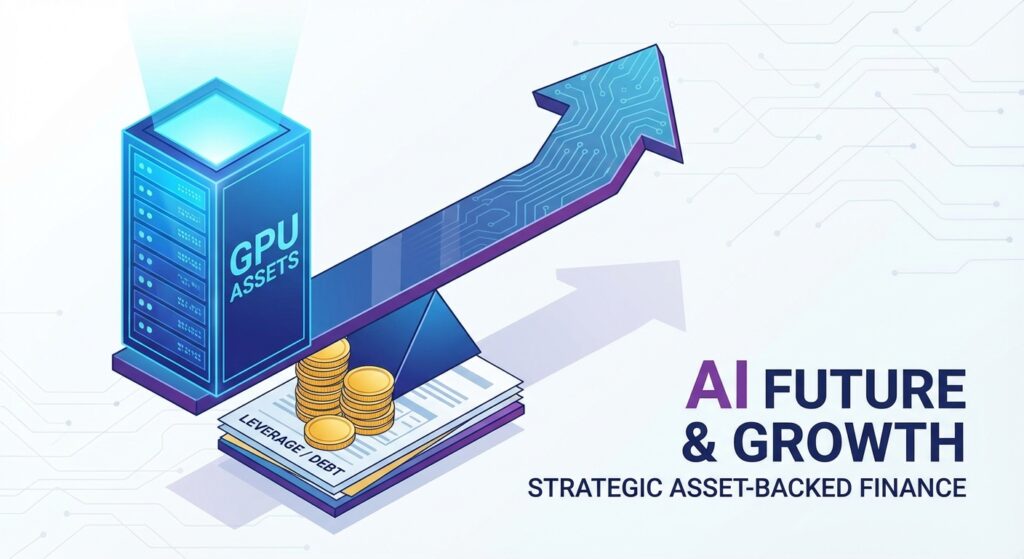
The Story: The Garage, The GPU, and The Mountain
In the high-velocity world of Silicon Valley, the standard playbook is well-worn: raise venture capital, sell equity, grow at all costs, and worry about profitability later. But by late 2025, one company had rewritten the rules of capital structure in the AI era, executing one of the most aggressive leverage plays in modern tech history.
CoreWeave, originally founded on the humble premise of mining Ethereum in a New Jersey garage, found itself at the epicenter of the generative AI boom. As demand for NVIDIA’s H100 and Blackwell chips outstripped supply, CoreWeave pivoted to become a specialized cloud provider. But unlike software startups with near-zero marginal costs, CoreWeave’s business required massive physical capex. They weren’t just writing code; they were building the digital equivalent of steel mills.
By November 2025, as reported by fortune.com, the company had become a "stock market darling" and a critical artery for giants like Microsoft. Yet, hidden beneath the revenue growth was a staggering balance sheet reality: the company was built on a "mountain of debt," carrying $11 billion in total debt obligations with $7.6 billion in current liabilities coming due within 12 months. This wasn’t just a pivot; it was a leveraged buyout of the future.
The Decision: Asset-Backed Velocity vs. Equity Dilution
The decision facing CoreWeave’s leadership (CEO Mike Intrator and his team) was a classic capital efficiency dilemma, scaled to eleven.
To compete with hyperscalers like Google and AWS, CoreWeave needed billions of dollars immediately to secure GPU allocation. The traditional VC path would have been ruinous. Raising $10 billion in equity would have diluted the founders and early employees down to single-digit basis points. Furthermore, equity investors typically demand outsized returns for taking on product and market risk, not necessarily hardware financing risk.
Instead, CoreWeave chose a path more akin to real estate developers than software founders: Asset-Backed Lending (ABL). They wagered that the GPUs themselves held intrinsic, liquid value that could collateralize the loans. By securing debt against the hardware, they could access billions in non-dilutive capital.
This strategy leveraged the unique market anomaly of 2023-2025: the GPU was the new gold. Lenders, including private credit heavyweights like fortune.com (Ares Management), were willing to underwrite these loans because clarity on cash flows (via signed contracts from Microsoft and others) was high, and the collateral was liquid. As noted by bloomberg.com, private credit firms in 2025 were aggressively pitching higher leverage and flexibility to win deals, creating a fertile environment for CoreWeave’s aggressive borrowing.
The Outcome: A High-Wire Act
As we stand in early 2026, the outcome of this massive leverage experiment is a study in duality.
On one hand, the strategy worked brilliantly for growth. CoreWeave scaled infrastructure faster than competitors who were bogged down by internal bureaucracy or equity fundraising cycles. They captured market share by simply having the chips when no one else did. The debt allowed them to retain ownership while behaving like a trillion-dollar cap ex spender.
On the other hand, the financial tension is palpable. With $7.6 billion in liabilities due in the short term, the company is on a treadmill that cannot stop. As Fortune analysis highlighted, bears view the company’s finances as emblematic of an "AI infrastructure bubble." If the spot price for GPU compute drops (or if the AI hype cycle cools even slightly) the revenue needed to service that mountain of debt could evaporate, while the debt remains.
Unlike equity, which forgives a bad quarter, debt demands payment. CoreWeave successfully avoided dilution, but they traded it for binary risk: massive success or a potential liquidity crisis if refinancing windows seal shut.
The Lessons: Principles for the Levered Founder
CoreWeave is an extreme outlier, but its capital structure offers critical lessons for founders and operators considering private credit or asset-backed financing.
1. Match the Liability to the Asset Lifespan
The danger in CoreWeave’s structure (as of late 2025) was the mismatch between long-term infrastructure build-outs and current liabilities. Founders should strive to match debt maturity with the useful life of the asset. Financing 5-year hardware with 12-month paper is a recipe for a liquidity crunch.
2. The "Liquid Collateral" Trap
CoreWeave benefited because GPUs were liquid. Lenders felt safe. But in technology, liquidity is fleeting. Unlike real estate, which retains value over decades, tech hardware depreciates rapidly. If you are borrowing against inventory or equipment, ensure your LTV (Loan-to-Value) ratios account for a scenario where your collateral becomes obsolete overnight.
3. Leverage is a Force Multiplier, Not a Strategy
Private credit allows you to pour gas on a fire, but you must have the fire first. CoreWeave had signed contracts with Microsoft before levering up. Using debt to find product-market fit is suicide; using debt to fulfill cemented demand is good business.
4. The Cost of Control
The founders kept control by choosing debt. The cost of that control is stress. When you run a levered company, you are working for the lenders first and yourself second until the facility is cleared. Founders must ask: Is the retained equity worth the existential risk of a covenant breach?
Key Insights
- Asset Specificity Matters: Debt is cheapest when collateral is liquid and easy to value (like H100s in 2024), but risks rise as technology cycles turn.
- Dilution vs. Solvency: Equity solves for solvency (you can’t go bankrupt with no debt); debt solves for dilution. Pick your poison based on your certainty of cash flow.
- Private Credit Flexibility: In 2025/2026, direct lenders offered terms banks wouldn’t touch, effectively fueling the AI infrastructure layer.
- Contracted Revenue is King: Massive leverage is only viable if backed by high-quality, long-term contracts (e.g., Microsoft) that match debt service obligations.
- Refinancing Risk: Short-term bridge loans (like Clearlake’s move with Dun & Bradstreet or CoreWeave’s current liabilities) create massive "cliff risk" if credit markets freeze.


