
The Underwriting Challenge: Structuring for Uncertainty
In the discipline of credit underwriting, the initial “yes” is often the easiest part of the transaction. The true rigor of risk management lies in constructing a framework that protects the lender when the borrower’s forecast meets the friction of reality. For institutional lenders, the covenant package serves as the primary early warning system, designed not to strangle a borrower, but to force a conversation before a liquidity crisis becomes a capital impairment event.
Effective underwriting requires moving beyond simple spreadsheet math to a structural analysis of downside protection. As noted in the 2025 Principles for the Management of Credit Risk by the Basel Committee on Banking Supervision, sound credit-granting processes must be paired with rigorous continued administration and measurement. This article outlines a framework for covenant design and monitoring that prioritizes capital preservation.
The Framework: The Covenant Triangle
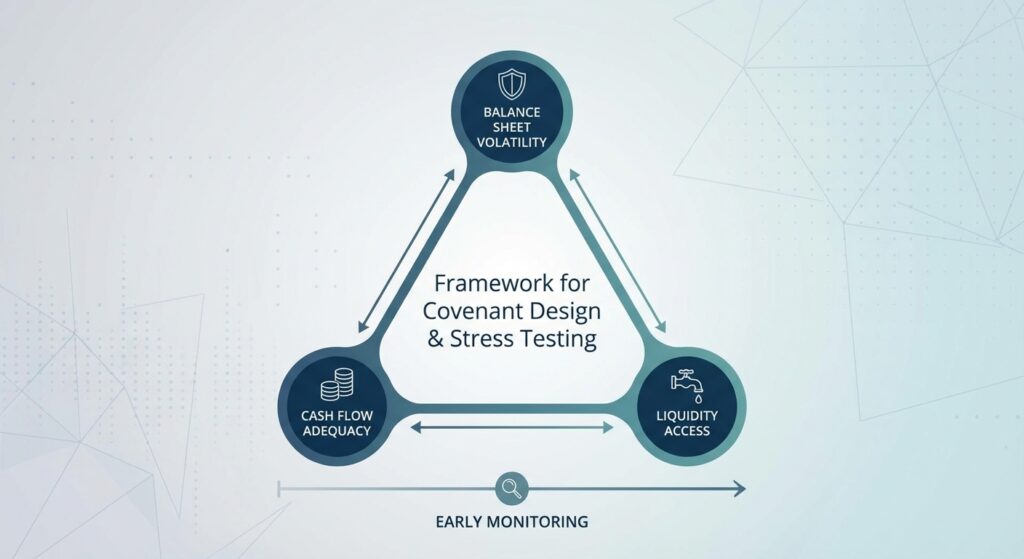
Robust covenant structures typically triangulate risk across three dimensions: Balance Sheet volatility, Cash Flow adequacy, and Liquidity access. Underwriting a deal requires calibrating these three levers based on the “Sector Risk Profile” and “Financial Profile,” key drivers identified in Fitch Ratings’ Corporate Rating Criteria.
- Maintenance vs. Incurrence: Private credit transactions typically utilize maintenance covenants (tested quarterly), whereas the syndicated market often skews toward “covenant-lite” structures relying on incurrence covenants (tested only when taking an action like raising debt).
- The Logic of cushions: A standard covenant cushion ranges from 15% to 25% relative to the base case model. The goal is to set the “tripwire” tight enough to catch deteriorating performance early, but loose enough to accommodate normal cyclical volatility without triggering a technical default.
The Analysis: Stress Testing the Breach Point
Consider a manufacturing borrower, “Alpha Corp,” with $10 million in LTM EBITDA and a request for $40 million in Senior Debt (4.0x opening leverage). The base case model projects EBITDA growth to $12 million in Year 1.
Correct Covenant Calibration
Instead of arbitrarily setting a 5.0x leverage cap, an underwriter must calculate the Breach Point.
- Scenario A (Flat Performance): If EBITDA stays at $10M, leverage remains 4.0x. Protocol: Safe.
- Scenario B (Input Cost Shock): If gross margins contract and EBITDA falls 20% to $8M, leverage spikes to 5.0x ($40M / $8M).
If the covenant is set at 4.75x, Scenario B triggers a default. This is the intended outcome: the lender gets back to the table while the company still has $8M in cash flow, rather than waiting until EBITDA evaporates. The “Fixed Charge Coverage Ratio” (FCCR) acts as the secondary backstop, ensuring that (EBITDA – Capex – Taxes) covers all debt service obligations.
Industry Standards and Portfolio Monitoring
Institutional standards for asset quality rely heavily on the integrity of the credit administration program. According to FDIC Asset Quality Guidelines, a bank’s asset quality rating reflects the quantity of existing credit risk and the ability of management to identify that risk. Lenders must look for:
- EBITDA Add-back “Creep”: Borrowers often aggressively define EBITDA to include uncapped “future synergies” or “one-time costs.” Best practice dictates capping add-backs (e.g., at 10-15% of Adjusted EBITDA) to preserve the integrity of the leverage metric.
- Documentation Diligence: In syndicated loans, the role of the administrative agent is critical for monitoring compliance certificates. As highlighted in recent industry analysis, managing lender relationships and documentation workflow is essential as markets shift between variable interest rate cycles.
Underwriting Checklist: Covenant Design
To ensure a robust risk framework, underwriters should validate the following points prior to committee approval:
- Definition of EBITDA: Is it tightly defined? Are “extraordinary items” clearly enumerated to prevent inflation of the denominator?
- Step-down Logic: Does the leverage covenant step down over time (e.g., 4.75x to 4.0x over 24 months) to track the amortization and projected deleveraging?
- Equity Cure Rights: Are there limits on how many times a sponsor can “cure” a default by injecting equity? (Standard: Max 2 consecutive quarters, 4 over the life of the loan).
- Sensitivity Analysis: Have you run a “Break-Even EBITDA” calculation to determine exactly how much earnings can drop before a covenant is breached?
- Reporting Requirements: Does the credit agreement require monthly financial packages for tighter monitoring, or only quarterly?
Key Risk Management Takeaways
- Covenants are levers, not locks: They force renegotiation, they do not guarantee repayment.
- Watch the denominator: A leverage ratio is only as good as the definition of EBITDA supporting it.
- Stress test early: Know the exact dollar amount of EBITDA decline that triggers a breach before funding.
- Monitor actively: A delayed compliance certificate is often the first sign of distress.
- Structure for the cycle: Ensure covenants provide protection even if the sector faces a cyclical downturn.


