
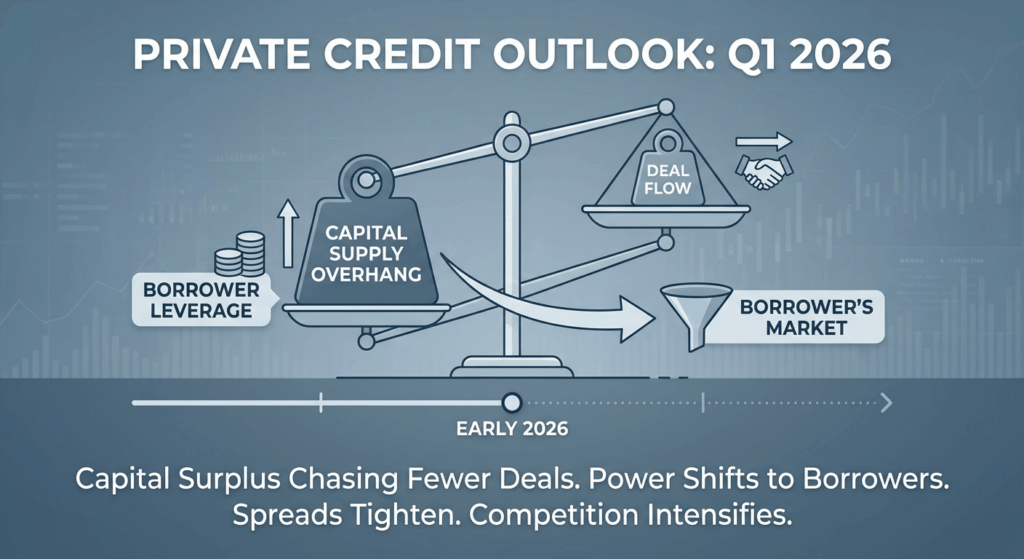
Market Headline: Capital Supply Overhang Shifts Power to Borrowers in Early 2026
As the market moves into Q1 2026, the defining characteristic of the private credit landscape is a pronounced technical imbalance: a surplus of capital chasing a constrained set of deals. Following a Q3 and Q4 2025 characterized by record syndicated loan activity and aggressive fundraising, middle-market borrowers now find themselves in an exceptionally favorable negotiating position.
While M&A activity began inching upward following the Federal Reserve’s rate adjustments in late 2025, deal flow has not kept pace with the dry powder accumulated by direct lenders. According to Capstone Partners, this “supply/demand imbalance” has forced lenders to compete aggressively on terms, resulting in tightened spreads and looser structures. Simultaneously, the broadly syndicated loan (BSL) market has made a roaring comeback, with Portage Point Partners reporting record quarterly primary issuance of $404 billion in Q3 2025, pressuring private credit managers to narrow their pricing premiums to win mandates.
Quantitative Snapshot: Late 2025 / Early 2026 Metrics
The following metrics highlight the current competitive tension between private credit and syndicated markets.
| Metric | Current Level / Trend | Comparison / Context | Source |
|---|---|---|---|
| Syndicated Loan Volume | $404 Billion (Q3 2025) | Highest quarterly total on record | Portage Point |
| Asset-Based Finance Spreads | Tightened 10–30 bps | vs. Prev 6 Months; Stable appetite | MetLife IM |
| Speculative-Grade Repricing | $227 Billion (Q3 2025) | 2nd Highest on record; driven by BSL competition | Portage Point |
| Average Credit Fund Size | >$900 Million | Up >50% from 2020 levels | Capstone / PDI |
Sector Analysis: Infrastructure Heats Up, Traditional M&A Lags
Infrastructure & Data Centers (Outperforming):
While general corporate M&A remains tepid, infrastructure debt is seeing robust activity. MetLife Investment Management reports strong global activity across digital infrastructure and utilities, driven by the secular demand for data centers and renewable energy projects. These sectors are commanding long-duration capital with competitive pricing, supported by a stabilizing interest rate outlook.
Refinancing & Recapitalization (Dominant):
Opportunistic refinancing continues to eclipse new money deals. Borrowers in the B-minus rated cohort have been particularly active, addressing 2028 maturities early. The resurgence of the BSL market has opened a window for lower-rated issuers to exit private credit facilities or force spread reductions from incumbent lenders, a trend Portage Point notes is driving “credit spreads at or near record lows.”
Traditional LBOs (Recovering):
Pure-play M&A financing remains below historical averages but shows “green shoots.” With the distraction of tariff policy implementation settling and the Fed’s easing cycle underway, dealmakers anticipate a release of pent-up PE inventory in the first half of 2026. Until then, intense competition for the few high-quality assets in market will sustain aggressive leverage multiples.
Implications for Borrowers & Lenders
For Borrowers: A Window of Opportunity
The current environment is undoubtedly a borrower’s market. With private lenders and banks competing for volume, issuers have the leverage to demand improved pricing, covenant-lite structures, and greater flexibility on add-on definitions. Companies with strong operational performance should aggressively explore refinancing or dividend recapitalizations while technical factors remain supportive.
For Investors/Lenders: Margin Compression Risks
The “premium” in private credit is under assault. As Nuveen highlights, the market is maturing, and the easy beta is gone. Lenders must now rely on differentiated origination (specifically in non-sponsored and asset-based niches) to maintain yield. Those reliant solely on sponsor-backed flow face continued spread compression and the risk of adverse selection as they chase volume to deploy record levels of dry powder.
Key Market Insights
- Spread Compression: Expect continued tightening in SOFR spreads as BSL resurgence forces private lenders to compete on price.
- Sector Rotation: Capital is flowing disproportionately toward infrastructure and asset-based finance (ABF) as defensive plays against economic uncertainty.
- Refinancing Wave: The primary use of proceeds remains refinancing; new money LBOs will likely not peak until mid-2026.
- Fund Bifurcation: Large funds (>$1B) are winning the bulk of allocations, but face the highest pressure to deploy, potentially driving looser underwriting standards.
- Macro Pivot: With 2025 rate cuts digested, the market is pricing in a “soft landing,” encouraging higher leverage multiples on new deals.


