
Introduction: The Hierarchy of Money
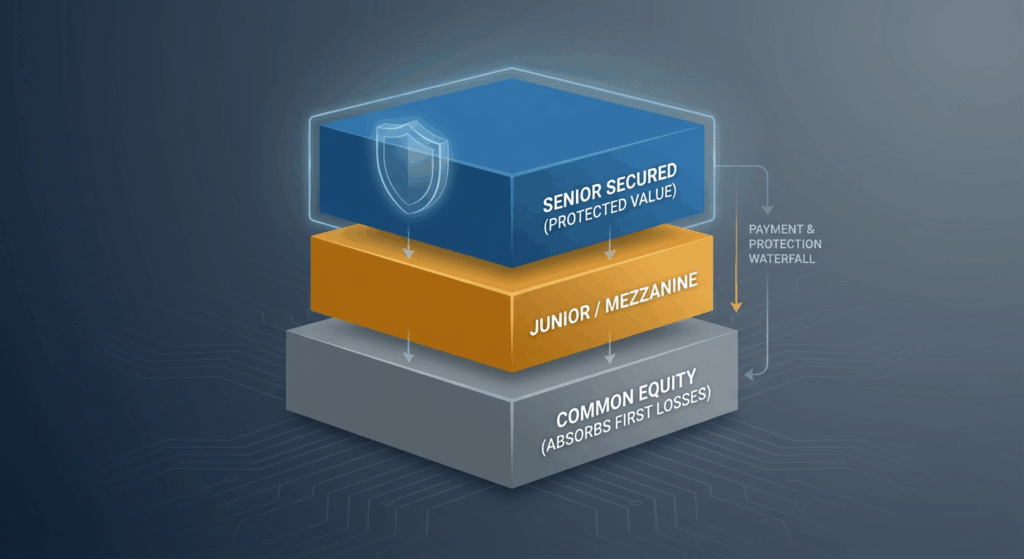
In the world of corporate finance, not all dollars are created equal. When a business seeks capital, it builds a structure resembling a layer cake, known technically as the Capital Stack. This structure dictates two critical realities: who gets paid first when things go well, and more importantly, who absorbs the losses when things go wrong.
For investors exploring the $2 trillion private credit market, understanding where a loan sits in this stack is more important than the interest rate headline. For business operators, understanding the stack is the key to optimizing the cost of capital without losing control of the company.
This article unpacks the mechanics of Seniority and Subordination: the fundamental protective structures that define private credit investing.
The Concept: Seniority and Subordination
The capital stack is arranged by priority of payment. At the very top sits Senior Secured Debt (often called First Lien). At the bottom sits Common Equity.
Seniority refers to the legal right to be repaid before other creditors or investors. If a company generates $1 of free cash flow, that dollar must service the senior debt before it can be used for dividends to equity holders.
Subordination is the inverse. It refers to capital that stands “behind” the senior debt. Junior debt and equity are subordinate to senior debt. This subordination acts as a protective shield for the senior lender. This concept is often referred to as the Equity Cushion: the percentage of the company’s value that must be wiped out before the senior lender loses a single penny.
How It Works: The Waterfall Mechanism
To see the mechanics of subordination in action, let’s look at a hypothetical transaction for a mid-sized software company, “TechCo.”
The Transaction: TechCo has an Enterprise Value (EV) of $100 million.
- Layer 1 (Top): Senior Secured Loan – $40 million (40% of EV)
- Layer 2 (Middle): Junior/Mezzanine Debt – $10 million (10% of EV)
- Layer 3 (Bottom): Private Equity – $50 million (50% of EV)
Scenario A: Success
TechCo is sold for $120 million. The Senior Lender gets their $40 million principle plus interest. The Junior Lender gets their $10 million plus interest. The Equity holders take the remaining $70 million upside.
Scenario B: Distress (The Protection Mechanism)
TechCo hits hard times and is forced to sell for only $55 million (a 45% drop in value).
- Senior Lender: Receives $40 million (100% Recovery).
- Junior Lender: Receives $10 million (100% Recovery).
- Equity Holders: Receive $5 million (90% Loss).
In this scenario, the subordination of the equity and junior debt fully protected the senior lender. The senior loan had a 60% Equity/Junior Cushion ($60M beneath it), meaning the company’s value could have dropped by 60% before the senior loan was impaired.
Current Market Relevance
As we move through 2026, the distinction between capital stack layers has become increasingly relevant due to shifting macroeconomic conditions. The private debt market has grown to fill the void left by traditional banks, but the structures remain disciplined.
According to Blackstone’s 2025 insights, private loans are typically structured as senior secured instruments, specifically designed to offer “defensive income” through this exact mechanism of subordination. The meaningful cushion below the senior debt is the primary risk mitigation tool against economic volatility.
Furthermore, data from PitchBook indicates the private debt asset class has surpassed $2 trillion, driven largely by senior direct lending strategies. As banks faced regulatory pressure to retreat from middle-market lending, private managers stepped in, typically demanding First Lien position to ensure safety.
For investors, this arguably makes private credit distinct from high-yield bonds, which are often unsecured and lower in the capital stack.
Decision Framework
For Investors: The LTV Ratio
When evaluating a private credit fund or deal, the primary metric to watch is Loan-to-Value (LTV) alongside the capital stack position.
- Conservative: Senior Debt at <50% LTV. High safety, lower yield.
- Aggressive: Junior Debt or Unitranche at >60% LTV. Higher yield, but the “equity cushion” is thinner, meaning less protection against valuation drops.
For Operators: Cost vs. Dilution
Business owners must weigh the Cost of Capital potential.
- Senior Debt is the cheapest capital (e.g., 8-10% interest) because it is the safest. However, it comes with strict covenants and amortization.
- Equity is the most expensive capital (giving up 20-30% of future upside) but is the most flexible, as it requires no immediate repayment.
Operators should use senior debt to lower their overall weighted average cost of capital (WACC), but never to the point where debt service stifles growth.
Key Takeaways
- Seniority is Safety: Senior secured debt is paid first. In a bankruptcy, valid senior claims must be satisfied 100% before junior layers get a cent.
- Subordination is the Shield: The equity and junior debt layers absorb the first losses, acting as a buffer for senior lenders.
- Check the Cushion: The “Equity Cushion” represents the margin of safety. A 40% LTV loan has a 60% cushion.
- Risk/Reward Trade-off: Moving down the stack (from Senior to Junior) increases yield potential but dramatically increases the risk of principal loss.
- Structure Matters: In the current 2026 market, private credit managers prioritize senior secured positions to provide defensive income stability.


