
The Strategic Trade-Off: Certainty vs. Cost
For middle-market operators and private equity sponsors, the financing dilemma often boils down to a single calculation: Is deal certainty and execution speed worth a 50 to 100 basis point premium? In the current leveraged finance landscape, the answer has increasingly been “yes,” driving the dominance of the unitranche facility.
As traditional bank syndication markets oscillate between “risk-on” and “risk-off” modes, the unitranche structure (a single credit facility that blends senior and subordinated risk into one instrument) has become the structural bedrock of modern private equity. Unlike a traditional capital stack that layers a senior bank loan on top of junior mezzanine debt, a unitranche facility presents a single face to the borrower. It offers one set of loan documents, one agent, and one interest rate.
However, the simplicity facing the borrower masks complex inter-creditor mechanics behind the scenes. This article dissects the anatomy of a unitranche deal, explaining how the structure works, how to price the risk, and where negotiation leverage lies in 2026.
Structure Breakdown: The “Layer Cake” Component
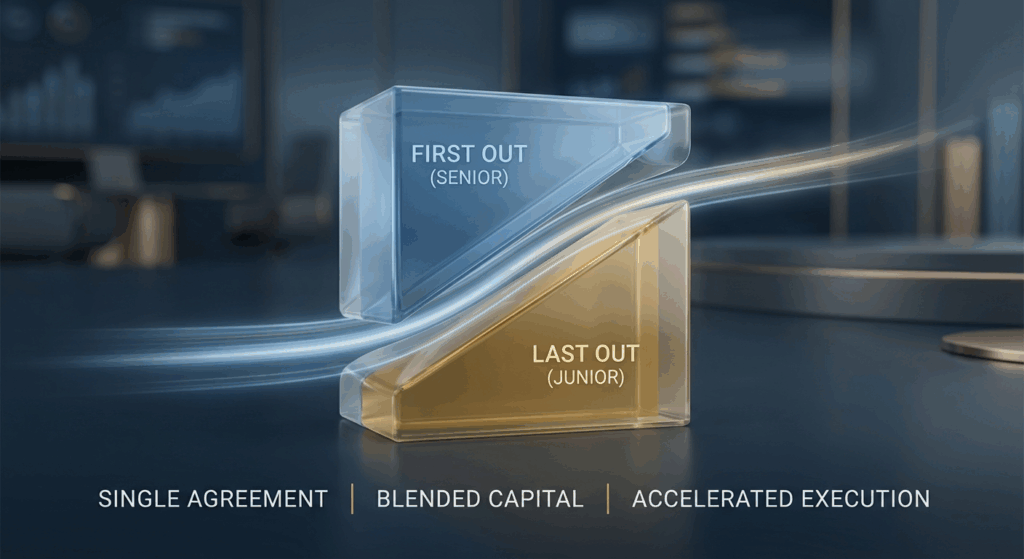
A unitranche loan legally functions as a single lien debt instrument. The borrower signs one credit agreement and pays one blended interest rate (e.g., SOFR + 650 bps). However, the lender group typically bifurcates the risk internally through an Agreement Among Lenders (AAL).
This AAL creates a synthetic “First Out” (senior) and “Last Out” (junior) tranche without burdening the borrower with separate negotiations.
Detailed Example: Financing a $100M SaaS Buyout
Consider a hypothetical software company with $10M EBITDA being acquired for a $100M Enterprise Value (10x multiple). The sponsor seeks 5.0x leverage ($50M debt).
The Unitranche Solution ($50M Total Facility):
- Tranche A (First Out): $30M funded by a commercial bank or low-cost insurance fund.
- Implied Rate: SOFR + 450 bps
- Risk Profile: Senior secured risk (0x to 3.0x leverage attachment).
- Tranche B (Last Out): $20M funded by a private credit fund.
- Implied Rate: SOFR + 950 bps
- Risk Profile: Junior/Mezzanine risk (3.0x to 5.0x leverage attachment).
- The Borrower Sees: A single $50M loan at a blended rate of roughly SOFR + 650 bps.
In this structure, the “Last Out” lender (often the private credit fund acting as the Administrative Agent) retains the majority of the economics to compensate for taking the first loss behind the equity. The “First Out” lender accepts a lower return for priority in the payment waterfall.
Comparative Analysis: When to Choose Unitranche
The unitranche structure competes primarily against Broadly Syndicated Loans (BSL) and traditional Senior/Mezzanine structures. Understanding the trade-offs is vital for CFOs and Investment Committees.
Vs. Broadly Syndicated Loans (BSL)
BSL markets typically offer lower pricing (often 50-100 bps cheaper) but carry market flex risk. If the syndication struggles, the arrangers can force higher pricing or tighter covenants on the borrower pre-close. Unitranche offers “locked” terms at the term sheet stage, eliminating this execution risk. The trade-off is the illiquidity premium the borrower pays for that certainty.
Vs. Senior + Mezzanine
Creating a stack with a senior bank loan (First Lien) and a separate Mezzanine lender (Second Lien or Unsecured) requires an Intercreditor Agreement. This creates legal friction, often delaying closing by weeks as lenders argue over standstill periods and enforcement rights. Unitranche removes the borrower from this crossfire; the AAL is a private contract between lenders that the borrower typically doesn’t even sign [Private Equity Bro].
Verdict: Unitranche wins on speed (closing in 3-4 weeks vs. 6-8 weeks) and ease of administration. BSL wins on cost of capital for large, stable issuers.
Current Market Terms (2025-2026 Trends)
The private credit market has matured significantly, with “jumbo unitranches” now serving issuers well above the traditional middle market.
- Pricing & Yields: As of recent market data, all-in yields for new private credit deals have hovered in the 11-13% range. The “speed premium” over syndicated markets generally holds at 75-100 basis points [Private Equity Bro].
- Leverage Profiles: Total leverage in sponsored unitranche deals averages around 5.0x – 5.5x EBITDA. Lenders have tightened focus on free cash flow coverage rather than just gross leverage multiples.
- Documentation: While private credit originally touted “covenant-lite” structures, the middle market realities often demand at least one financial maintenance covenant (e.g., Net Leverage Ratio), set with 25-30% headroom.
- Jumbo Deals: The market has seen a surge in facilities exceeding $2 billion, facilitated by clubs of direct lenders pooling capital to displace the public high-yield bond market [Financial Edge].
Structuring Guidance & Negotiation
For Operators (Borrowers)
While you may not sign the AAL, its terms impact you. Specifically, ensure the “drag-along” rights are clear. If the Last Out lender wants to grant a waiver (e.g., for a covenant breach), they should have the power to drag the First Out lender into that decision. Without this, a risk-averse commercial bank in the First Out position could block a necessary restructuring.
Additionally, negotiate the incremental facility (accordion) upfront. Unitranche lenders are typically buy-and-hold investors who want to deploy more capital. Pre-baking an acquisition line into the document can save significant legal fees later.
For Investors (Lenders)
The AAL is your primary protection. In a bankruptcy scenario, the First Out lender must be paid in full before the Last Out sees a dollar. However, Last Out lenders should negotiate for “silent” enforcement rights, ensuring that if they trigger a buyout of the First Out position, they can seize control of the workout process without obstruction.
Key Takeaways
- Single Point of Contact: Unitranche consolidates debt into one agreement, reducing administrative burden and closing timelines by 30-45 days.
- Hidden Layers: The “blended” rate masks a First Out/Last Out split managed via a private Agreement Among Lenders (AAL).
- Pricing Premium: Borrowers pay ~50-100 bps more than syndicated markets in exchange for preventing “market flex” and execution risk.
- Leverage Tolerance: Typical structures support ~5.0x EBITDA leverage, often reaching deeper than traditional banks would go alone.
- Acquisition Fuel: The structure is ideal for platform strategies where speed of add-on acquisitions is critical.


