
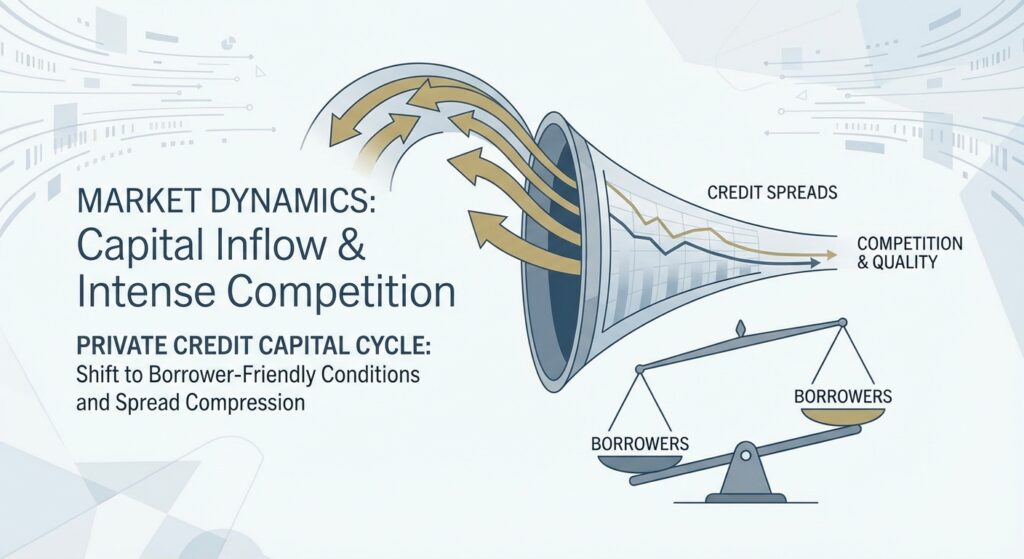
Market Headline: Intense Competition Drives Borrower-Friendly Conditions in Early 2026
As markets settle into 2026, the private credit landscape is defined by a pronounced supply-demand imbalance that has shifted leverage squarely to borrowers. Following a year of record capital accumulation, a technical scarcity of new M&A mandates has forced lenders to compete aggressively on price and terms. Data from late 2025 reveals that while liquidity is abundant, the “deallog” has been dominated by opportunistic refinancing and recapitalizations rather than new money buyouts.
The resurgence of the syndicated loan market has intensified this dynamic. Primary syndicated loan activity reached record highs in late 2025, challenging private lenders to tighten spreads to defend market share. Consequently, credit spreads across both middle-market and large-cap transactions have compressed to multi-year lows. For incumbent lenders, the priority has shifted from aggressive deployment to defending existing portfolios against repricing waves, while borrowers are seizing the window to optimize capital structures ahead of growing clarity on 2026 macroeconomic policies.
Quantitative Snapshot: The Liquidity Wall
The following metrics highlight the intense technical pressure currently shaping pricing and volume in the market:
| Metric | Current Level / Trend | Context & Comparison | Source |
|---|---|---|---|
| Syndicated Loan Volume | $404 Billion (Quarterly) | Highest quarterly total on record; driven by BSL resurgence. | Portage Point |
| Asset-Based Spreads | Tightened 10–30 bps | Compression noted in bilateral and club transactions. | MetLife IM |
| Transaction Mix | 82% Refi / Repricing | Only 18% of recent syndicated issuance was new-money LBO/M&A. | Portage Point |
| Fund Size Growth | ~$900 Million (Avg) | Average fund size up >50% since 2020, signaling massive dry powder. | Capstone |
| IG Credit Spreads | ~5 bps from Lows | Investment Grade spreads hovering near post-2000 tights. | Chicago Atlantic |
Sector Analysis: Infrastructure & Asset-Based Finance Lead
While broad corporate M&A remains lukewarm, specific verticals are commanding significant attention and premium valuations.
Infrastructure & Renewables: This sector remains a standout for capital deployment. Late 2025 data showed strong origination volumes, with major institutional investors deploying over $3.3 billion in infrastructure debt in a single quarter. The drivers are structural: lower rates and insatiable demand from data center projects and energy transition initiatives are supporting long-dated issuance. Unlike general corporate credit, infrastructure debt is seeing demand match supply, maintaining healthier pricing dynamics.
Asset-Based Finance (ABF): As corporate credit spreads compress, capital is rotating into ABF seeking yield and security. However, this influx is tightening spreads here as well. Recent reports indicate spreads on commercial and consumer asset-backed transactions have tightened by 10–30 basis points. The segment is seeing momentum in “club” transactions, where small groups of lenders finance large asset pools, bypassing broader syndication.
Technology & AI: Following the public equity rally in AI-driven sectors throughout 2025, private credit appetite for tech remains robust. However, lenders remain selective, favoring recurring-revenue models that can withstand potential economic volatility. The public market resilience suggests a continued flow of capital into tech-adjacent credit opportunities in 2026.
Implications: The Refinancing Wave
For Borrowers: The current environment presents a rare window of opportunity. With lenders competing for assets, borrowers with strong operational performance can negotiate terms that were unavailable 12 months ago. This includes not just lower spreads, but improved document flexibility and “covenant-lite” structures migrating down-market. Companies facing 2027 or 2028 maturities should act immediately to lock in these favorable conditions via refinancing or “blend-and-extend” amendments.
For Lenders & Investors: The “golden era” of easy yield via base rate hikes is over. With the Federal Reserve cutting rates (starting Sep 2025) and spreads compressing due to competition, forward return expectations must be recalibrated. Managers are under pressure to deploy massive dry powder reserves without compromising credit standards, a classic late-cycle risk. We expect a bifurcation where top-tier managers maintain discipline, while newer entrants may concede too much on structure to win share.
Forward-Looking View
- M&A Rebound: As tariff policies clarify and interest rates stabilize following the Fed’s recent easing cycle, M&A activity is projected to inch upward in H1 2026, finally unlocking “new money” deal flow.
- Spread Stabilization: The rapid tightening seen in late 2025 likely has a floor. Expect spreads to settle near current levels as lenders push back against further margin erosion.
- Convergence: The line between the Broadly Syndicated Loan (BSL) market and private credit will continue to blur, with large-cap borrowers dual-tracking processes to extract the best pricing.
- Sector Rotation: Expect capital to flow heavily into digital infrastructure and power generation financing as the AI capex boom matures into a financing phase.
- Credit Quality Watch: While defaults remain low, the aggression in current lending terms could plant seeds for future vintage risks if economic growth underperforms forecasts.


