
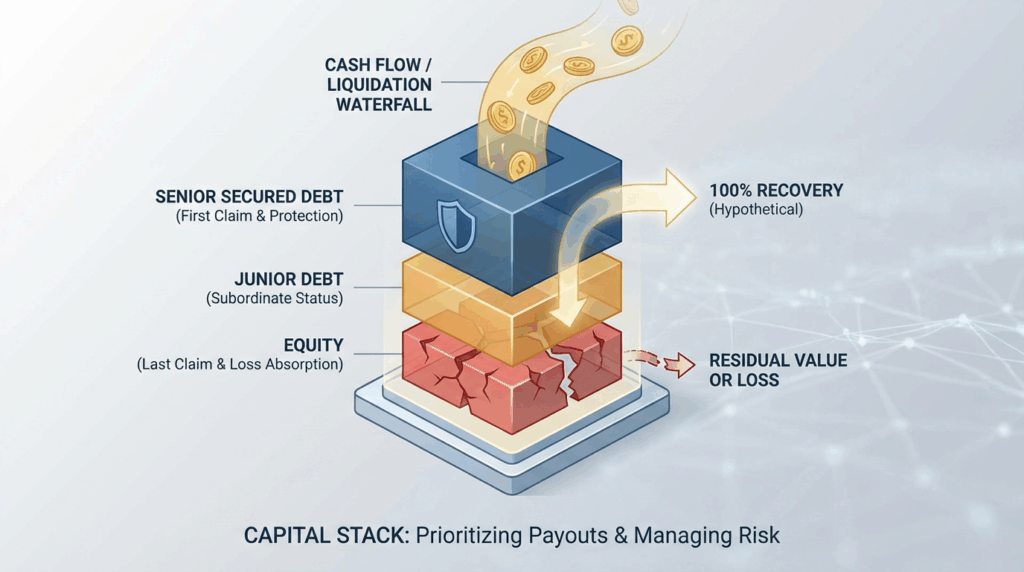
Not All Capital Is Created Equal
In the world of corporate finance, the single most important concept for understanding risk is the Capital Stack. Whether you are an investor seeking yield or a business owner raising funds, knowing where you sit in the stack determines two critical realities: when you get paid, and how likely you are to lose your principal.
While news headlines often focus on interest rates and total market size, the structural fundamentals of seniority and subordination remain the bedrock of private credit. This article breaks down the mechanics of the capital stack, explaining why "Senior Secured" positions offer defensive income and how operators should weigh the cost of debt against the cost of equity.
The Concept: Understanding the Waterfall
The Capital Stack is essentially a hierarchy of rights to a company’s cash flow and assets. Think of it as a waterfall. When a company earns revenue or is liquidated, money flows from the top down.
- Senior Secured Debt (Top): This layer has the first claim on assets and cash flow. It is “secured” by collateral (like receivables, inventory, or IP). It offers the lowest yield in the stack but the highest protection.
- Mezzanine / Junior Debt (Middle): This layer is subordinate to senior debt. It gets paid only after senior lenders are satisfied. To compensate for this higher risk, it demands a higher yield.
- Equity (Bottom): This is the ownership layer. Equity holders get paid last, only after all debt obligations are met. However, they enjoy unlimited upside potential if the company grows.
In private credit, the vast majority of direct lending activity focuses on the Senior Secured layer, prioritizing capital preservation over unlimited appreciation.
How It Works: A Concrete Example
To visualize the protective power of seniority, let’s look at a hypothetical scenario involving a mid-market logistics firm, “LogiTech Inc.”
The Structure:
LogiTech has an Enterprise Value (EV) of $100 million. To fund expansion, they utilize the following capital structure:
- Senior Secured Loan: $40 million (Provided by a Private Credit Fund)
- Equity Contribution: $60 million (Provided by the Founder and PE Sponsors)
The Downside Scenario:
Two years later, LogiTech faces severe headwinds. Revenue drops, and the company is forced to sell at a distressed price of $50 million (a 50% decline in value).
The Distressed Payout:
Because of the capital stack priority:
- Senior Lender: Receives $40 million. (100% principal recovery, despite the company losing half its value).
- Equity Holders: Receive the remaining $10 million. (An $50 million loss, or -83% return).
This mechanism highlights the Equity Cushion. In this example, the lender had a 60% cushion ($60M equity below the debt). The company’s value had to fall by more than 60% before said lender would lose a single dollar. This structural protection is why private credit is often described as “defensive.”>
Current Market Relevance
As we navigate 2026, the data reinforces the shift toward private credit structures that prioritize this seniority.
According to NEPC’s recent guide, the private debt market has grown to approximately $1.7 trillion. This growth is driven by investors seeking alternatives to public fixed income, but specifically those that offer structural safety. As traditional bank lending standards tightened following regulatory shifts, private managers stepped in to offer these senior solutions.
Furthermore, major managers like Blackstone describe this attribute as "Defensive Income." In their analysis, the combination of senior secured status and floating rate coupons (which adjust with base rates) provides a dual layer of protection: one against credit loss (via the stack) and one against inflation (via the changing coupon).
The current market environment favors this top-of-stack approach. As noted in Lord Abbett’s Aug 2025 insight, private credit prices are not marked daily like public bonds, reducing volatility “noise,” but the real stability comes from the borrower’s fundamental equity cushion.
Decision Framework
Whether you are allocating capital or raising it, understanding the stack triggers different decision criteria.
For Investors (LPs)
When evaluating a private credit fund, ask: Where is the average position?
- Defensive Strategy: First Lien / Senior Secured. Target yields are lower (e.g., Base Rate + 5-7%), but recovery rates are high. Ideal for income replacement.
- Aggressive Strategy: Second Lien / Mezzanine. Target yields are higher (e.g., Base Rate + 9-11%), but you are the first to suffer if the equity cushion evaporates.
For Operators (Borrowers)
When choosing between debt and equity, ask: What is the cost of dilution?
- Debt (Senior): Cheaper cost of capital. You pay interest (perhaps 10-12%), but you retain ownership. If your company doubles in value, the lender gets 0% of that upside.
- Equity: Most expensive capital. If you sell 10% of your business for $5M today, and the business exits for $200M in 5 years, that $5M capital cost you $20M in lost value. Use senior debt to minimize this dilution when cash flows are stable.
Key Takeaways
- Seniority is Safety: In a liquidation event, Senior Secured lenders are paid first. Losses flow from the bottom (Equity) up.
- The Equity Cushion: The percentage of capital below the debt acts as a shock absorber. A 40% Loan-to-Value (LTV) implies a 60% equity cushion.
- Defensive Income: Private credit yields are high not just because of risk, but because of an “illiquidity premium.” The structural risk is often lower than public equities.
- Cost of Capital: For business owners, senior debt prevents expensive equity dilution, allowing founders to keep the upside they create.
- Market Validation: With $1.7T in AUM, the market has validated the senior secured model as a primary tool for corporate financing in the post-bank-dominance era.


