
The Most Overlooked Metric in Private Credit
In the high-yield environment of 2026, it is tempting for both investors and business operators to focus exclusively on the headline rate. With private credit continuing to offer premiums over public markets, the \”yield chase\” often dominates the conversation.
However, veteran dealmakers know that while the interest rate determines the return, the capital structure determines the risk. The most critical component of that structure is not the coupon; it is the Equity Cushion.
As traditional banks continue their retreat from middle-market lending, forcing borrowers toward private alternatives, understanding this structural protection is essential. For investors, the equity cushion is the primary defense against capital loss. For business owners, it is the measurement of their margin for error before losing control of their company.
The Concept: What is the Equity Cushion?
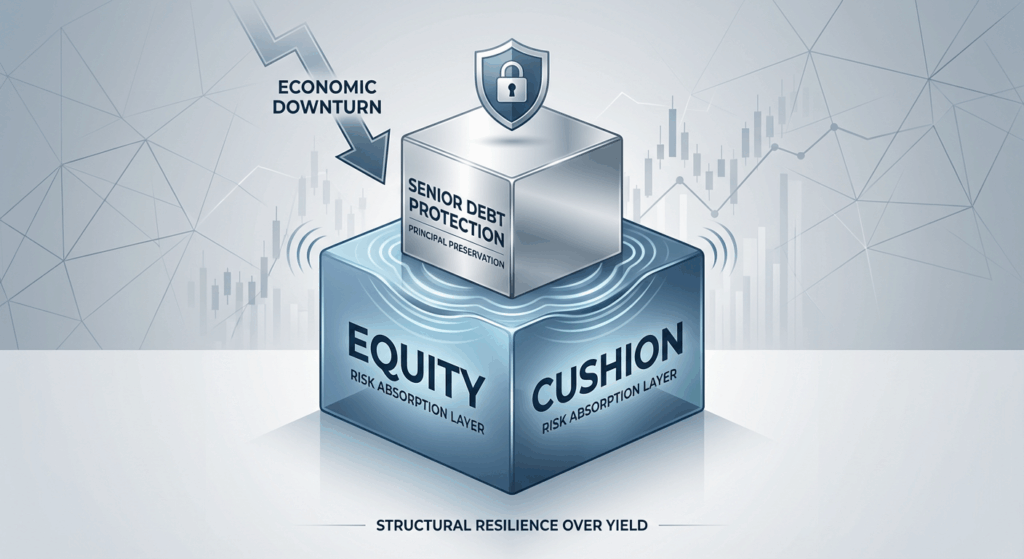
The Equity Cushion represents the value of a company that is junior to the debt in the capital stack. It acts as a financial shock absorber, absorbing the first losses in a downturn so that the lender’s principal remains untouched.
Think of it like the \”crumple zone\” in a car. If a collision (economic downturn) occurs, the crumple zone (equity) is designed to get crushed to protect the passengers (debt holders). The thicker the cushion, the harder the impact the company can withstand without harming the lender.
In technical terms, this is often expressed through the Loan-to-Value (LTV) ratio. A lower LTV implies a thicker equity cushion.
- Enterprise Value (EV): The total value of the business (Debt + Equity).
- Senior Debt: Roughly equivalent to a mortgage; the first money to be repaid.
- Equity Cushion: EV minus Senior Debt.
How It Works in Practice
Let’s look at a concrete example of a middle-market manufacturing company, \”Alpha Corp,\” seeking capital in today’s market.
The Setup:
- EBITDA: $10 million
- Valuation Multiple: 10x EBITDA
- Enterprise Value: $100 million
The Deal Structure:
A private credit fund provides a $40 million senior secured loan (4.0x leverage). The remaining $60 million is the Equity Cushion (held by the founder or a PE sponsor).
The \”Recession\” Scenario:
Imagine a severe market downturn hits in Q2 2026. Alpha Corp’s EBITDA drops 20% to $8 million, and simultaneously, market sentiment sours, compressing the valuation multiple to 8x.
- New Enterprise Value: $8 million EBITDA x 8.0x = $64 million.
- Debt Outstanding: Still $40 million.
- New Equity Value: $24 million.
The Outcome:
Even though the company lost 36% of its total value ($100M $\rightarrow$ $64M), the lender’s $40 million principle is still fully covered by asset value. The equity holder took a massive hit (value dropped from $60M to $24M), but the lender remained whole. This is why private credit investors prioritize attachment points: the point in the capital stack where their risk begins, over yield alone.
Market Snapshot: Private Credit Q1 2026
Current market data reinforces why this structural discipline is vital as the market bifurcates between large public deals and middle-market private deals.
| Metric | Value | Source |
|---|---|---|
| Private Debt Market Size (AuM) | ~$1.7 Trillion | NEPC / Preqin Dec 2025 |
| Private Capital Universe | $15.5 Trillion | NEPC / Preqin Dec 2025 |
| Avg US High Yield Deal Size | >$700 Million | BlackRock / Dealogic via NEPC |
| Avg Leveraged Loan Deal Size | ~$450 Million | BlackRock / Dealogic via NEPC |
| IG Private Credit Market | $1 Trillion | Voya June 2025 |
According to the NEPC Guide to Private Debt (Dec 2025), the private debt market has swelled to approximately $1.7 trillion, comprising roughly 11% of the total $15.5 trillion private capital universe. A key driver remains the structural shift in banking; NEPC notes that the share of bank lending to U.S. GDP has \”declined materially\” as banks prioritize capital efficiency.
This has left a specific void. As noted by BlackRock and Dealogic data cited in the NEPC report, public high-yield markets are increasingly catering to mega-borrowers, with average deal sizes exceeding $700 million. In contrast, the middle market, where deal sizes are smaller, requires the bespoke structures that private credit provides. Blackstone’s July 2025 insights emphasize this, noting that private loans are typically \”senior secured with meaningful cushion below in the form of junior debt and equity,\” a feature designed specifically for principal preservation in this fragmented market.
Decision Framework
For Investors:
When evaluating a private credit opportunity, look beyond the yield. A 12% yield on a loan with a 80% LTV (thin cushion) is often riskier than a 10% yield with a 40% LTV (thick cushion). Ask:
- What is the implied valuation multiple? Is it realistic?
- How much enterprise value can evaporate before my principal is touched?
- Is the cushion \”true equity\” (cash) or implied value?
For Operators:
Business owners often dislike the dilution of selling equity and prefer debt. However, maintaining a healthy equity cushion is vital leverage negotiation.
- The Trade-off: Higher leverage reduces your equity dilution but increases the risk of covenant breaches.
- The Strategy: In uncertain economic times, it is often wiser to accept slightly cheaper equity valuations to keep debt loads manageable (e.g., 3.5x – 4.0x EBITDA) rather than maxing out leverage and risking the company at the first sign of headwinds.
Key Takeaways
- Structure > Rate: The safety of a private credit asset is defined by what is below it in the capital stack, not the interest rate attached to it.
- The Crumple Zone: Equity cushions absorb valuation shocks; ensuring a thick cushion (40%+) is the primary defense against default loss.
- Market Bifurcation: With public markets pursuing $700M+ deals and banks retreating, the middle market relies on private credit’s structural flexibility.
- Valuation Sensitivity: Investors must stress-test the enterprise value; if the valuation is inflated, the \”cushion\” is an illusion.
- Defensive Income: In 2026, the goal of private credit allocation is often principal preservation with yield, achieved through senior secured positioning.


