
The Mechanics of Protection
In the private markets, headline interest rates often grab the most attention. However, sophisticated participants (both the investors allocating capital and the operators deploying it) know that structure trumps rate. At the heart of every private credit transaction lies a fundamental concept known as the Capital Stack, and its most critical component: the Equity Cushion.
While publicly traded bonds fluctuate daily based on market sentiment (often referred to as "market noise" in recent research from Lord Abbett), private credit derives its stability not from trading volume, but from its contractual position in this stack.
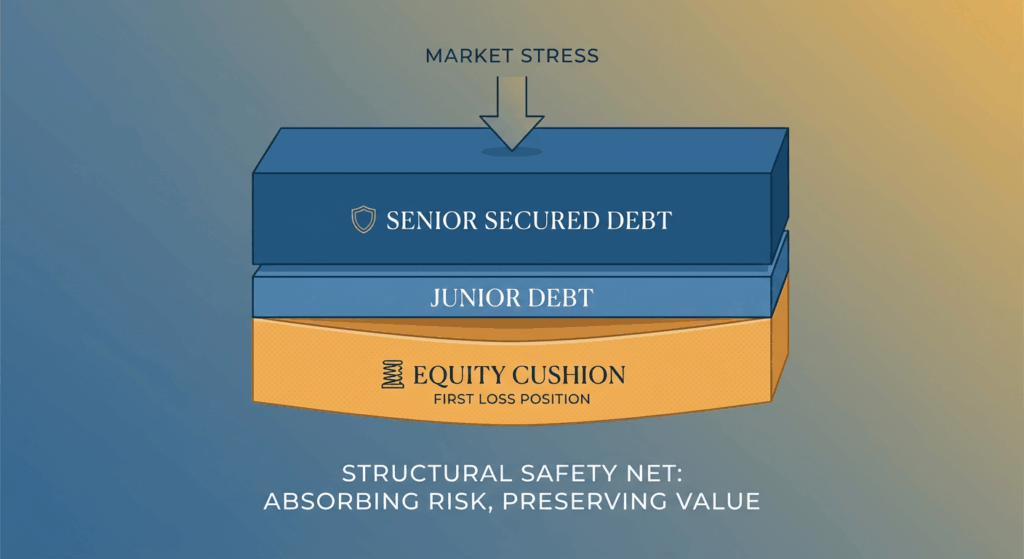
The Concept: The Subordination Cascade
Think of a company’s total capitalization as a multi-layer cake. When money flows into the company (revenue) or out of the company (in a liquidation event), it flows through a specific order of priority. This is the Subordination Cascade.
- Senior Secured Debt (Top): This is where most private credit sits. It has the first claim on assets and cash flow. It is "secured" by the company’s assets (collateral).
- Junior/Mezzanine Debt (Middle): Higher risk, higher return. Gets paid only after senior debt is satisfied.
- Equity (Bottom): The owners (Sponsors/Founders). They have the highest upside potential but sit in the "First Loss" position.
The Equity Cushion is the percentage of the company’s value owned by the equity holders below the debt. As noted by Blackstone, private loans typically feature a "meaningful cushion below in the form of junior debt and equity," which is what provides the asset class with its "defensive" nature.
How It Works in Practice
Let’s apply this to a concrete scenario to illustrate why this structure matters.
Imagine a software company, TechCo, with $10M in EBITDA. Based on current market multiples, the company has an Enterprise Value (EV) of $100 million.
TechCo needs capital to acquire a competitor. They approach a Direct Lender (Private Credit fund).
- The Structure: The lender provides a $40 million Senior Secured Loan.
- The Cushion: The remaining $60 million of value is the Equity Cushion (60% Loan-to-Value or LTV).
The Safety Mechanism:
Two years later, the economy softens. TechCo’s valuation drops by 30% due to market compression. The company is now worth $70 million.
- Equity Impact: The owners have lost $30 million of paper value (a 50% hit to their initial stake).
- Private Credit Impact: The lender is fully whole. The company is still worth $70M, covering the $40M loan with $30M to spare.
Because the equity sits in the "First Loss" position, it acts as a shock absorber. The company’s value would have to fall by more than 60% before the senior lender loses a single dollar of principal.
Why This Matters Now
Current market research highlights a divergence in capital availability. According to NEPC, banks have retreated from lending due to regulatory constraints and a focus on ROE, creating a gap that private credit has filled (now a $2T+ market per PitchBook).
This shift makes understanding the Capital Stack critical for two reasons tied to the current economic cycle:
- Valuation Uncertainty: In a high-interest-rate environment, valuations are harder to pin down. A thick equity cushion ensures that even if a borrower was overvalued at origination, the lender remains protected.
- The Flight to Quality: As Adams Street Partners notes, the predominant form of private credit is "senior secured direct lending." Investors are currently prioritizing this top-of-stack safety over the higher yields found in unsecured or distressed debt.
Decision Framework
For Investors (Allocators)
When evaluating a private credit fund, look past the yield. Interrogate the Attachment Point.
- Question: "What is the average Loan-to-Value (LTV) across the portfolio?"
- Guidance: A portfolio with a 40-50% LTV implies a massive 50-60% equity cushion protecting your capital. If a fund is reaching for 80% LTV to generate yield, they have a much thinner shock absorber if a recession hits.
For Operators (Borrowers)
When deciding between raising more Equity or taking on Private Debt, calculate the Dilution Tax.
- Scenario: You need $10M.
- Equity Path: Selling $10M of stock permanently shrinks your ownership pie. If your company doubles in value, that equity becomes the most expensive capital you ever took.
- Debt Path: Borrowing $10M at 12% is expensive cash-flow wise, but it is non-dilutive. You preserve your position in the Capital Stack (the upside).
- Guidance: If you have high confidence in your asset value and cash flow coverage, use debt to preserve your equity upside. If your cash flows are volatile, the safety of an all-equity stack may be worth the dilution.
Key Takeaways
- Seniority is Safety: Senior Secured debt gets paid first. In a bankruptcy or sale, this position is paramount.
- The Cushion Absorbs the Shock: The Equity Cushion constitutes the "First Loss" tranche. Lenders are protected by the value of the equity beneath them.
- Structure Over Rate: For investors, a slightly lower yield with a 60% equity cushion is often superior to a high yield with a 10% cushion on a risk-adjusted basis.
- Gap Filling: With banks retreating (as noted by NEPC and Blackstone), private credit structures allow borrowers to access capital based on enterprise value, not just hard asset liquidation values.


