
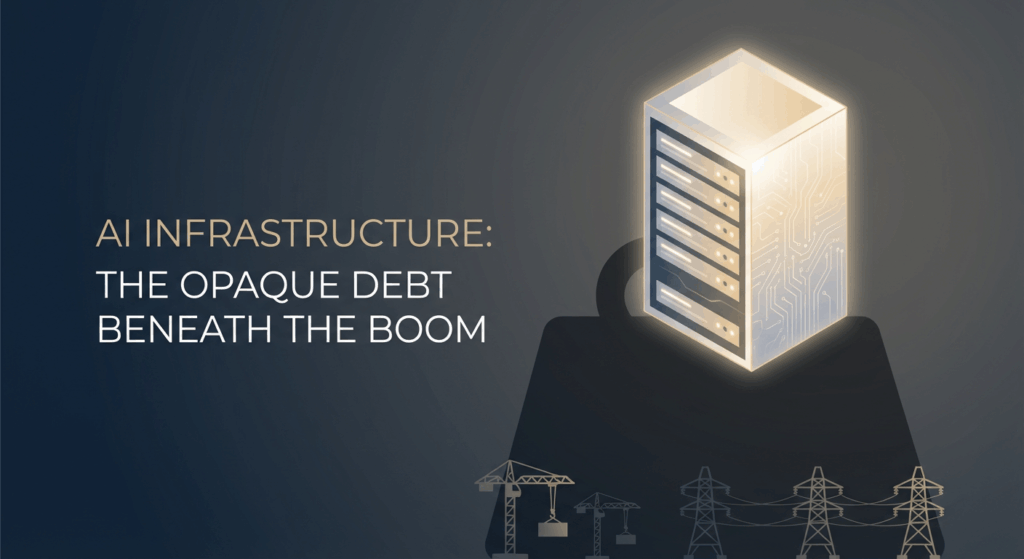
The Price of Compute: “Everything, Everywhere, All At Once”
The race to build the physical backbone of the artificial intelligence economy has officially transcended equity markets and flooded the world of credit. Recent data from JPMorgan Chase & Co. estimates that the AI data center boom will require between $5 trillion and $7 trillion in capital expenditure over the next five years. This is no longer just a technology story; it is an industrial construction story of unprecedented scale.
As of late 2025, deal flow for AI data centers and project financing surged to $125 billion, up nearly tenfold from the previous year. Yet, beneath these headline numbers lies a complex web of financial engineering. As major technology firms race to secure server capacity without destroying their balance sheets, they are turning to increasingly opaque debt structures. For the astute observer, the market is flashing signals of both massive opportunity and irrational exuberance.
The Rise of “Shadow” Infrastructure Debt
While the “Magnificent Seven” tech giants report robust quarterly earnings, their methods for financing this build-out have shifted. Strategies such as synthetic leases and third-party financing vehicles are allowing companies like Microsoft and Meta to secure billions in computing power while keeping the associated debt largely off their official ledgers. According to reports from the New York Times, these structures transfer significant risk to smaller, private intermediaries and their lenders.
This “off-balance-sheet” maneuvering has created a bifurcated market:
- Public Giants: Are leveraging their credit ratings to push risk downstream, engaging in what industry insiders call “circular deals” to bolster valuations.
- Private Developers: Are facing a “lending frenzy.” Reports from Fortune indicate some borrowers are requesting loans covering **150% of construction costs**, banking on future valuation uplifts that have not yet materialized.
Credit Discipline in a Dislocated Market
The sheer velocity of capital has begun to distort risk pricing. Credit Default Swaps (CDS) for major players like Oracle have spiked to levels not seen since 2009, signaling that institutional investors are growing wary of the execution risk involved in these mega-projects. The Bank of England has sounded alarms regarding the stability of this debt-fueled expansion.
For the middle-market borrower (the construction firms, specialized component manufacturers, and energy grid service providers helping build these data centers) this environment presents a unique challenge. While capital is abundant, it is becoming increasingly erratic and focused on speculative valuations rather than cash-flow fundamentals.
The Bond Capital View: Funding Real Assets, Not Financial Engineering
The physical build-out of AI requires massive capital. While equity grabs headlines, debt finances the steel, concrete, and cooling systems essential to the future economy. However, a market where borrowers ask for 150% loan-to-cost ratios is a market drifting toward dangerous territory.
At Bond Capital, we distinguish between funding growth and funding hype. We understand the complex CapEx needs of the industrial base supporting this AI revolution. Unlike the “irrational exuberance” evident in some corners of the private credit market, our approach remains rooted in asset value and business fundamentals. We provide flexible, certainty-of-execution capital to the builders of this infrastructure, ensuring that when the inevitable market correction cleanses the speculative excess, the physical assets (and our partners) remain standing.


