
The Trillion-Dollar Borrowing Binge
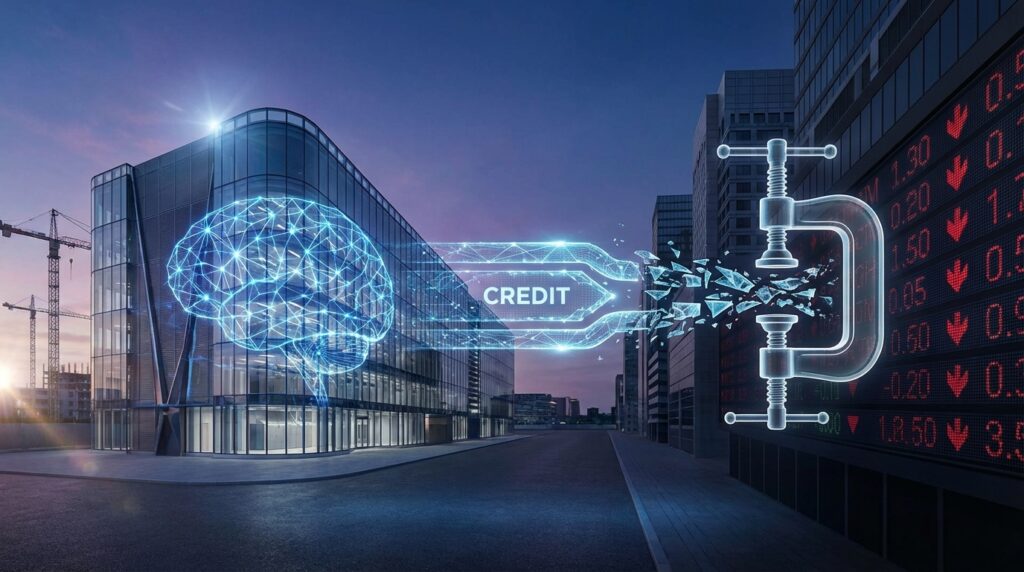
The bill for the Artificial Intelligence revolution has arrived, and public credit markets are struggling to process the sheer volume of the invoice. According to data from JPMorgan, the financing required for the AI infrastructure build-out (comprising data centers, power grids, and cooling systems) could reach $1.5 trillion by 2030. This massive capital expenditure cycle is no longer a forecast; it is an active liquidity drain on the market.
Since September, major hyperscalers including Amazon, Alphabet, and Meta have issued nearly $90 billion in investment-grade bonds, a pace that has overwhelmed investor appetite. The result is a classic supply-demand dislocation: bond prices for these tech giants are sliding, and spreads are widening. As reported by The Wall Street Journal, the market is struggling to absorb this flood of new paper, leading to increased volatility even for top-tier issuers.
The Indigestion of Innovation
The urgency to build capacity has driven borrowers toward aggressive financial engineering. With construction costs for data centers soaring, borrowers in some cases seeking loans for 150% of construction costs, corporations are utilizing synthetic leases and off-balance-sheet vehicles to mask their leverage. Fortune reports that this “insatiable demand for debt” has sparked fears of a glut, with veteran investors like Oaktree’s Howard Marks warning that the boom could result in uneconomic assets and substantial pain for credit players who ignore discipline.
This congestion is creating a ripple effect. Institutional investors, rigorous about portfolio diversification, are hitting their exposure limits for the technology sector. As Forbes notes, when pension funds and insurers hit their “concentration caps” for issuers like Oracle or Microsoft, they cease buying, forcing yields higher and shutting out other borrowers. The public market’s capacity to fund the AI physical layer is being tested, and cracks are appearing in the form of wider credit spreads and stalled issuances.
The Bond Capital Perspective: Real Assets over Hype
For the middle-market borrower, the implications of this “AI squeeze” are significant. As liquidity accumulates at the top of the market to fund hyperscale projects, traditional bank lending for other sectors may tighten. However, this dislocation validates the private credit thesis.
While public markets oscillate between greed and indigestion regarding AI valuations, Bond Capital remains focused on the tangible. The physical build-out of AI requires massive capital, but we distinguish between speculative growth financing and asset-backed infrastructure investment. In a market environment characterized by widening spreads and “lending frenzies,” our disciplined approach focuses on steel, concrete, and operational cash flow rather than theoretical future adoption rates.
When public markets are volatile, private capital offers certainty. For business owners navigating this high-cost environment, the priority must be flexible capital structures that can weather the volatility of a market currently obsessed with (and perhaps choked by) the next technological revolution.


