
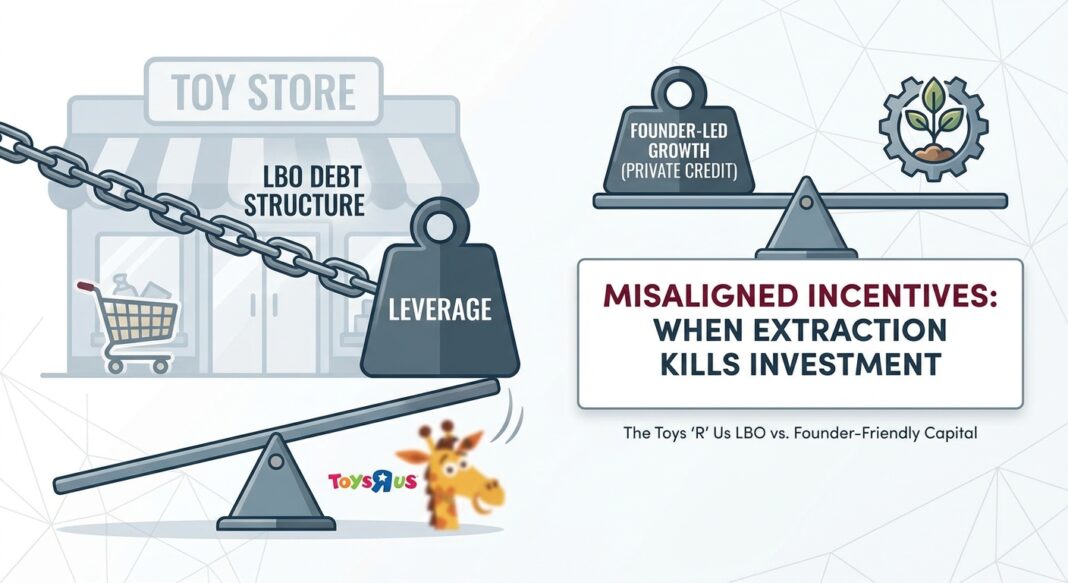
The Story: An Icon Enters the Debt Machine
In July 2005, Toys “R” Us was still the dominant name in American toy retail. It faced genuine competitive pressure — Walmart and Target were eating into its margins — but the company was profitable, operational, and repairable. Then three financial buyers arrived with a different plan.
KKR, Bain Capital, and Vornado Realty Trust announced the acquisition of Toys “R” Us at a $6.6 billion enterprise value — the largest retail leveraged buyout of its era. The buyers put in $1.6 billion in equity and drew on more than $5 billion in debt. The thesis was familiar: take a recognizable consumer brand private, restructure its operations, reduce costs, and eventually re-list or sell at a premium. A clean playbook. Except the math was broken from day one.
What followed over the next twelve years was not a turnaround. It was slow suffocation. The 2005 Toys “R” Us LBO returned a 0.0x MOIC to limited partners and ended in a 2017 bankruptcy — a $400-million-a-year debt spiral that killed an American retail icon. By 2018, every last store had shuttered. Approximately 800 locations closed and 33,000 employees lost their jobs.
This is not simply a story about a brand that lost to Amazon. It is a story about what happens when leverage is used to extract, rather than to build — and why every founder or operator considering a capital event must understand the difference.
The Decision: Structure Is Strategy
At the time of the deal, before the company went private as a result of the 2005 LBO, Toys “R” Us carried a debt load of $1.86 billion. Sales had slumped prior to the deal, but the company consistently maintained sales even through the Great Recession. In other words, the underlying business had staying power. Its problem was execution — and execution requires cash, flexibility, and the capacity to invest.
The buyout structure provided none of those things. The buyers put in $1.6 billion in equity and drew on more than $5 billion in debt. Because the debt was recourse only to Toys “R” Us itself, the private equity buyers could pile on leverage expecting they would not ultimately be responsible for paying it off. The incentives were asymmetric from the first signature.
The private-equity owners collected management fees and transaction profits regardless of the company’s performance. Bankruptcy filings later showed millions in recurring fees paid out to Bain, KKR, and Vornado even as store conditions deteriorated.
In financial management terms, such extreme leverage drastically reduces operational flexibility. While competitors invested in new technologies, Toys “R” Us cut expenses simply to avoid default. The company was no longer competing for customers. It was competing against its own debt schedule.
This is the misalignment that founders who accept outside capital must interrogate: Who bears the downside, and who collects regardless of outcome? In a properly structured debt relationship — one negotiated by an owner-operator using private credit for growth or recapitalization — the borrower retains control, bears the cost, and captures the upside. In an LBO with misaligned fee structures, the sponsor extracts while the company absorbs.
The Outcome: What the Numbers Reveal
Analysts described the LBO as a trap: the moment sales softened or competition intensified, Toys “R” Us had no cushion, no escape route, and no access to capital markets without further leveraging itself.
Toys “R” Us filed for Chapter 11 bankruptcy in September 2017, citing approximately $7.9 billion in debt against $6.6 billion in assets — the majority of that debt a direct result of the 2005 leveraged buyout.
Now run the counterfactual. Imagine Toys “R” Us had instead accessed $500 million in growth-focused private credit in 2005 — a structured term loan against its real estate and inventory assets — and used it to accelerate an e-commerce buildout and supply chain modernization. The existing equity holders (including public shareholders) retain full ownership. The company services debt from strong cash flows. While competitors invested in new technologies, Toys “R” Us cut expenses just to avoid default — but a non-extractive structure would have freed it to invest instead.
Its fate was not sealed by Amazon or changing trends alone. Documents tell a clearer story: Toys “R” Us was profitable, viable, and repairable until the burden of LBO debt stripped it of the ability to adapt.
The contrast with the founder-led model is sharp. Today, middle-market owner-operators using dividend recapitalizations or direct lending to fund growth — rather than selling to an LBO sponsor — access liquidity and retain upside. As equity dilution remains an unattractive option for many business owners, dividend recapitalization is rapidly gaining traction across the middle market, particularly among founder-led businesses seeking to realize returns without relinquishing ownership or initiating a sale.
The market data supports the shift. Amid a challenging M&A environment, dividend recapitalization activity has maintained its pace as businesses seek to generate liquidity. In H1 2025, dividend recap volumes within the leveraged loan market reached $35 billion — not far behind a record-setting 2024, which saw $81 billion of annual dividend recap loan issuance, nearly an all-time record.
The Lessons: A Framework for Founders Facing Capital Decisions
The Toys “R” Us story is extreme, but its underlying dynamics surface in deals of every size. Any operator who has been approached by a financial buyer, offered a recap, or weighed equity dilution against a debt structure should internalize these principles:
1. Understand Who Services the Debt
In a founder-controlled recap or direct lending arrangement, the borrowing company services its own debt from operating cash flows — and the owner-operator retains the equity. In a sponsor-led LBO, the company also services the debt, but the sponsor collects fees, management charges, and transaction income regardless of performance. The Toys “R” Us deal did not fail because the sponsors made a mechanical error. It failed because the structure let the sponsors get paid while the company, and their own LPs, did not.
2. Leverage Must Enable Investment, Not Replace It
The financial engineering of the private equity funds sought short-term returns but ultimately stripped the chain of its structural resilience. Debt became an unbearable burden right when the market demanded the biggest transformation in its history. Productive leverage funds modernization, acquisitions, and market expansion. Extractive leverage funds distributions while starving the operating company of capital.
3. Coverage Matters More Than Multiples
A company can absorb significant debt if its operating cash flows comfortably service the interest and principal. Despite higher pricing, leverage remains available — senior leverage on sponsored middle-market deals averaged 4.5 to 5.0 times EBITDA in late 2024. The discipline is sizing debt to what the business can genuinely service across cycles, not to what a bank will approve in a peak market.
4. The VC Dilution Path Has Its Own Compounding Cost
Founders considering equity raises should also model the long-term ownership cost. Equity dilution is cumulative, and ownership shrinks across rounds faster than most founders expect. According to Carta’s founder ownership data, the median founding team retains about 56.2% after their seed round, roughly 36.1% after Series A, and around 23% after Series B. A well-structured debt instrument that preserves majority ownership may deliver a superior outcome at exit, even at a higher all-in cost of capital.
The JP Morgan illustration is instructive: a founder raising $100 million entirely through equity at a $500 million valuation gives up 20% ownership. Raising $80 million in equity and supplementing with $20 million in non-dilutive debt reduces dilution to 16% — preserving more ownership but introducing covenants and interest payments.
5. The Market Has Created Real Alternatives
The private credit expansion has fundamentally changed what is available to operating companies outside the VC and LBO ecosystems. U.S. venture debt volume reached $58.7 billion in 2024, double the volume from 2023, reflecting strong founder demand for growth capital that does not require giving up ownership. Established companies with predictable revenue streams are well positioned to service debt, allowing them to fund acquisitions, expansion, or recapitalizations without reducing their share of the upside.
Credit markets have rebounded with total leveraged loan issuance reaching $467 billion in H1 2025. The persistent supply-demand imbalance and continued spread compression have created a borrower-friendly environment, allowing companies to opportunistically extend maturities, reduce funding costs, and pursue dividend recapitalizations on favorable terms.
Key Insights
- Debt structure defines incentives: In the Toys “R” Us LBO, misaligned fee structures meant sponsors were paid regardless of company performance. Founders using direct lending or recaps operate under no such misalignment — they own the upside and the downside equally.
- Leverage can heal or hollow out a business: The same financial instrument that helps a founder fund a bolt-on acquisition or extract personal liquidity can, in the wrong hands and at the wrong scale, strip a company of every dollar it needs to compete. Size and purpose determine whether debt is a tool or a trap.
- VC dilution compounds silently: Founders who reflexively reach for equity rounds often underestimate the cumulative ownership erosion across multiple rounds. A median founding team retains only ~23% by Series B — a cost of capital that is rarely modeled against the debt alternative.
- The market for founder-friendly debt has never been deeper: With $1.7 trillion in global private debt AUM and an increasingly borrower-friendly environment, middle-market founders have genuine access to non-dilutive capital at competitive terms that would have been unavailable a decade ago.
- The question is not debt vs. equity — it is alignment: The real framework for any capital decision is whether the structure aligns the capital provider’s incentives with the long-term health of the business. A thoughtfully structured private credit facility, a dividend recap sized to genuine cash flow capacity, or a non-dilutive growth loan all share one feature the Toys “R” Us LBO lacked: the lender only wins if the business wins.


