
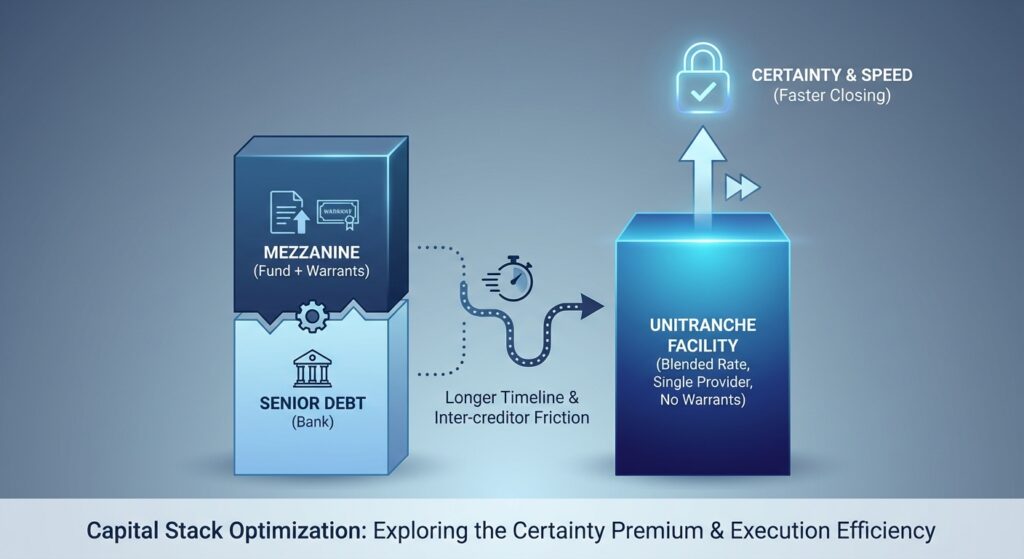
The Certainty Premium: Why Unitranche Dominates the Mid-Market Stack
For middle-market operators and private equity sponsors, the choice of debt structure often dictates the speed and certainty of a transaction closing. In the current financing environment, the structural debate frequently narrows to two distinct paths: a unified unitranche facility versus a traditional senior-plus-mezzanine (senior-mezz) stack.
While senior-mezz structures can theoretically offer a lower weighted average cost of capital (WACC), the market has shifted decisively toward unitranche solutions. Recent analysis indicates that unitranche now accounts for the vast majority of private credit executions in the leverage buyout (LBO) mid-market. This shift is driven by the “speed premium”—the willingness of borrowers to pay marginal basis points in yield to remove execution risk and inter-creditor friction.
Structure Breakdown: The Mechanics of Unitranche
A unitranche facility combines senior and subordinated risk into a single debt instrument with one blended interest rate and one set of governing documents. Unlike a bifurcated structure involving a bank (senior) and a credit fund (junior), the borrower interfaces with a single administrative agent.
The “Behind the Scenes” Tranching
While the borrower sees a flat structure, the risk is often tranched internally among lenders via an Agreement Among Lenders (AAL). This document creates a “first-out” and “last-out” waterfall without clouding the borrower’s credit agreement. The first-out lender (often a bank) takes the lower-risk, lower-return portion, while the last-out lender (a direct lender or credit fund) absorbs the higher risk for a higher return.
Deal Example: $100M Enterprise Value SaaS Buyout
Consider a software company with $10M EBITDA valued at $100M (10x multiple). The sponsor requires $55M in total debt financing (5.5x leverage).
Option A: Unitranche Structure
- Total Facility: $55M
- Pricing: SOFR + 575 bps (Floating)
- Security: First lien on all assets
- Amortization: 1% per annum
- Covenants: Loose maintenance (e.g., Net Leverage < 7.0x)
- Closing Timeline: 45 days
Option B: Traditional Senior-Mezz Split
- Senior Tranche ($40M): SOFR + 350 bps (Bank provided)
- Mezzanine Tranche ($15M): 12% cash coupon + 2% PIK + Warrants (Equity kicker)
- Intercreditor: Required negotiation between Bank and Mezz Fund
- Closing Timeline: 70+ days
In this scenario, the unitranche offers a simpler execution path, while the mezzanine option introduces equity dilution via warrants and extends the timeline significantly.
How It Compares: Trade-offs and Considerations
The decision between these structures involves evaluating cost versus control.
Speed and Certainty
Data from Financely Group highlights a stark difference in execution timing. The median sign-to-fund time for unitranche deals is approximately 45 days, compared to 70 days for senior-mezz structures. In competitive auction processes, this 25-day difference can be the deciding factor in winning a bid.
Cost vs. Dilution
Traditional mezzanine debt often requires an “equity kicker”—warrants that provide the lender upside potential to offset the subordination risk. Warrants can cost sponsors 3% to 5% of post-money equity. In contrast, unitranche facilities typically exclude warrants. Sponsors effectively trade a higher cash interest rate (the unitranche premium) to preserve 100% of the equity upside.
Flexibility
Unitranche lenders, typically unregulated private credit funds, can offer greater flexibility regarding covenants. While banks providing senior loans often require strict maintenance covenants, unitranche providers focus more on “covenant-lite” or loose maintenance structures that provide headroom for operational volatility.
Current Market Terms (2025-2026)
As of late 2025 and moving into 2026, market terms for unitranche facilities in the core middle market have stabilized around the following benchmarks:
- Pricing Spreads: SOFR + 475 to 575 basis points.
- Loan-to-Value (LTV): Average LTVs on live deals hover around 60%.
- Upfront Fees: 1.5% to 2.0% of the facility amount.
- Leverage Profiles: Total leverage continues to sit near 5.0x – 5.5x EBITDA for healthy credits.
Market reports suggest that lenders are increasingly arranging “mega-unitranche” facilities exceeding $2 billion, proving this structure’s viability is no longer limited to the lower middle market. Conversely, standalone mezzanine pricing remains expensive, often hitting 12-14% yields when combining cash and PIK components.
Structuring Guidance
For Operators and Sponsors
When negotiating a unitranche facility, focus on the incremental cost of certainty. Calculate the “all-in” cost of the senior-mezz alternative, including the legal fees of two counsels and the economic cost of warrants. Often, the higher spread of the unitranche is cheaper than the realized cost of equity dilution. Additionally, push for “scalability”—ensure the facility has an accordion feature or delayed draw term loan (DDTL) to fund future acquisitions without restriking the entire credit agreement.
For Investors and Lenders
Evaluating the Agreement Among Lenders (AAL) is critical if participating in a syndicated unitranche. Understanding the “waterfall”—how payments are prioritized in a default scenario—determines true risk exposure. The “last-out” position acts essentially as mezzanine risk but without the separate enforcement rights found in a traditional inter-creditor agreement.
Key Takeaways
- Certainty Premium: Unitranche closes ~35% faster than bifurcated structures, crucial for competitive M&A.
- No Dilution: Unlike mezzanine debt, unitranche rarely demands warrants, preserving equity upside.
- Simplified Governance: A single credit agreement reduces ongoing administrative burden and amendment costs.
- Pricing Reality: Borrowers pay a spread premium (SOFR + ~500 bps) for this flexibility.
- Market Dominance: Private credit funds have solidified unitranche as the standard for buyouts under $500M EV.


