
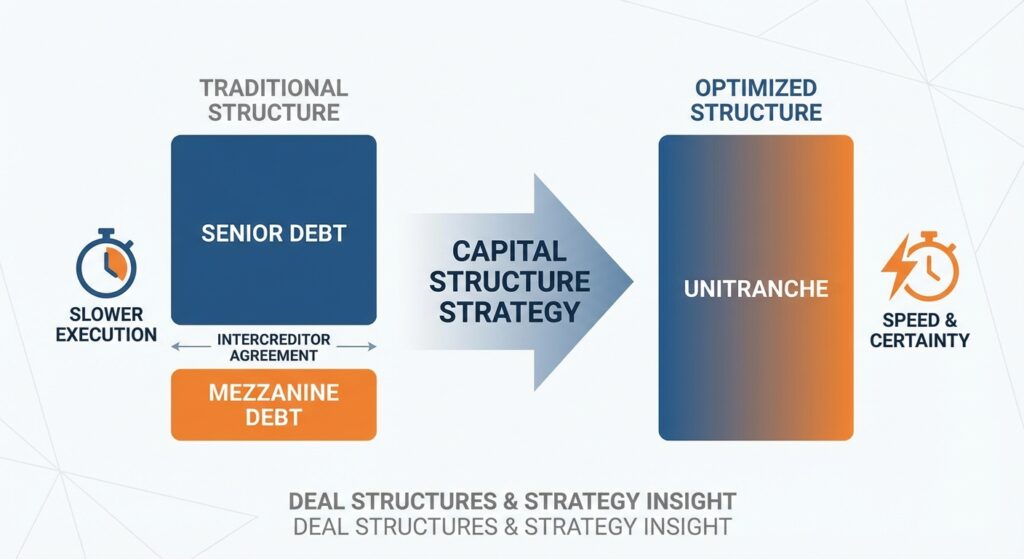
For middle-market operators and private equity sponsors, the choice of debt structure often dictates the speed and certainty of a transaction. While traditional bank-led syndicates offer lower headline interest rates, the complexity of intercreditor negotiations can imperil timeline-sensitive deals. As a result, Unitranche financing has emerged as the dominant structure for leveraged buyouts (LBOs) and significant recapitalizations, particularly in the $50 million to $500 million enterprise value range.
This deep dive examines the mechanics of unitranche structures, compares them against traditional Senior-Mezzanine stacks, and outlines current market terms for 2026.
Structure Breakdown: The “One-Stop” Solution
A unitranche facility combines senior and subordinated debt risk into a single instrument. Unlike a traditional stratified capital structure where a borrower negotiates separate credit agreements with a senior bank and a junior mezzanine lender, a unitranche involves one credit agreement, one security package, and one blended interest rate.
Behind the scenes, however, the risk is often bifurcated. This is achieved through an Agreement Among Lenders (AAL), which creates a “First-Out / Last-Out” (FOLO) structure invisible to the borrower. The “First-Out” tranche (typically mimicking senior bank risk) takes a lower return for priority in repayment, while the “Last-Out” tranche (mimicking mezzanine risk) demands a higher yield for a subordinate position.
Detailed Example: Structuring a $60M Facility
Consider a software company with $10 million in EBITDA seeking $60 million in leverage (6.0x) for an acquisition.
- Headline Unitranche Terms: The borrower signs a single $60 million facility priced at SOFR + 575 bps.
- The “Invisible” Split:
- First-Out Tranche ($35M): Priced internally at SOFR + 350 bps (risk roughly equivalent to 3.5x leverage).
- Last-Out Tranche ($25M): Priced internally to achieve the blended return, effectively functioning as the junior capital.
Crucially, the borrower does not negotiate the AAL. They simply benefit from a unitary relationship with the agent, avoiding the friction of a complex intercreditor agreement that typifies multi-lender stacks [PipelineRoad].
Comparative Analysis: Unitranche vs. Senior-Mezz
When choosing between unitranche and a traditional Senior-Mezzanine structure, deal teams must weigh cost against execution certainty.
1. Speed and Certainty
In 2025-2026, the median sign-to-fund timeline for unitranche deals has compressed to approximately 45 days, compared to 70 days for Senior-Mezzanine executions [Financely Group]. The removal of the “intercreditor drag”—disputes between senior and junior lenders over enforcement rights and payment blocks—streamlines the closing process significantly.
2. Cost of Capital vs. Dilution
Traditional senior debt is cheaper (SOFR + 300-400 bps), but the mezzanine layer is expensive (10-14% coupons) and often requires equity warrants (equity kickers) to juice returns. Unitranche facilities typically feature a higher blended cash coupon (SOFR + 475-575 bps) but rarely require warrants. For sponsors, paying a higher cash interest rate is often preferable to suffering permanent equity dilution [Financely Group].
3. Leverage Capacity
Unitranche providers often stretch deeper into the capital structure, offering Loan-to-Value (LTV) ratios of 55-65%, whereas traditional senior banks typically cap out at 40-50%, requiring a heavy mezzanine layer to fill the gap [Financely Group].
Current Market Terms (2025-2026 Data)
Recent data indicates the following standard terms for middle-market unitranche facilities:
- Pricing (Spread): SOFR + 475 to 575 basis points.
- Upfront Fees: 1.50% to 2.00% of the facility amount.
- Leverage Profiles: 5.0x to 6.0x EBITDA, depending on sector defensibility (e.g., software vs. industrial).
- Covenants: Typically a single financial maintenance covenant (Leverage Ratio of Net Debt / EBITDA), set with a 25-30% cushion to the closing model [JDSupra].
Structuring Guidance & Negotiation
For Operators and Borrowers:
- Focus on “Add-On” Capacity: Since unitranche lenders hold the entire debt stack, negotiating a “delayed draw term loan” (DDTL) committed at closing allows you to execute buy-and-build strategies without re-underwriting the entire credit.
- Define EBITDA Carefully: With leverage often touching 6.0x, the definition of “Adjusted EBITDA” becomes the battleground. Ensure “pro forma” adjustments for synergies and cost-savings are included to prevent early covenant tripping.
For Investors and Lenders:
- Review the AAL: If participating as a “Last-Out” lender in a syndicated unitranche, the voting rights in the AAL are critical. Ensure you have blocking rights on material amendments (e.g., releasing collateral or reducing interest rates) even if the “First-Out” lender holds the majority of the debt.
Key Takeaways
- Unitranche blends senior and junior risk into one instrument, typically pricing at SOFR + 475-575 bps.
- Speed is the primary advantage, closing ~25 days faster than multi-lender layered structures.
- It eliminates intercreditor complexity for the borrower, though lenders still bifurcate risk internally via an AAL.
- The structure avoids the equity dilution (warrants) common in mezzanine financing.
- Negotiation should focus on flexibility for future add-ons (DDTLs) and loose definitions of EBITDA to manage the higher leverage load.


