
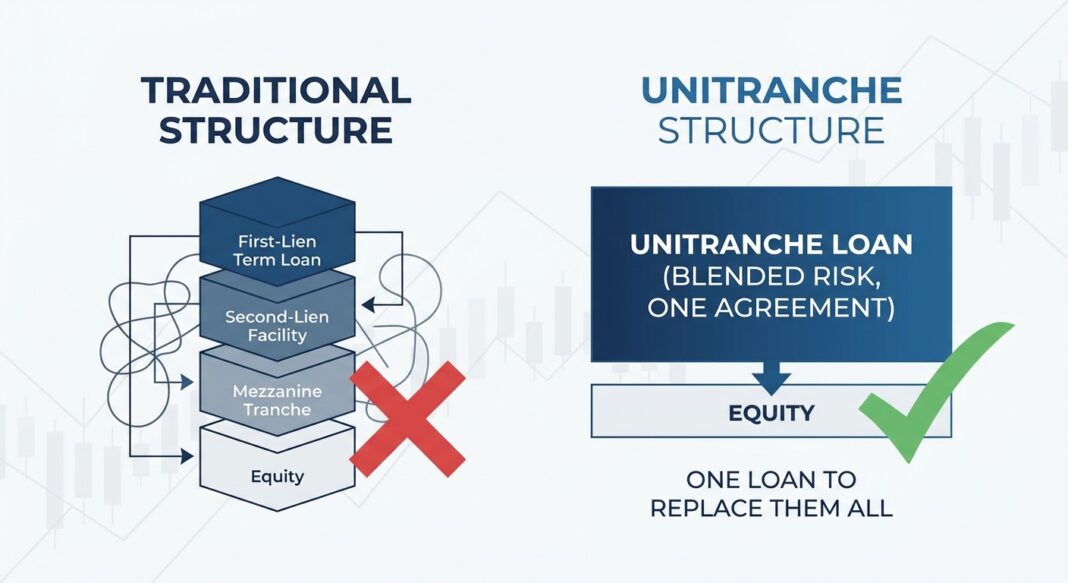
One Loan to Replace Them All
In the traditional world of leveraged finance, financing a business acquisition meant assembling a layered capital structure: a first-lien term loan, a second-lien facility, perhaps a mezzanine tranche, and finally the equity check at the bottom. Each layer had its own lender group, its own intercreditor agreement, its own legal counsel, and its own negotiating dynamics. For a middle-market business owner or a private equity sponsor closing a deal in 45 days, this complexity was expensive, slow, and often deal-breaking.
The unitranche loan was invented to solve exactly that problem. It is now the dominant financing structure for middle-market leveraged buyouts in the United States and a cornerstone of the private credit market’s rise to $1.7 trillion in global assets under management. Understanding how unitranche loans work — their mechanics, their pricing, their protections, and their tradeoffs — is essential knowledge for anyone evaluating private credit as an investor or considering it as a source of capital for their business.
This article breaks the unitranche structure down from first principles, anchors it in current 2026 market data, and delivers a decision framework for both audiences.
What Is a Unitranche Loan?
A unitranche loan is a single debt facility that blends senior and subordinated credit risk into one instrument at one blended interest rate. Rather than a borrower signing separate agreements with a first-lien lender and a second-lien or mezzanine lender — each holding different priority claims on collateral — the unitranche borrower signs a single credit agreement with a single lender or a small club of lenders.
The subordination that previously existed between lenders as a public legal structure is moved inside the lender group through a private contract called an Agreement Among Lenders (AAL). This agreement divides the loan into a “first-out” portion (lower risk, lower return, paid first in a recovery) and a “last-out” portion (higher risk, higher return, paid last). From the borrower’s perspective, none of this internal arrangement is visible — they simply make one interest payment, deal with one agent, and operate under one set of covenants.
According to Private Credit Hub, a unitranche typically occupies the senior secured term loan position with a first-priority lien, and effectively replaces a first-lien plus second-lien or mezzanine capital stack. A super-senior revolving credit facility for working capital may sit above the term loan in the waterfall, but the unitranche itself is the primary debt instrument in the structure.
How It Works: A Concrete Example
Consider a private equity firm acquiring a manufacturing business with $10 million in annual EBITDA. The agreed enterprise value is $60 million — a 6.0x EBITDA multiple. The sponsor wants to finance the deal with 50% debt and 50% equity, resulting in a $30 million loan and a $30 million equity contribution.
Under the traditional structure, this might have been split as follows:
- First-lien term loan: $20 million at SOFR + 375 bps (all-in ~8.75%)
- Second-lien loan: $10 million at SOFR + 700 bps (all-in ~12.00%)
- Equity: $30 million (targeting 20%+ IRR)
The blended cost of the two debt tranches is roughly 9.8%, but the total transaction required two sets of legal documents, two intercreditor agreements, two lender groups, and a closing process that could stretch to 60–90 days.
Under the unitranche structure, the same $30 million in debt becomes a single facility at a blended rate — say SOFR + 500 bps (all-in approximately 9.5% to 10.5% in today’s market). The first-out and last-out split (perhaps $20M/$10M) is handled privately among lenders. The result for the borrower:
- One credit agreement, one agent bank, one set of covenants
- A closing timeline that can compress to 30–45 days
- A modestly higher blended rate than the first-lien alone — but lower total transaction cost and greater certainty of execution
As noted by Private Equity Bro, the borrower trades a modestly higher all-in cost for deal certainty, faster execution, and fewer counterparties to manage — a tradeoff most sponsors and business owners find compelling in time-sensitive transactions.
Current Market Relevance: Where Unitranche Stands in 2026
The unitranche has gone from an innovation to an institution. According to CT Acquisitions (July 2026), roughly 80% of lower-middle-market leveraged buyouts closed in 2025 used a private credit unitranche rather than a syndicated bank loan — a figure that underscores just how completely this structure has displaced the traditional capital stack in its target market.
Here is a snapshot of current unitranche market conditions:
| Metric | Current Level (2026) | Source |
|---|---|---|
| New-issue unitranche all-in yield | ~9.0% – 9.75% | Valuation Research Corp., Q2 2026 |
| New-issue unitranche spread (over SOFR) | ~SOFR + 525 bps (Q1 2026) | CT Acquisitions / PitchBook LCD, July 2026 |
| Spread compression vs. 2023 peak | ~125–175 bps tighter than peak | CT Acquisitions / PitchBook LCD, July 2026 |
| Financial maintenance covenant frequency | 62% of new unitranche facilities (Q1 2026) | Yanne Capital / S&P LCD, Q1 2026 |
| CDLI trailing-year return (ending June 30, 2026) | 7.7% | Cliffwater CDLI Mid-Year Results, August 2026 |
The spread compression story is important context. According to CT Acquisitions (July 2026), new-issue unitranche spreads averaged approximately SOFR + 525 basis points in Q1 2026, down from the 650–700 bps range that prevailed through 2023 — a reflection of rising lender competition and a resurgent broadly syndicated loan market providing borrowers with alternatives.
Yet the market is not simply compressing into a race to the bottom. According to Lord Abbett’s 2026 Midyear Outlook, spreads actually widened by roughly 50 to 100 basis points since late 2025, with defensive documentation also improving — suggesting a bifurcation between strong credits that attract compressed pricing and weaker credits where lenders are reasserting terms. The Federal Reserve’s July 2026 SLOOS adds further context: bank lending standards for C&I loans remained essentially unchanged in Q2 2026, meaning banks have not broadly re-entered markets vacated during tightening cycles — keeping the structural opportunity for private credit unitranche lenders intact in the middle market.
Decision Framework
For Investors Evaluating Private Credit Unitranche Exposure
When evaluating a fund or BDC with significant unitranche exposure, investors consider the following dimensions:
- Leverage multiple at underwriting: What is the debt-to-EBITDA at close? According to Yanne Capital (Q1 2026), the median EBITDA multiple accepted by direct lenders on new unitranche facilities dropped from 6.1x in Q4 2025 to 5.4x in Q1 2026 — a constructive signal for new vintage protection.
- Covenant presence: Is the loan maintenance-covenant or covenant-lite? Maintenance covenants — tested quarterly against a leverage or debt-service coverage ratio — give lenders early warning and the ability to intervene before distress becomes default. Per S&P LCD data (Q1 2026), 62% of new middle-market unitranche facilities carried financial maintenance covenants, up sharply from 41% a year prior.
- Loan-to-value and equity cushion: As noted by Lord Abbett, a lower loan-to-value ratio means the lender is advancing a smaller portion of the company’s value — providing a cushion if operating performance weakens or market valuations decline.
- Portfolio credit health: Track non-accrual rates and PIK income as leading indicators. The Cliffwater CDLI mid-year 2026 release reported that across 23,000+ private loans, non-accruals and PIK income remain stable and well below long-term averages, with realized losses from defaults running at half their 1.0% historical average.
For Business Owners and Operators Evaluating Unitranche Financing
Operators evaluating a unitranche facility against alternatives weigh the following:
- Speed and certainty: If a transaction has a hard deadline — an acquisition, a partner buyout, a recapitalization — the unitranche’s single-lender execution can close 30–45 days faster than an equivalent syndicated structure. That speed premium has real economic value.
- Covenant headroom: A typical unitranche financial covenant is set with 25–35% cushion above the base case plan. Operators should model downside scenarios to assess how much business deterioration is tolerable before a covenant trip triggers lender intervention.
- All-in cost vs. headline rate: According to Yanne Capital (Q1 2026), the median gap between the stated coupon and the true all-in yield on non-sponsored unitranche facilities was approximately 240 basis points — meaning OID, fees, and other terms matter as much as the headline spread. Operators are well-served by negotiating total cost of capital, not just rate.
- Flexibility provisions: Unitranche agreements typically include incremental debt baskets (for future acquisitions), restricted payment permissions, and PIK toggle options. Understanding what these permit — and what they restrict — is critical before signing.
Key Takeaways
- Simplicity is the product. The unitranche’s core value is structural: one lender, one agreement, one set of covenants. The internal first-out/last-out split among lenders is invisible to the borrower but materially affects how lenders price and allocate risk.
- Price compression is real but selective. New-issue unitranche all-in yields have fallen roughly 250 bps from 2023 peaks to approximately 9.0%–9.75% in mid-2026, but the spread move is not uniform — weaker credits and non-sponsored borrowers are still paying meaningful premiums.
- Covenants are returning. The share of new middle-market unitranche facilities carrying financial maintenance covenants rose from 41% to 62% in just one year, per S&P LCD data. This is lender-protective documentation improving, not a borrower concession to ignore.
- The equity cushion is your first line of defense. Whether evaluating from the lender’s or investor’s seat, the size of the equity contribution below the debt directly determines how much enterprise value can erode before the loan is impaired. Conservative underwriting leverage (5.0x–5.5x EBITDA in the current market) matters more than headline yield.
- Performance data supports the structure. The Cliffwater CDLI — tracking 23,000+ US middle-market loans — has delivered 22 years of returns averaging 9.5% with only one negative year. Mid-year 2026 data shows continued stability in non-accruals and loss rates well below historical averages, reinforcing the asset class’s track record through multiple credit cycles.


