
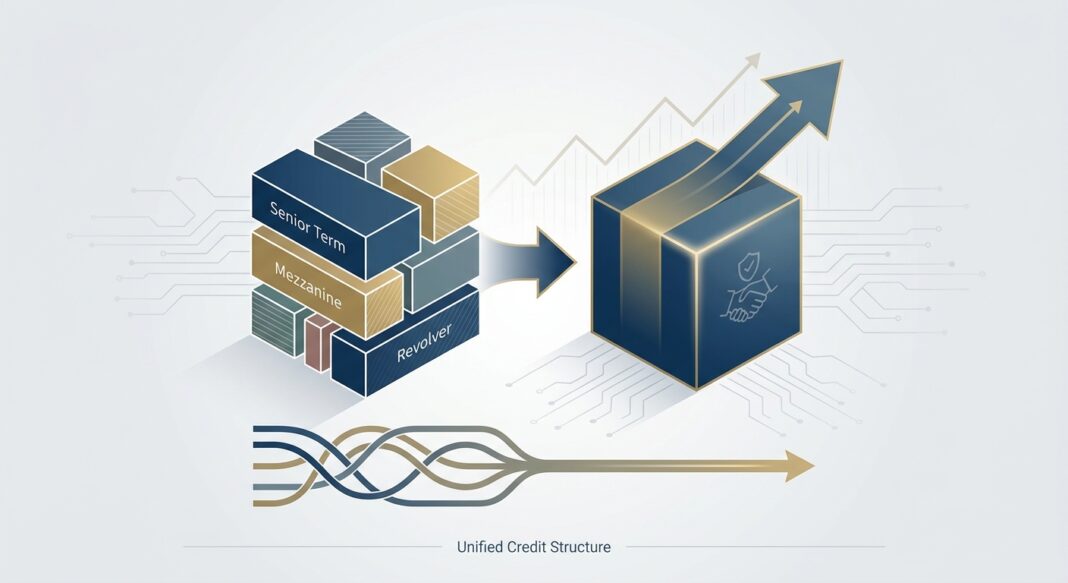
One Loan to Rule Them All
Imagine you are a private equity sponsor closing a $150 million leveraged buyout. Under a traditional structure, you would negotiate a senior secured term loan with a bank, layer a separate mezzanine facility on top of it, manage two sets of lenders with competing interests, work through an intercreditor agreement, and run two parallel due diligence processes — all under deal-clock pressure. Now imagine doing all of that through a single credit agreement with one lender, closing in roughly half the time.
That is the commercial promise of the unitranche loan — and it has quietly become the dominant financing structure for middle-market acquisitions in the United States. Understanding how it works, what it costs, and when it makes sense is essential knowledge for both investors evaluating private credit funds and business owners or sponsors considering their financing options in 2026.
What Is a Unitranche Loan?
Unitranche financing is a single secured loan facility that economically combines senior and subordinated debt into one instrument, carrying a single blended interest rate. As LexisNexis Banking & Finance (2026) describes it, the key legal features include one facility agreement, one security package, a single set of covenants and events of default, and a single ranking against the borrower group.
From the borrower’s perspective, the experience is straightforward: one lead lender, one credit agreement, and one set of reporting requirements. This simplified structure dramatically reduces the administrative burden typically associated with multi-tranche financing. From the lender’s perspective, however, the reality is more nuanced. Behind the scenes, two or more lenders typically split the facility into a “first-out” (FO) tranche and a “last-out” (LO) tranche under a confidential side document called an Agreement Among Lenders (AAL).
According to McDermott Will & Emery (May 2026), the AAL is kept separate from the borrower’s credit agreement. The first-out lender — often a bank providing the revolving credit facility — receives lower interest but gets paid back first in a liquidation. The last-out lender — typically a private credit fund — earns a higher rate but absorbs losses ahead of equity if the borrower defaults.
How the Math Works: A Concrete Example
Consider a private equity firm acquiring a software company with $20 million in EBITDA at a 7.5x multiple — a $150 million enterprise value. The sponsor contributes $60 million in equity (40% of the capital structure) and needs $90 million in debt financing.
Under a traditional two-lender structure, the deal might look like this:
- Senior secured term loan: $65 million at SOFR + 350 bps (~8.8% all-in)
- Mezzanine facility: $25 million at a fixed 13–14%
- Two separate negotiations, two closings, an intercreditor agreement, and a 90-day process
Under a unitranche structure, the same $90 million comes through one facility:
- Single unitranche loan: $90 million at SOFR + 550–600 bps (a blended ~10.0–10.5% all-in)
- Behind the scenes: $20 million first-out at SOFR + 375 bps; $70 million last-out at SOFR + 625 bps
- One negotiation, one closing, one lender relationship post-close
The borrower pays a modest rate premium versus the senior loan alone — but that premium buys speed, simplicity, and access to more total leverage than a traditional bank might provide. According to CT Acquisitions (June 2026), unitranche structures in 2026 typically carry total leverage of 4–6x EBITDA at blended rates of approximately SOFR + 500–700 bps, translating to all-in rates in the 8–11% range depending on borrower credit quality and market conditions.
Why Unitranche Is Dominating the Market Right Now
The structural rise of unitranche lending is not accidental — it is a direct consequence of bank retrenchment and the growth of institutional private credit capital. Several data points illustrate the current market reality:
| Metric | Data Point | Source |
|---|---|---|
| CDLI 2025 Full-Year Return | 9.3% (interest income: 10.4%) | Cliffwater, Mar 2026 |
| Direct Loan Median Spread (Year-End 2025) | 544 bps (down from 716 bps peak in Mar 2023) | McKinsey / Kroll StepStone, Jun 2026 |
| Direct Lending All-In New-Issue Yield (2025) | ~9.3% (down from 10.5% in 2024) | McKinsey / Kroll StepStone, Jun 2026 |
| First-Lien Yield Floor (2026 Forecast) | 8.0%–8.5% trough expected | Morgan Stanley IM, 2026 Outlook |
| Bank C&I Lending Standards (Q1 2026) | Net tighter for firms of all sizes | Federal Reserve SLOOS, Apr 2026 |
| Covenant-Lite Direct Lending Deals (2025) | 21% of deals (up from 4% in 2023) | McKinsey / Proskauer, Jun 2026 |
Bank retrenchment is the structural tailwind powering unitranche growth. The Federal Reserve’s April 2026 SLOOS confirmed that banks reported tighter lending standards for commercial and industrial loans across firms of all sizes in Q1 2026, and reported tighter standards across all categories of loans to non-depository financial institutions (NDFIs) over the past year. The most commonly cited tightening actions included higher risk premiums, stricter covenants, shorter maturities, and reduced credit line maximums — a clear signal that bank capital is becoming structurally less available for middle-market borrowers.
Private credit has stepped directly into that gap. According to Morgan Stanley Investment Management, private credit now exceeds $1 trillion in assets and has become a central component of the broader financial ecosystem, supported by long-term, committed capital that better aligns with the illiquid nature of middle-market lending than bank balance sheets can accommodate.
Meanwhile, Lord Abbett’s 2026 Midyear Outlook (June 2026) notes a notable structural improvement in new loan quality: new deals are increasingly featuring less leverage, more covenants, fewer payment-in-kind requests, and tighter documentation — a lender-friendly reset that benefits disciplined direct lenders operating in the unitranche space.
Decision Framework: Investors and Operators
For Investors Evaluating Private Credit Funds
When assessing a private credit fund’s exposure to unitranche loans, consider evaluating the following:
- First-out vs. last-out positioning: A fund holding predominantly last-out positions carries meaningfully different risk than one positioned first-out. The last-out lender earns more yield but absorbs losses ahead of the first-out lender in a default scenario. Investors may wish to understand how a fund discloses and classifies these positions in portfolio reporting.
- Leverage and coverage ratios: Morgan Stanley IM’s 2026 Midyear Outlook notes that broader credit fundamentals have remained resilient, with interest coverage ratios edging higher and leverage ratios stable, but stress remains concentrated in specific sectors — particularly healthcare and highly leveraged software names.
- Spread premium over public markets: According to Northleaf Capital (Q1 2026), direct lending continues to generate high single-digit unlevered asset returns, providing a meaningful premium over public credit markets. Investors consider whether that illiquidity premium adequately compensates for reduced transparency and limited secondary liquidity.
- AAL quality and enforcement provisions: The Agreement Among Lenders governs how proceeds are distributed in a default. Investors evaluate whether fund managers have negotiated favorable AAL terms, particularly around standstill periods and the first-out lender’s ability to accelerate enforcement independently.
For Business Operators and Sponsors Considering Unitranche
Unitranche is not the right tool for every situation. Operators and sponsors typically evaluate it when:
- Speed is critical: Competitive auction processes favor unitranche because a single-lender close can happen materially faster than coordinating a senior/mezz club deal.
- Transaction size is $25M–$300M: According to CT Acquisitions (June 2026), unitranche dominates the lower middle market for deals in the $25M–$200M enterprise value range. Below that, SBA structures or seller notes may be more cost-efficient; above $300–500M, broadly syndicated loans often offer lower spreads.
- Simplicity post-close matters: Managing one lender relationship reduces covenant waiver negotiations, amendment complexity, and lender-coordination risk over the life of the deal.
- Rate premium is acceptable: Unitranche carries a blended rate above a pure senior facility. Operators consider whether the operational savings and execution certainty justify the additional cost of capital relative to a traditional bank structure.
Key Takeaways
- Unitranche simplifies without eliminating complexity: From the borrower’s side, it is one loan. Behind the scenes, an Agreement Among Lenders divides economic risk and return between first-out and last-out lenders — a distinction that matters critically in a default.
- Bank tightening is structural, not cyclical: The Fed’s April 2026 SLOOS confirms continued tightening across C&I lending categories, reinforcing the structural opportunity for private credit lenders to fill the middle-market gap.
- Yield compression is real but still historically elevated: All-in new-issue direct lending yields declined to approximately 9.3% in 2025, per McKinsey and Kroll StepStone data, but remain in the upper half of their 12-year historical range according to Morgan Stanley IM.
- Credit quality in new deals is improving: Lord Abbett’s midyear analysis notes fewer PIK provisions, less leverage, and tighter documentation on new 2026 vintages — a potentially more favorable risk-adjusted entry point for investors than the looser conditions of 2022–2023.
- Position in the unitranche matters as much as the loan itself: Investors and operators alike benefit from understanding whether a given exposure is first-out, last-out, or a blended unitranche — each carries a different yield, recovery profile, and risk position within the capital stack.


