
The Capital Stack Problem That Unitranche Solved
Picture a private equity sponsor trying to close a $700 million acquisition in 30 days. The traditional path required negotiating a senior term loan from a commercial bank, then separately arranging a second-lien or mezzanine facility from a different lender — two sets of credit agreements, two legal teams, two covenant packages, and an intercreditor agreement governing their relationship. The complexity was not just administrative. It was a genuine deal risk.
The unitranche loan was designed to eliminate that problem. Since gaining traction after the 2008 financial crisis — when bank retrenchment created space for non-bank direct lenders — unitranche has become the flagship product of the private credit market. Today it dominates middle-market acquisition financing and is increasingly appearing in deals well above $1 billion in size.
Understanding how a unitranche actually works, what it costs, and when it makes sense is essential knowledge for any investor evaluating private credit funds or any business owner considering a leveraged recapitalization or acquisition. This article teaches the mechanics from first principles, anchored to current market data.
What a Unitranche Loan Actually Is
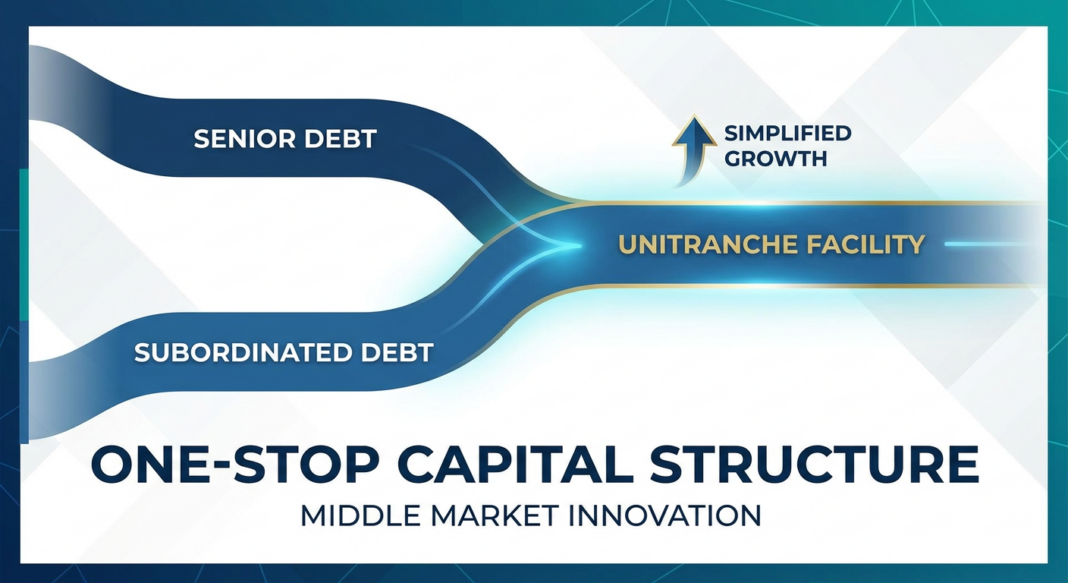
A unitranche facility combines senior and subordinated debt into a single credit agreement with a single blended interest rate. The borrower sees one lender (or a small club of lenders), signs one loan document, and manages one set of reporting requirements. The word itself is instructive: uni (one) + tranche (a layer of debt).
What makes the structure genuinely innovative is that the simplicity the borrower experiences is an illusion of sorts — in the best possible way. Behind the scenes, lenders often split the facility into a first-out (FO) tranche and a last-out (LO) tranche, governed by a confidential Agreement Among Lenders (AAL). According to Global Legal Insights (January 2026), the AAL specifies the payment waterfall, allocation of fees and interest, voting rights, lien priorities, and enforcement rules between the lenders — none of which the borrower needs to negotiate.
The FO tranche is economically equivalent to senior debt: it has first claim on principal and interest, lower risk, and a lower rate. The LO tranche absorbs subordinated risk in exchange for higher yield. The borrower pays a single blended rate that sits between what pure senior debt would cost and what standalone mezzanine would demand. This is the unitranche innovation: the lender group internalizes the tranche complexity so the borrower does not have to.
There is also a simpler variant — the stretch unitranche — which functions like a traditional Term Loan B but extends to higher leverage multiples than a bank would typically accept, without bifurcating the lender group at all.
A Concrete Example: The $400 Million LBO
Consider a private equity firm acquiring a business for $700 million at a 14x EBITDA multiple, with $50 million of annual EBITDA. The sponsor plans to contribute $300 million in equity and raise $400 million in debt.
A commercial bank offers financing at SOFR + 375–400 bps — but will only lend up to $200 million (roughly 4x EBITDA) due to regulatory capital constraints and credit appetite. That leaves a $200 million gap that a second-lien or mezzanine lender would need to fill at materially higher rates, plus the complexity of intercreditor negotiations.
A private credit fund instead offers a $400 million unitranche at SOFR + 525 bps, structured as a single first-lien facility. According to ABF Journal (August 2025), unitranche facilities for upper middle-market transactions currently price at approximately SOFR + 425–475 bps, with core middle-market credits commanding 50–100 bps more. With SOFR near 4.3–4.5%, all-in rates for quality borrowers are running in the 9–11% range in mid-2026.
At $400 million of debt and $50 million EBITDA, the deal enters at 8x leverage. Annual interest at a 10% all-in rate is $40 million — leaving $10 million of EBITDA coverage before principal amortization (which is minimal on unitranche, per market convention). The sponsor gains $200 million more in debt capacity than a bank would provide, closes in weeks rather than months, and avoids a second negotiating counterparty entirely.
The tradeoff is clear: the borrower pays a blended rate higher than pure senior debt. According to Private Capital Global (September 2025), private credit can close within four weeks while bank syndications may require six to eight weeks — a speed premium that sponsors frequently justify at 50–100 bps of additional spread when deal certainty is at stake.
Current Market Reality: Where Unitranche Stands in Mid-2026
Unitranche did not just survive a decade of credit cycles — it reshaped the market around itself. The numbers tell a striking story of scale and structural shift.
| Metric | Figure | Source |
|---|---|---|
| N. American direct lending AUM (year-end 2025) | ~$644 billion | PIMCO / Preqin, March 2026 |
| Direct lending median new-issue spread (year-end 2025) | 544 bps | McKinsey Global Private Markets Report, June 2026 |
| Spread widening on new direct loans (Q4 2025 to Q1 2026) | ~25 bps | Northleaf Capital, May 2026 |
| Covenant-lite share of direct lending deals (2025) | 21% (up from 4% in 2023) | McKinsey / Proskauer, June 2026 |
| Large-cap unitranche activity in 2024 | $210 billion (up from $94B in 2023) | Global Legal Insights, January 2026 |
| Fed SLOOS: Bank C&I lending standards (Q1 2026) | Tighter for all firm sizes | Federal Reserve SLOOS, April 2026 |
The competitive backdrop has shifted in early 2026. According to Lord Abbett (June 2026), spreads on new private credit loans have widened by roughly 50–100 basis points since late 2025, while credit structures have also improved — less leverage, more covenants, and tighter documentation on new originations. This is a meaningful shift from the borrower-friendly conditions that prevailed through most of 2024 and early 2025, when heavy capital inflows compressed spreads to cycle lows.
Bank lending has not eased the pressure on borrowers. The Federal Reserve’s April 2026 SLOOS confirmed that banks reported tighter lending standards for commercial and industrial loans to firms of all sizes in Q1 2026 — continuing a persistent tightening trend that has made private credit an increasingly necessary, not merely convenient, option for leveraged borrowers.
At the same time, Northleaf Capital (May 2026) notes that periods of market volatility historically prompt banks and liquid credit markets to retrench, with PE sponsors turning to private credit for execution certainty — reinforcing the structural role unitranche plays as a reliable financing alternative.
Decision Framework: Investors and Operators
For Investors Evaluating Private Credit Funds
When assessing a fund’s unitranche portfolio, investors consider several structural dimensions:
- First-out vs. last-out exposure: Funds holding last-out positions earn higher yields but absorb loss first within the unitranche waterfall. Some BDCs carry concentrated last-out exposure, which investors evaluate carefully against disclosed yield premiums.
- Covenant quality: Unlike the broadly syndicated loan market — where over 90% of senior loans carry no meaningful maintenance covenants — most middle-market unitranche facilities retain at least one financial maintenance covenant, per ABF Journal (2025). Investors consider the cushion above closing leverage (typically 25–35%) as a proxy for structural protection.
- PIK toggle risk: Payment-in-kind features — where borrowers defer cash interest and add it to principal — have grown more common. According to With Intelligence (June 2026), public BDCs now receive an average of 8% of investment income via PIK. High PIK concentrations can signal underlying borrower stress rather than structural flexibility.
- Sector and vintage concentration: The 2026 market environment has highlighted risks in software-heavy portfolios, particularly loans originated at low rates in 2019–2022. Investors evaluate managers on their vintage diversification and sector limits.
For Operators and Business Owners
A business owner or CFO evaluating unitranche financing considers the following tradeoffs:
- Speed vs. cost: Unitranche closes faster — often within four weeks versus six to eight weeks for bank syndications. For acquisition financing where a purchase agreement has a hard closing date, that speed premium often justifies 50–100 bps of additional all-in cost.
- Simplicity vs. flexibility: One lender relationship simplifies covenant modifications, add-on acquisition financing, and dividend recapitalizations. Operators managing active M&A programs often find the administrative efficiency of unitranche worth the blended rate.
- Leverage capacity: Banks typically cap senior leverage at 3–4x EBITDA for most borrowers. Unitranche structures routinely extend to 5–6x — critical for acquisition financing where deal multiples are in the double digits. Operators consider whether that incremental leverage is supportable from a cash interest coverage perspective: the market currently expects minimum coverage of 2.0x, with stronger deals targeting 2.5–3.0x, per Private Capital Global (2025).
- Current pricing environment: With all-in rates in the 9–11% range for quality middle-market borrowers in mid-2026, operators model debt service carefully. EBITDA growth assumptions must be robust enough to sustain interest costs through a full credit cycle, not just at origination.
Key Takeaways
- Unitranche is a structural innovation, not a cyclical trend. It emerged post-2008 to fill the gap left by bank retrenchment, and has grown into the dominant financing structure for middle-market leveraged buyouts — with large-cap unitranche volume more than doubling from $94 billion in 2023 to $210 billion in 2024.
- The borrower sees one deal; the lenders manage the complexity privately. The Agreement Among Lenders (AAL) governs how first-out and last-out lenders split economics, payment priority, and enforcement rights — without adding counterparty complexity for the borrower.
- Pricing is a blended rate that reflects both senior and subordinated risk. Current market pricing for upper middle-market unitranche facilities runs approximately SOFR + 425–475 bps, implying all-in rates of 9–11% for quality credits in the current rate environment.
- Structural protections are tightening in 2026. After a prolonged borrower-friendly period, new unitranche originations are carrying more covenants, less leverage, and wider spreads — a lender-friendly reset that investors in private credit funds consider when evaluating forward return potential.
- Bank tightening reinforces unitranche demand. The Federal Reserve’s April 2026 SLOOS confirmed continued tightening of bank C&I lending standards, a persistent structural driver that keeps unitranche financing relevant for leveraged borrowers who cannot access bank capital at the leverage multiples their transactions require.


