
The “All-in-One” Loan Structure Driving Private Credit
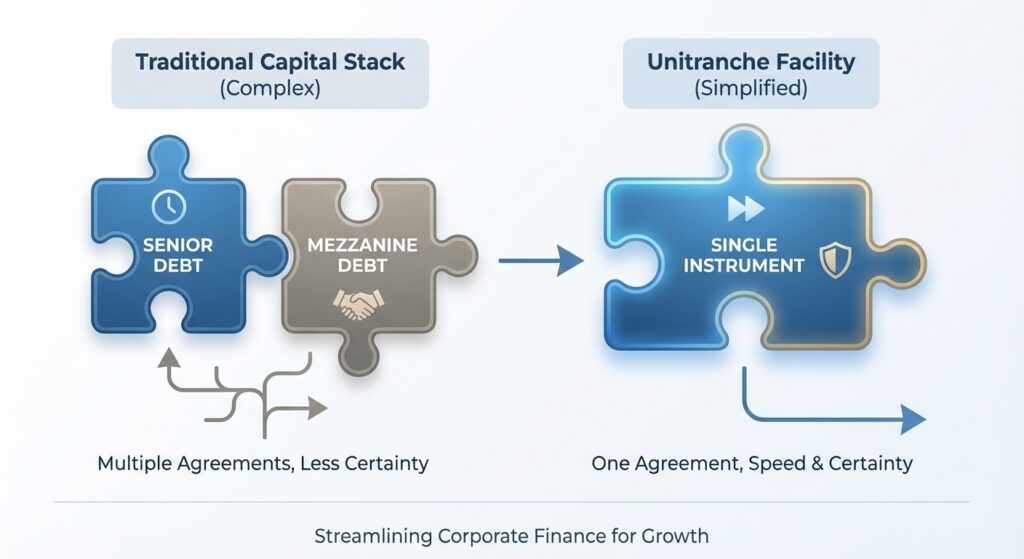
In the landscape of corporate finance, simplicity often commands a premium. For decades, middle-market companies seeking significant leverage had to navigate a fragmented capital stack: negotiating with a commercial bank for a senior loan and a separate mezzanine lender for junior capital. Today, the unitranche facility has largely replaced this two-step process, becoming the workhorse of the private credit market.
As the name implies, a unitranche loan creates a single “unit” of debt that covers the entire leverage multiple, combining the characteristics of senior and subordinated debt into one instrument. For investors and operators alike, understanding the mechanics of this structure is essential to navigating the $2 trillion private debt market.
The Concept: Blending Senior and Junior Risk
Structurally, a unitranche loan is a hybrid. It sits in a single lien position on the borrower’s capital stack, usually secured by a first lien on assets. However, internally, it absorbs risk levels that were historically separated.
From the borrower’s perspective, there is one credit agreement, one interest rate, and one set of covenants. This eliminates the need for an intercreditor agreement between two warring classes of lenders (senior vs. junior) that often complicates workouts and slows down execution.
According to Umbrex, while the borrower sees a single loan, unitranche lenders may still utilize an “Agreement Among Lenders” (AAL) behind the scenes. This creates a synthetic “First Out/Last Out” structure where different investors (or different pockets of capital within a fund) take different tranches of risk within that single instrument.
How It Works: The Cost of Capital Math
To understand why a borrower would choose a unitranche over cheaper bank debt, one must look at the Weighted Average Cost of Capital (WACC) and leverage capability.
Consider a hypothetical manufacturing company with $50 million in EBITDA seeking 5.0x leverage ($250 million total debt).
Scenario A: Traditional Multi-Lender Stack
- Senior Bank Loan (3.0x leverage): $150M at SOFR + 3.50%
- Mezzanine Debt (2.0x leverage): $100M at 12.00% fixed
- Structural Complexity: High (two diligence processes, intercreditor negotiations).
Scenario B: Unitranche Solution
- Total Unitranche Facility (5.0x leverage): $250M at SOFR + 5.75%
- Structural Complexity: Low (one lender, one document).
While the unitranche “headline rate” (SOFR + 5.75%) appears higher than the senior bank rate, it is often comparable to the blended cost of the traditional stack. More importantly, the borrower secures the full 5.0x leverage in a single motion, often closing in weeks rather than months. The lender, in turn, captures a higher yield for holding a deeper risk position.
Current Market Relevance
The shift toward unitranche financing has been a primary driver in the growth of the private credit asset class. Recent data confirms that private credit has expanded beyond niche lending into a primary financing tool for the middle market.
- Market Scale: The private debt market has grown to exceed $2 trillion, with direct lending funds (the primary issuers of unitranche debt) driving much of this volume (PitchBook).
- Market Share: Direct lending strategies, which heavily utilize unitranche structures, now account for approximately 40% of the U.S. private credit market (NAIC).
- Execution Certainty: In volatile rate environments, the certainty of a single private lender is often valued over the lower cost of a syndicated bank solution, which is subject to “flex” terms where pricing can change before closing.
Decision Framework
When evaluating a unitranche structure, market participants generally use the following criteria:
For Operators (Borrowers)
Choose Unitranche When: Speed of execution is critical (e.g., M&A auctions), or when the complexity of managing multiple lender groups outweighs the cost savings of bank debt. It is also ideal for “buy-and-build” strategies where a single lender can easily provide add-on capital.
For Investors (Lenders/LPs)
Evaluate Based On: The “attachment point” (total leverage). A unitranche loan at 4.0x EBITDA is fundamentally safer than one at 6.0x EBITDA. Investors must also scrutinize the underlying “First Out/Last Out” structure—if a fund is taking the “Last Out” piece of a unitranche, they are effectively taking junior risk and should demand mezzanine-like returns.
Key Takeaways
- Simplicity: Unitranche loans combine senior and junior debt into a single instrument with one interest rate and one credit agreement.
- Efficiency: Borrowers pay a “convenience premium” for speed, certainty of close, and the elimination of intercreditor disputes.
- Pricing Mechanism: The interest rate is a blend of low-risk senior returns and high-risk junior returns.
- Hidden Structure: An “Agreement Among Lenders” (AAL) often exists behind the scenes to allocate risk between First Out and Last Out participants.
- Market Dominance: This structure is the engine behind the growth of the $2T+ private debt market, replacing traditional bank syndicates for many middle-market buyouts.


