
Deal Structures & Strategy
Unitranche Financing in the Middle Market: Structure, Pricing, and the 2026 Negotiation Playbook
The unitranche has consolidated private credit dealmaking. Here is exactly how it is built, what it costs, and how to negotiate it.
September 5, 2026 — Bond Capital Editorial Desk
The Challenge: One Structure, All the Risk
A sponsor-backed software business with $12 million in EBITDA is under a 45-day exclusivity window. The seller wants certainty. The buyer wants speed. A traditional bank-led senior plus mezzanine stack can finance the deal — but coordinating two separate lender groups, two intercreditor agreements, and two distinct covenant packages across a competitive close window is a structural risk in itself.
This is the scenario that the unitranche loan was built to solve. And in 2026, it is not merely a solution of convenience — it has become the defining structure of middle-market leveraged finance. The U.S. private credit market now sits at roughly $1.3 trillion and is positioned for continued expansion, with direct lending remaining the dominant strategy fueled by borrower demand for flexible, fast financing. The unitranche is the instrument at the center of that demand.
But “simple” is not the same as “cheap.” The structure carries embedded complexity — particularly in how risk is allocated among lenders — and the terms borrowers accept today will govern their operational and financial flexibility for the next five to seven years. Understanding the mechanics is not optional. It is the job.
Structure Breakdown: One Loan, One Agreement, One Blended Rate
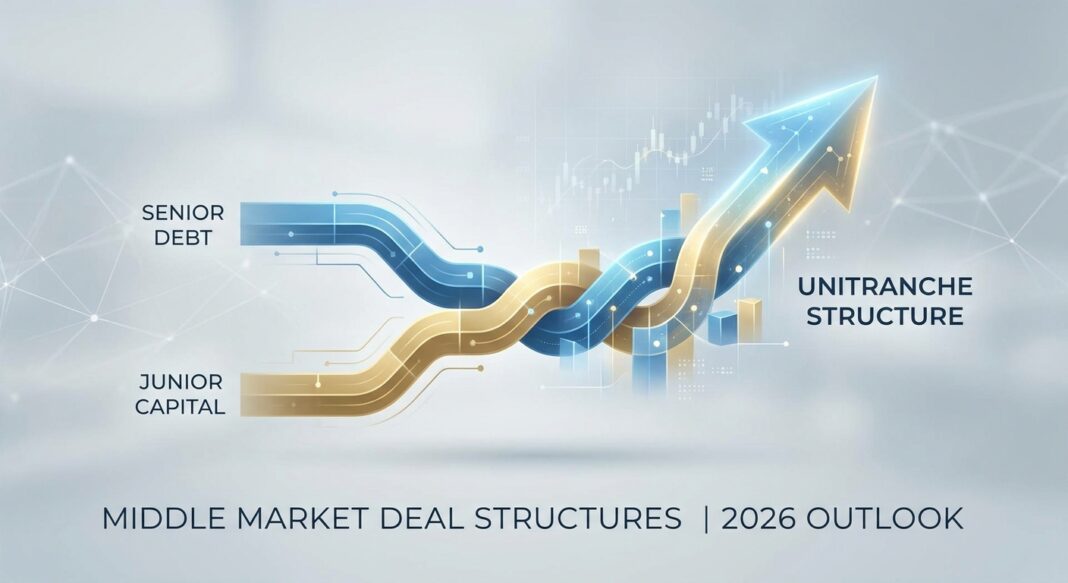
At its core, a unitranche merges senior and junior debt into a single credit agreement with a single blended interest rate. The borrower executes one loan document, posts one collateral package, and manages one lender relationship. What the borrower does not see is the Agreement Among Lenders (AAL) — a private intercreditor document that splits the lender group into first-out (FO) and last-out (LO) tranches, each receiving different economics and absorbing risk in a defined sequence.
The first-out tranche is the safer position: it receives priority in cash flow and recovery, typically pricing tighter. The last-out tranche absorbs residual losses and earns a higher effective return. The borrower pays one blended margin; the lenders settle the economics privately. This structure gives the capital provider flexibility to attract co-lenders at differing risk appetites while maintaining the simplicity that sponsors and borrowers value.
Illustrative 2026 Term Sheet: $60M Unitranche for a $120M EV Software Business
| Term Sheet Element | Detail |
|---|---|
| Borrower | Sponsor-backed B2B SaaS platform, $12M EBITDA, 85% recurring revenue |
| Enterprise Value | $120M (10x EBITDA) |
| Facility | $60M unitranche term loan + $7.5M revolving credit facility |
| Implied Leverage | 5.0x Total Debt / EBITDA |
| Sponsor Equity | $60M (50% equity contribution) |
| Interest Rate | Term SOFR + 575 bps (blended), 1% SOFR floor |
| All-In Rate (Q3 2026 SOFR ~4.3%) | Approximately 9.75% to 10.0% cash pay |
| OID | 2.0% of funded principal |
| Term | 6 years, bullet maturity |
| Amortization | 1% per annum (quarterly) |
| Financial Covenant | Single maximum total leverage ratio, stepping down annually; springing fixed charge coverage on revolver drawings above 35% |
| Prepayment | 102 / 101 / par (call protection years 1–3) |
| Administrative Agent | Lead direct lender; AAL governs FO/LO split internally |
| Total Legal / Closing Cost | Approximately $200,000–$300,000 |
| Estimated Close Timeline | 45–75 days from executed term sheet |
The SOFR + 575 bps spread in this example sits at the midpoint of the current lower-middle-market pricing band. Per Lincoln International’s Q1 2026 Senior Debt Facility data, SOFR plus 500 to 650 basis points is the working 2026 pricing band for unitranche facilities on a $10 million EBITDA target. The OID adds approximately 33 basis points of annualized cost over a six-year term, bringing the true all-in cost closer to 10.1% before any fee amortization.
Unitranche vs. the Senior / Mezzanine Split: When Each Structure Wins
The unitranche does not win on price — it wins on execution. The structure prices above a plain senior loan precisely because it is carrying junior risk inside the same wrapper; what the borrower buys is not a lower coupon but a simpler, faster, more certain transaction. That distinction shapes every “unitranche vs. stack” decision.
| Dimension | Unitranche | Senior + Mezzanine Split |
|---|---|---|
| All-In Cost | Higher blended rate; single OID | Lower blended rate possible; but two OIDs, two fee sets |
| Execution Speed | 45–75 days from term sheet | 60–90 days; intercreditor negotiation adds time |
| Covenant Package | Single maintenance leverage covenant; springing FCCR on revolver | Senior covenant + separate mezz covenant set 0.5x–1.0x wider; tiered framework increases complexity |
| Amendment Mechanics | Bilateral; single decision-maker; days to execute | Requires independent senior and mezz lender consent; intercreditor controls threshold; weeks to resolve contentious amendments |
| PIK / Equity Features | Rare in standard unitranche; sometimes PIK toggle on last-out | Mezzanine tranche often carries PIK option, warrant coverage (1%–3% equity), or equity co-invest right |
| Ideal Use Case | Competitive auctions, buy-and-build strategies, tight timelines, sponsor-backed platforms | Owner-operated businesses, lower time pressure, borrowers prioritizing lowest possible blended cost over speed |
For sponsor-backed portfolio companies executing multiple add-on acquisitions over a 2–3 year period, the single-lender relationship of a unitranche is operationally decisive. Every incremental acquisition financing, covenant reset, and incremental facility request flows through one approval process. The senior/mezz stack introduces consent mechanics that can slow or block exactly the organic deal activity that justifies the original acquisition premium.
Current Market Terms: What the Data Shows in 2026
The pricing and structural environment entering the second half of 2026 reflects a market that is more active than 2024 but increasingly selective about credit quality. The following data points define the current baseline:
- Average Unitranche Coupon (U.S.): KBRA’s direct lending data, cited by Brinley Partners, placed the average private unitranche coupon at roughly 9.00% at end-2025, running approximately 160 basis points above comparable broadly syndicated loans. That premium represents the toll direct lenders charge for speed and certainty of close.
- Lower Middle Market Spread Band: SOFR plus 500 to 650 basis points is the operative 2026 pricing band for unitranche facilities on businesses with approximately $10 million in EBITDA. Base-rate floors of 50 to 100 basis points remain standard.
- OID: Original issue discount on private credit deals currently runs 2.0%–2.5% of funded principal as a market standard, amortized over the loan term for accounting purposes.
- Covenant Evolution: Covenant-lite transactions rose to 21% of direct lending deals in 2025, up from just 4% in 2023 — a dramatic shift driven by upper-middle-market competition with the syndicated market. However, covenant-lite loans are standard above $50 million EBITDA and rare below $15 million EBITDA. Lower-middle-market borrowers in 2026 should expect a single leverage covenant plus fixed charge coverage in most credit agreements.
- Large-Cap Benchmark: In March 2026, PitchBook reported that the WWEX and Auctane merger (a Thoma Bravo-backed transaction) secured a $4.815 billion unitranche loan plus a $275 million revolver, priced at 575 basis points over the benchmark rate, with Ares Capital as administrative agent for a 33-lender club including Blackstone, Blue Owl, Apollo, and Oaktree. This transaction is indicative of how unitranche mechanics — once exclusive to the sub-$200M deal market — now operate at institutional scale.
- Documentation Trend: New loans in 2026 are increasingly coming with better credit structures: less leverage, more covenants, fewer PIK requests, and tighter documentation — a lender-friendly reset following the covenant-erosion of the 2021–2023 vintage.
- Total BDC AUM: Total BDC gross assets under management reached $575 billion in Q1 2026, up 21% year over year, reflecting the scale of deployable capital sitting behind the unitranche market.
Direct lending transactions backing LBO buyouts rose to 57% in Q4 2025, while debt pricing declined slightly to SOFR + 507 bps on average for that cohort. The trajectory heading into H2 2026 shows a recovering M&A pipeline and competitive lender dynamics that borrowers can and should leverage.
Structuring Guidance: For Operators and Sponsors
For Operators (CFOs, Business Owners)
- Anchor to EBITDA, not revenue. Lenders size unitranche debt at 4x–6x EBITDA. Understand your sustainable, lender-defined EBITDA before entering any process. Aggressive addbacks narrow the covenant cushion faster than sponsors anticipate.
- Model the covenant step-down. A 5.0x opening leverage covenant stepping to 4.5x in year two sounds manageable — until an add-on acquisition temporarily inflates gross debt. Map every covenant step against your operating plan and your acquisition pipeline simultaneously.
- Negotiate the EBITDA definition first. The definition of “Consolidated EBITDA” in the credit agreement is where borrower-friendly flexibility is won or lost. Run-rate adjustments, pro forma synergies for acquisitions, and equity compensation addbacks are all negotiated here — bilaterally, before signing.
- Understand prepayment economics. A 102/101/par prepayment schedule means refinancing or a sale in year one or two carries a meaningful cost. Build this into any sensitivity on exit timing.
For Investors (Lenders, Sponsors)
- Interrogate the AAL before pricing. The first-out/last-out mechanics inside the AAL determine recovery sequencing in stress scenarios. The borrower’s blended margin tells you the average; the AAL tells you where the tail risk lands.
- PIK toggle discipline matters in 2026. A series of high-profile leveraged loan defaults in late 2025 and the rising use of payment-in-kind toggles in direct lending have flagged mounting stress signals in the 2021–2023 vintage. Lenders underwriting new paper should treat PIK mechanics as a structural risk indicator, not a flexibility feature.
- Speed premium has limits. If a unitranche can close 30 to 45 days faster than a syndicated alternative, sponsors often justify 50 to 100 basis points of extra spread by avoiding broken syndications or delayed closings that jeopardize purchase agreements — but not 200 basis points. When pricing compression accelerates, the case for syndication improves quickly.
Key Takeaways
- The unitranche dominates, but not on cost. The structure prices 150–200 bps above a plain senior loan because it wraps junior risk inside a first-lien instrument. Borrowers are buying execution certainty and speed, not a cheaper coupon.
- SOFR + 500–650 bps is the 2026 LMM clearing range. All-in rates of 9.5%–10.5% are the working assumption for a $10M EBITDA business; top-tier credits at larger scale can clear tighter, as demonstrated by the WWEX/Auctane benchmark of SOFR + 575 bps at $4.8 billion.
- Covenant design is the most negotiable element. The EBITDA definition, covenant step-down schedule, and basket structures for permitted acquisitions are where sophisticated borrowers extract real structural value — not the headline spread.
- Cov-lite is the upper market’s privilege. Covenant-lite has grown from 4% to 21% of direct lending deals since 2023, but it remains concentrated above $50M EBITDA. LMM borrowers should plan for a maintenance leverage covenant plus springing FCCR as the 2026 standard.
- The Amendment Advantage is real. For buy-and-build sponsors, the unitranche’s bilateral amendment mechanics — one decision-maker, days to execute — versus the senior/mezz stack’s dual-consent intercreditor framework is a material operational advantage across a multi-acquisition hold period.


