
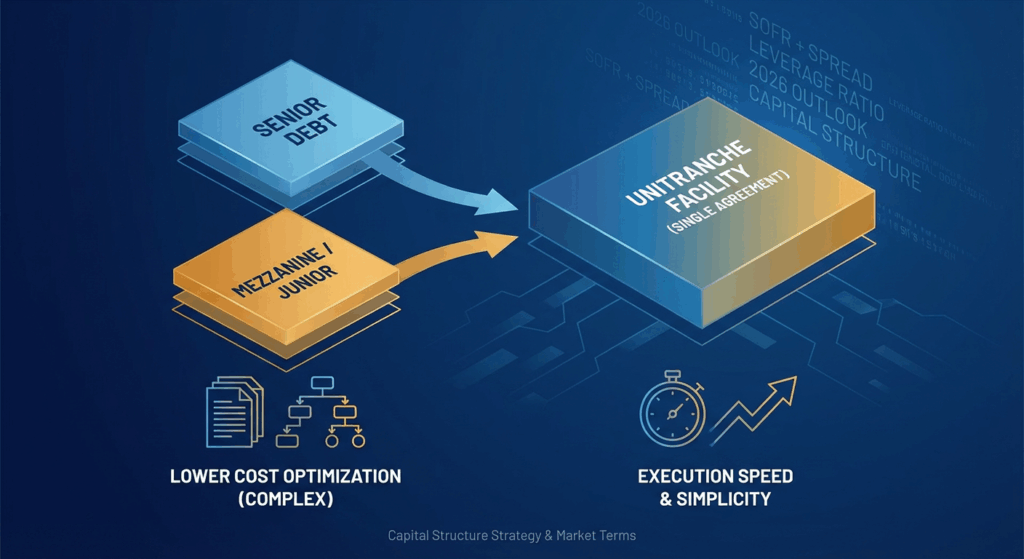
The Financing Dilemma: Speed vs. Cost in 2026
In the high-velocity world of middle-market M&A, the capital structure chosen at the Letter of Intent (LOI) stage often dictates the certainty of closing. As of early 2026, private credit assets under management have swelled to approximately $2.1 trillion, cementing direct lending as the dominant funding route for sponsor-backed buyouts. Yet, investment committees continue to grapple with a fundamental structural question: Do we prioritize the speed and simplicity of a unitranche facility, or do we engineer a bifurcated senior-mezzanine stack to optimize the cost of capital?
The unitranche structure—a single debt facility blending senior and subordinated risk—has evolved from a niche product to the market standard for buyouts ranging from $50 million to over $2 billion. However, as spreads tighten and competition among direct lenders heats up, the nuances of these structures have changed. This analysis breaks down the mechanics of the modern unitranche facility, current market terms, and the strategic trade-offs operators must weigh against traditional financing alternatives.
Structure Breakdown: Mechanics of the Unitranche
A unitranche facility combines first-lien and junior debt characteristics into a single instrument with one set of loan documents and a single blended interest rate. This contrasts with a bifurcated structure, where a company borrows from a senior lender (bank) and a separate junior lender (mezzanine fund), requiring an intercreditor agreement to adjudicate rights between them.
The “Invisible” Bifurcation
While the borrower signs one credit agreement, the risk is often tranched behind the scenes through an Agreement Among Lenders (AAL). This document splits the loan into a “first-out” tranche (lower risk, lower return, often held by banks) and a “last-out” tranche (higher risk, higher return, held by private credit funds). The borrower typically remains agnostic to this internal waterfall, dealing with a single administrative agent.
Deal Example: $100M SaaS Acquisition
Consider a hypothetical software company with $10 million in EBITDA being acquired for $100 million (10x multiple). The sponsor seeks 5.5x leverage ($55 million debt).
Option A: Unitranche Structure
- Facility Size: $55 million
- Pricing: SOFR + 550 bps (Cash pay)
- Amortization: 1% per annum
- Documents: Single credit agreement
- Closing Time: ~45 days
Option B: Senior-Mezzanine Structure
- Senior Tranche ($35M): SOFR + 350 bps (Bank debt)
- Mezzanine Tranche ($20M): 11% Cash + 2% PIK + Warrants
- Documents: Two agreements + Intercreditor Deed
- Closing Time: ~70 days
In this scenario, the unitranche offers a higher cash coupon but eliminates the dilution of warrants often attached to mezzanine debt and significantly accelerates the closing timeline.
Comparative Analysis: When Unitranche Wins
The choice between unitranche and a bifurcated stack depends on the transaction’s specific constraints.
1. Execution Speed and Certainty
Market data indicates a median “sign-to-fund” timeline of 45 days for unitranche deals versus roughly 70 days for senior-mezzanine structures. In competitive auctions where “certainty of close” is a bid attribute, the unitranche structure provides a distinct advantage by removing the friction of negotiating an intercreditor agreement between two distinct lending institutions.
2. Dilution Impact
Historical mezzanine financing often requires an “equity kicker”—warrants providing the lender with 3-5% of the post-money equity to boost their IRR. Unitranche lenders generally price their risk entirely into the floating spread and upfront fees, preserving the sponsor’s equity upside. This is crucial for growth-oriented theses where equity value compounding is the primary return driver.
3. Scalability (The “Accordion”)
Unitranche facilities typically include committed delayed draw term loans (DDTLs) or “accordion” features that allow the facility to grow as the borrower acquires new targets. Because there is only one lender relationship to manage, accessing incremental capital for bolt-on acquisitions is generally faster than coordinating a syndicate of senior and junior lenders.
Current Market Terms (Q1 2026)
Following a year of aggressive capital deployment, terms for unitranche facilities in the core middle market have stabilized. According to recent market surveys, the following terms are standard for credits with $10M-$50M EBITDA:
- All-In Spreads: SOFR + 475 to 575 basis points.
- Leverage Profiles: 5.0x to 6.0x Total Net Leverage, with LTVs hovering between 55% and 65%.
- Upfront Fees: 1.5% to 2.0% (original issue discount or closing fees).
- Covenants: Typically one financial maintenance covenant (Leverage Ratio or Fixed Charge Coverage Ratio), but with increasing “covenant-lite” features appearing in the upper middle market ($50M+ EBITDA).
Notably, the “speed premium”—the extra spread a borrower pays for the convenience of unitranche versus a syndicated solution—has compressed to approximately 50-75 basis points, down from over 100 bps in previous cycles.
Structuring Guidance
For Borrowers and Operators
When negotiating a unitranche term sheet, focus heavily on the definition of EBITDA and incremental facility terms. Since the lender holds the entire debt stack, ensuring you have pre-baked flexibility to add leverage for acquisitions (without paying a repricing fee on the existing debt) is critical. Additionally, try to negotiate “holidays” or step-downs for the financial covenants during the first 12 months to allow for integration hiccups.
For Investors and Lenders
In club deals where multiple direct lenders share a unitranche facility, the voting rights become paramount. Ensure the “Required Lenders” threshold (typically >50%) prevents a minority holder from blocking waivers or amendments. If participating in a “last-out” position via an AAL, scrutinize the “payment blockage” provisions carefully: understand exactly what “trigger events” allow the senior (first-out) lender to turn off your cash flow.
Key Takeaways
- Certainty Premium: Unitranche closes ~25 days faster than multi-tranche deals.
- Cost Convergence: Spreads have tightened to SOFR + 475-575 bps, reducing the gap with bank pricing.
- No Equity Kicker: Unlike mezzanine debt, unitranche rarely requires warrants, preserving cap table integrity.
- Single Point of Control: One credit agreement simplifies post-close administration and buy-and-build strategies.
- Hidden Structures: Behind the scenes, “first-out/last-out” agreements often tranche risk without borrower involvement.


