
One Loan to Rule Them All
For decades, financing a leveraged buyout meant assembling a layered capital stack: a senior secured loan from one lender, a subordinated mezzanine tranche from another, and equity at the base. Each layer had its own legal agreement, its own lender group, its own pricing, and its own set of negotiations. The process was slow, expensive, and full of coordination risk.
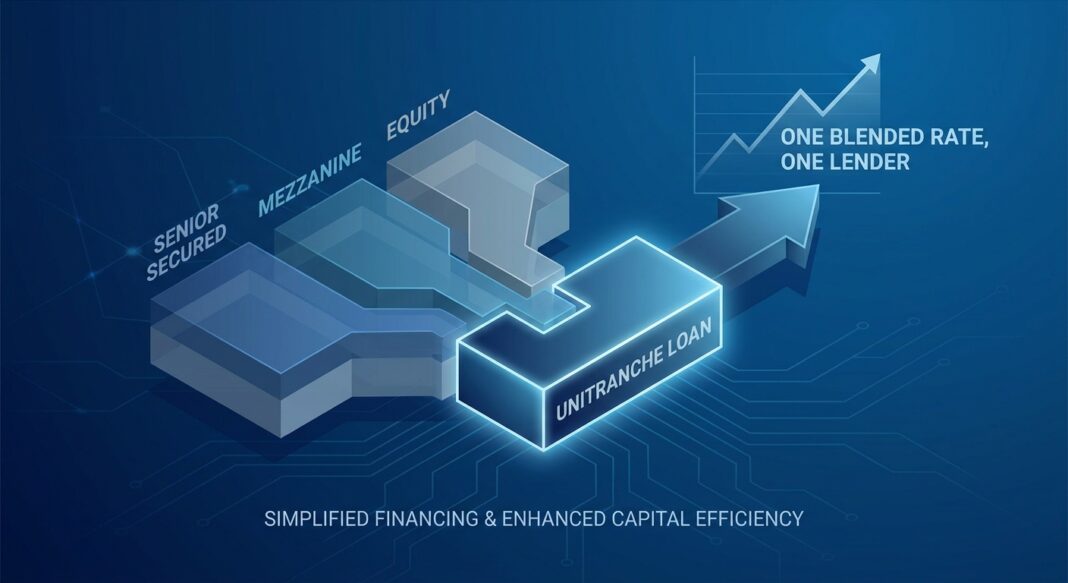
Then came the unitranche loan — a structure that collapsed all of those layers into a single facility, a single lender relationship, and a single blended interest rate. What began as a niche private equity financing tool in the mid-2000s has become the dominant deal structure in private credit today. For investors trying to understand how private credit works — and for business owners evaluating their capital options — the unitranche is the concept that unlocks the entire asset class.
This article explains exactly what a unitranche is, how its pricing is built, what risks sit inside it, and why it has become the preferred financing instrument for middle-market companies in 2026.
What Is a Unitranche Loan?
Unitranche debt is a hybrid loan structure that combines senior secured debt and subordinated debt into a single credit facility, governed by one credit agreement and one security agreement. The borrower pays a single blended interest rate rather than separate rates on each layer, and they manage one lender relationship rather than a syndicate of creditors with competing priorities.
The term itself is telling: “uni” for single, “tranche” for a layer of debt. As the New Mountain Guardian IV BDC 10-Q (FY2026) describes, unitranche loans combine both senior and subordinated debt, generally in a first-lien position — meaning the lender holds a claim on company assets that ranks ahead of equity holders in any default scenario.
Inside many unitranche facilities, lenders privately split their exposure into two tiers via an Agreement Among Lenders (AAL): a first-out tranche that receives priority repayment and carries lower yield, and a last-out tranche that absorbs first loss and demands a higher spread in return. Crucially, the borrower sees only one rate and one counterparty — the internal risk-splitting is invisible to them.
This structure emerged in the United States around 2005 as private equity sponsors sought to simplify the financing of leveraged buyouts, replacing the cumbersome senior/subordinated architecture with a single, streamlined instrument. Today it has matured into the default mechanism for mid-market private credit deals.
How Unitranche Pricing Actually Works: A Concrete Example
To understand unitranche economics, it helps to build one from scratch. Consider a hypothetical acquisition of a software company generating $10 million in annual EBITDA. A private equity sponsor wants to acquire the business for $60 million (a 6x EBITDA multiple) and finance $40 million of that with debt, contributing $20 million in equity.
Rather than arranging a $25 million senior loan at SOFR + 300 bps and a $15 million subordinated note at SOFR + 850 bps — each with separate legal documents and lender groups — the sponsor approaches a private credit fund for a single $40 million unitranche facility.
Here is how the all-in cost is built in the current market environment:
- Base rate: 3-month Term SOFR at approximately 3.69% (as of Q2 2026)
- Credit spread: According to Valuation Research Corporation’s Q2 2026 Private Markets Update, unitranche coupon spreads generally range from 4.75% to 5.50% for standard middle-market transactions
- All-in yield: The same report places overall unitranche yields between approximately 9.00% and 9.75%
- Original Issue Discount (OID): According to CT Acquisitions’ 2026 Unitranche Financing Guide, standard OIDs hold between 98.75 and 99.25, meaning on a $40 million facility, the borrower receives roughly $39.5 million at close but owes the full $40 million — the discount functions as upfront yield to the lender
On the $40 million facility at a 9.25% blended yield, the borrower pays approximately $3.7 million per year in interest. Compare that to the traditional two-tranche structure, which would involve separate legal fees, two sets of documentation, inter-creditor negotiations, and potentially slower execution. The speed premium alone is significant: according to Private Equity Bro’s 2025 analysis, unitranche financing can close 30 to 45 days faster than a syndicated alternative — a gap sponsors often gladly pay 50 to 100 basis points to avoid.
The borrower also benefits from equity cure rights: if the company misses a financial covenant, the sponsor can inject additional equity to remedy the breach. Per the CT Acquisitions guide, standard 2026 terms allow up to four cures over the life of the loan, with no more than two in any consecutive four-quarter period.
Current Market Relevance: Where Unitranche Sits in 2026
Unitranche is no longer a niche innovation — it is the backbone of private credit dealmaking. The market data for 2026 tells a striking story:
| Metric | Data Point | Source |
|---|---|---|
| Large-cap unitranche market activity (2024) | ~$210 billion, up from $94B in 2023 | Alternative Fortune, Mar 2026 |
| Unitranche all-in yield range (Q2 2026) | ~9.00% – 9.75% | Valuation Research Corp., Jul 2026 |
| Middle-market direct lending spreads (Q4 2025) | ~SOFR + 500 bps | Octus, 2026 Outlook |
| Global private credit AUM (2025) | ~$2.1 trillion | Private Equity Bro, Oct 2025 |
| Projected private credit AUM by 2030 | $4.5 trillion | Preqin via IQ-EQ, Feb 2026 |
| Bank C&I lending standards (Q2 2026) | Basically unchanged; standards easier than historic midpoint | Federal Reserve SLOOS, Jul 2026 |
The context matters: even as bank lending standards have stabilized in mid-2026 — the Federal Reserve’s July 2026 SLOOS shows C&I standards broadly unchanged for businesses of all sizes — banks still serve large, investment-grade borrowers most efficiently. Middle-market companies, typically defined as those with $10 million to $150 million in EBITDA, frequently fall outside the credit appetite of regulated banks, creating a structural gap that private credit and the unitranche fill.
According to Lord Abbett’s 2026 Midyear Outlook, spreads have widened by roughly 50 to 100 basis points since late 2025, and new loans are increasingly coming with better credit structures and tighter documentation — a shift that favors disciplined lenders deploying fresh capital.
Decision Framework: Investors and Operators
For Investors Evaluating Private Credit Funds
Not all unitranche exposure is equal. Investors evaluating a private credit fund or BDC consider asking these questions:
- What share of the portfolio is last-out? Last-out tranches within a unitranche can price at SOFR + 850 bps or more — but they also absorb first losses in a default. A fund reporting strong yields may be carrying significant last-out concentration.
- At what spread are new loans being written? Alternative Fortune’s March 2026 analysis notes that the Cliffwater Direct Lending Index returned 9.3% in 2025, but those returns were earned on older, wider-spread loans. Forward yields on new originations are a more accurate indicator of future income.
- How tight are the maintenance covenants? Per the Lord Abbett midyear view, covenant quality has improved in 2026. Investors consider whether a fund’s loan documents include meaningful financial maintenance tests — or whether loose covenants have traded away lender protection to win deal flow.
- What is the OID and prepayment structure? Standard 2026 prepayment schedules run at 102/101/par over the first three years. Investors evaluate how quickly the portfolio is recycling capital and whether prepayment economics are being preserved.
For Business Owners and Operators
Operators considering unitranche financing evaluate it against two primary alternatives: a traditional bank loan or a two-tranche (senior + mezzanine) structure.
- Choose unitranche when: Speed is critical, the business is sponsor-backed, the deal is a leveraged acquisition or buy-and-build, and the company needs a single decisive lender who can move in two to three weeks.
- Scrutinize the all-in cost carefully: The blended rate sits above a pure senior bank loan. Operators model the full cost including OID, arrangement fees, and any prepayment penalties before committing. A lower headline rate on a bank loan may be worth the additional time — or may not, if a broken syndication risks a deal collapse.
- Negotiate equity cure rights and MFN clauses: The most operator-friendly terms include broad equity cure flexibility and a Most-Favored-Nation (MFN) clause that only triggers on meaningful spread differentials (typically 50 bps or more). Per the CT Acquisitions guide, standard MFN protection in 2026 carries a 12-month sunset — a detail worth understanding before signing.
- Avoid unitranche if: The business has volatile cash flows, thin margins, or near-term public market refinancing options that could offer materially tighter pricing.
Key Takeaways
- Unitranche is the dominant private credit structure. The large-cap market nearly doubled to $210 billion in 2024, and unitranche now defines how private equity finances mid-market buyouts.
- The blended rate hides an internal risk split. Inside many unitranche facilities, first-out and last-out lenders share different risk and return profiles — investors evaluating funds should understand how much last-out exposure a portfolio carries.
- All-in yields in Q2 2026 range from 9.00% to 9.75%, representing a ~250 basis point decline from 2023 peak levels but still well above pre-2022 ranges of 7%–8%.
- Speed and certainty are the borrower’s premium. Unitranche can close 30–45 days faster than syndicated alternatives — a meaningful advantage in competitive M&A processes where financing certainty can determine deal outcomes.
- Structural quality matters more than headline yield. In a market where spreads are compressing and new loans are pricing thinner than legacy portfolios, covenant tightness, OID terms, and lender selectivity are the differentiating factors for both investors and operators.


