
What Is a Unitranche Loan — and Why Does It Dominate Private Credit in 2026?
Walk into most middle-market leveraged buyout negotiations today and you will not see a tidy arrangement of first-lien banks, second-lien funds, and mezzanine providers sitting at separate tables. Instead, you will likely find a single private credit lender holding one loan document that covers the entire debt capital structure above the equity. That instrument is called a unitranche loan, and it has quietly reshaped how private companies access capital.
Understanding unitranche is not optional for anyone participating in private credit — whether as an investor allocating capital to a direct lending fund or as a business owner evaluating financing options. The structure determines how risk is layered, how quickly a deal closes, and how much total interest a borrower ultimately pays. This article breaks down exactly how unitranche works, what it costs in today’s market, and when each party benefits most from using it.
The Concept: One Loan, One Lender, One Agreement
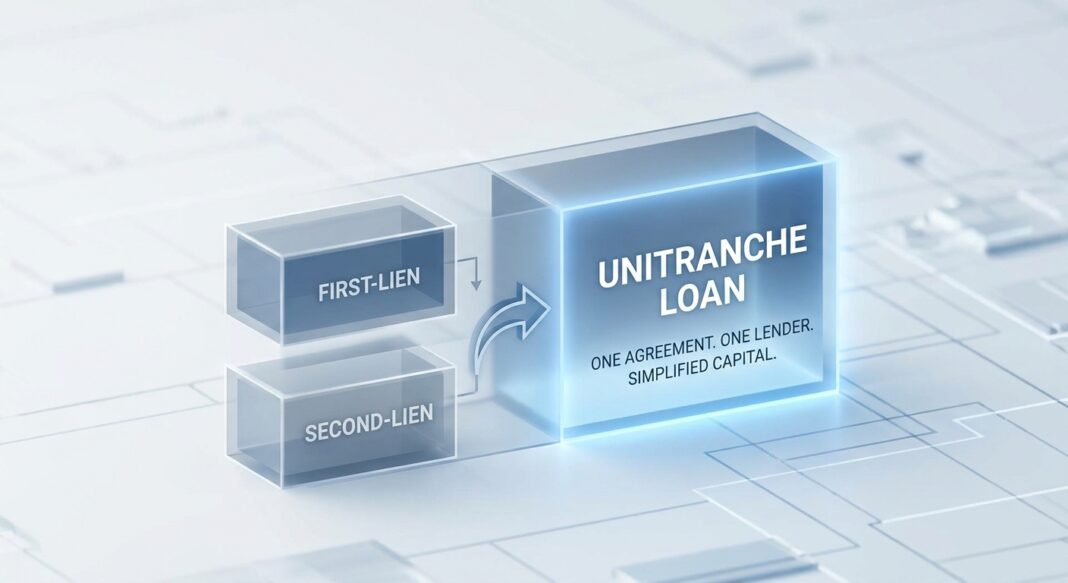
A unitranche loan is a single secured term loan that combines what would traditionally have been two or more separate debt instruments — typically a first-lien senior loan and a second-lien or mezzanine loan — into one facility governed by a single credit agreement. As described in SEC filings from multiple Business Development Companies (BDCs), unitranche structures combine characteristics of first-lien senior secured debt with elements of second-lien and subordinated loans, delivering a blended pricing structure to the borrower.
The key mechanical innovation is the Agreement Among Lenders (AAL). When multiple lenders participate, the AAL sits behind the scenes and divides the single loan into a first-out sleeve (senior economics, lower rate) and a last-out sleeve (subordinate economics, higher rate). The borrower sees one loan. The lenders settle priority, payment waterfalls, and voting rights privately through the AAL. A straight unitranche held by one fund has no internal split at all — one lender, one rate, maximum simplicity.
Relative to a first-lien plus second-lien structure, unitranche compresses documentation, removes intercreditor negotiations, and creates a single enforcement path if the borrower defaults. All recoveries flow through one lien rather than through competing security interests, which materially simplifies workouts.
How It Works: A Concrete Example With Numbers
Consider a private equity sponsor acquiring a software business with $10 million of EBITDA at a 10x purchase price — a $100 million enterprise value. The sponsor contributes $45 million in equity (45% of the capital structure) and needs $55 million in debt financing.
Traditional Two-Tranche Structure:
- First-Lien Loan: $35 million at SOFR + 400 bps (~8.7% all-in)
- Second-Lien Loan: $20 million at SOFR + 800 bps (~12.7% all-in)
- Two credit agreements, two lien packages, one intercreditor agreement
- Blended cost on $55M: approximately 10.2%
- Timeline to close: 8–12 weeks
Unitranche Structure:
- Unitranche Loan: $55 million at SOFR + 525 bps (~9.25% all-in)
- One credit agreement, one lien, one administrative agent
- Blended cost on $55M: approximately 9.25%
- Timeline to close: 4–6 weeks
The borrower saves roughly 95 basis points of annual interest cost — approximately $522,000 per year on the $55 million facility — while also gaining speed. The lender earns a rate that reflects a blend of first-lien and second-lien risk. Neither party is disadvantaged; the structure simply eliminates friction and cost from a multi-party coordination problem.
The tradeoff: the unitranche lender holds the full exposure. There is no second-lien lender to absorb losses below the first-lien waterfall. The lender must underwrite the entire credit, including the subordinated risk embedded in the last-out sleeve, and price accordingly.
Current Market Relevance: Where Unitranche Sits in 2026
Unitranche is not an emerging structure — it is now the default instrument for middle-market private credit transactions. The data confirm this dominance.
According to Valuation Research Corporation’s Q2 2026 Private Markets Trends Report, unitranche structures continue to dominate new issuance, with coupon spreads generally ranging from 4.75% to 5.50% in the second quarter of 2026 — approximately 25 basis points above year-end 2025 levels. The same report shows overall unitranche yields ranging between approximately 9.00% and 9.75%, representing a decline of roughly 250 basis points from late-2023 peak levels of 11.5%–12.5%, while remaining above the pre-2022 historical range of 7%–8%.
According to Credit Benchmark’s 2026 Private Credit Funds Review, median gross loan spreads across a sample of 6,450 loans have narrowed to the 4%–5% range, down from 5%–6% a year prior, even as more than 15% of loans in the sample now carry rates above 8% — reflecting increased use of PIK provisions in more stressed credits.
The bank lending environment continues to push borrowers toward private credit structures. According to the Federal Reserve’s April 2026 SLOOS, banks reported tighter lending standards for commercial and industrial loans during Q1 2026, with a notable net share also tightening standards and terms on loans to non-depository financial institutions — including higher risk premiums, stricter covenants, and shorter maturities. The FRED SLOOS data series shows the net percentage of large banks tightening C&I standards rose to 10.0% in Q2 2026, up from -5.3% in Q1 2026, signaling renewed caution in traditional lending channels.
The macro context reinforces unitranche demand. According to CTA Acquisitions citing Preqin’s 2026 Global Alternatives Report, global private credit AUM reached approximately $1.7 trillion at the start of 2026, up from $970 billion in 2019. Preqin’s 2026 Private Markets in North America report notes that private credit has been scaling as a core source of capital with renewed momentum in 2026, and projects the asset class to more than double to $4.5 trillion by 2030.
| Metric | Value | Source |
|---|---|---|
| Unitranche coupon spread range (Q2 2026) | SOFR + 4.75%–5.50% | VRC Q2 2026 |
| Unitranche all-in yield range (Q2 2026) | 9.00%–9.75% | VRC Q2 2026 |
| Median private credit loan spread (2026) | 4%–5% over SOFR | Credit Benchmark 2026 |
| Net % of large banks tightening C&I standards (Q2 2026) | 10.0% | FRED / Federal Reserve SLOOS |
| Global private credit AUM (start of 2026) | ~$1.7 trillion | Preqin via CTA Acquisitions 2026 |
Decision Framework: Investors and Operators
For Investors Evaluating Unitranche Exposure:
- Understand your sleeve. Investors in a direct lending fund holding unitranche loans should ask whether they hold first-out or last-out exposure. A fund that retains last-out positions carries subordinated credit risk despite technically holding a first-lien instrument.
- Scrutinize leverage multiples. According to Coyote Wealth’s 2026 Direct Lending Guide, typical middle-market unitranche facilities are sized at 4.0x–5.5x EBITDA. Higher leverage means a thinner equity cushion absorbing losses before the loan is impaired — a critical risk variable.
- Assess covenant protections. Unitranche loans typically carry one or two maintenance covenants (commonly a leverage covenant and an interest coverage test). Investors should evaluate how tightly these are set and whether the manager actively enforces them or waives them under pressure.
- Compare blended yield to public alternatives. According to Callan’s 2Q25 Private Credit Analysis, private credit has outperformed leveraged loans and high yield over the 5-, 10-, and 20-year periods, with a net IRR of 8.6% over the past decade — but spread compression in 2025–2026 warrants reassessment of the risk/return premium relative to broadly syndicated alternatives.
For Operators Evaluating Unitranche Financing:
- Speed matters more than price in M&A contexts. When acquisition exclusivity periods are tight, the ability to close a unitranche in 4–6 weeks versus 10–12 weeks for a syndicated deal can be the deciding factor. Operators should quantify what a failed deal costs versus the incremental interest on a unitranche.
- Model the full cost of capital. Unitranche rates in 2026 sit in the 9%–10% range all-in. Operators should stress-test coverage ratios at current rates and under a scenario where SOFR moves higher — unitranche loans are floating rate instruments.
- Negotiate covenant headroom carefully. Maintenance covenants in unitranche facilities are negotiated, not standardized. Operators with seasonal cash flow patterns or integration-related EBITDA dips should negotiate appropriate headroom before signing.
Key Takeaways
- Unitranche is now the standard. A single-lender, single-document structure has replaced the traditional multi-tranche capital stack as the dominant instrument in middle-market private credit, combining the senior and subordinate layers into one blended-rate facility.
- Pricing in 2026 ranges from 9%–9.75% all-in. Spreads have compressed roughly 250 basis points from 2023 peaks but remain well above pre-2022 levels, reflecting a structurally elevated base rate environment via Term SOFR.
- Bank retrenchment sustains demand. With the Federal Reserve’s SLOOS showing renewed C&I lending tightening in Q2 2026, private unitranche lenders continue to fill the gap left by traditional banks — particularly for leveraged and sponsor-backed borrowers.
- First-out versus last-out risk is not cosmetic. Investors must understand which sleeve of a unitranche facility their fund holds. Last-out exposure carries meaningfully higher loss-given-default risk than first-out, even though both appear as first-lien senior secured in portfolio disclosures.
- Operators should evaluate the full cost, not just the headline rate. OID, closing fees, undrawn revolver commitments, and covenant structures are all negotiable terms that affect the true economics of a unitranche facility and should be modeled holistically before execution.


