
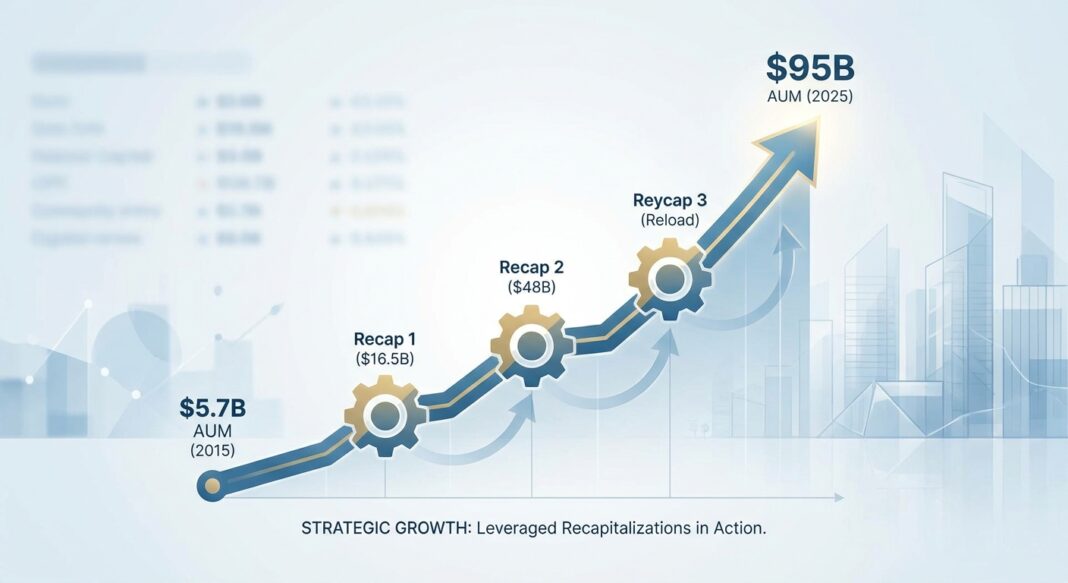
The Story: A Denver RIA That Chose the Recap Path — Three Times
In 1985, a tax attorney named Kendrick Mercer founded a small wealth management firm in Santa Barbara, California. His mission was modest and precise: help families — mostly self-employed dentists at first — achieve financial freedom. Four decades later, that firm, Mercer Advisors, oversees $95 billion in assets across more than 110 offices nationwide. It never went public. Its founders were never forced into a full sale. And it got there by mastering one of the most underappreciated tools in private capital: the leveraged recapitalization.
The story of Mercer Advisors is not a story about venture capital chasing a unicorn. It is a story about how carefully structured capital events — each one a deliberate reset of the ownership stack — can fund explosive growth while preserving continuity, culture, and optionality for the people who built the business.
By 2015, Mercer was managing roughly $5.7 billion in AUM. A good business. A profitable one. But fragmented wealth management was consolidating fast, and the firm’s leadership understood that organic growth alone would leave them behind. The choice in front of them was the one every successful founder eventually faces: Sell the whole thing and walk away, or find a capital structure that lets you keep playing — and playing to win.
They chose the recap path. And then they chose it again. And then again.
The Decision: Three Recapitalizations, One Strategic Thread
The mechanics of a leveraged recapitalization are elegantly simple: a company raises new capital — typically a blend of private equity equity investment and debt — to restructure its ownership without a full change of control. Existing shareholders can take some liquidity off the table. New capital enters to fund growth. The business continues. No one has to sell everything.
For Mercer Advisors, the first major inflection came in 2015, when Genstar Capital took a majority stake in the firm when it managed less than $5.7 billion in AUM. That wasn’t an exit — it was an acceleration. By 2019, Mercer had grown to $16.5 billion in AUM, and a second recapitalization brought in Oak Hill Capital, which acquired a stake from existing investors Genstar and Lovell Minnick Partners. The transaction provided, as Willkie Farr noted in its deal announcement, “significant additional capital to support investments in the expanding client offering and Mercer’s momentum as a leading RIA platform,” while Genstar stayed in as a strategic partner.
Then came the third act. In June 2023, with AUM at $48 billion, Mercer executed a third recapitalization — this time bringing in Altas Partners alongside Genstar and Oak Hill. The deal raised more than $1 billion in common equity and pushed the firm’s valuation north of $3 billion. Moelis & Company served as advisor on the transaction. Three PE firms now held roughly equal stakes. More than 300 employees carried equity in the company. The firm was not for sale — it was reloading.
Each recap accomplished two things simultaneously: it provided partial liquidity to earlier investors (creating realized returns without forcing a full exit), and it injected new growth capital into the acquisition engine that would drive Mercer’s next chapter. The debt component of each structure gave the platform leverage to move faster on bolt-on acquisitions than any equity-only model could.
The Outcome: $5.7B to $95B in a Decade — Fueled by Structured Capital
The numbers tell the story cleanly. Mercer Advisors grew from $5.7 billion AUM in 2015 to over $95 billion by late 2025 — a 16x increase in a decade. By the time of its 2023 recapitalization, the firm had completed 96 acquisitions. The M&A engine never stopped. Even into 2025 and 2026, Mercer was acquiring firms at pace — Beach Freeman Lim & Cleland, Long Run Wealth Advisors, Glass Jacobson Wealth Advisors — each deal adding hundreds of millions to billions in AUM.
CEO Dave Welling, speaking around the time of the 2023 Altas recapitalization, captured the logic precisely: “We’re at $50 billion today; we were at about $8 billion when I joined in 2017; but we’re by no means done.” He noted that the capital not going toward liquidity was being reinvested into client services, organic growth, and M&A — in that order.
Now consider the counterfactual. Had Mercer sold outright in 2015 — a clean exit at whatever multiple a strategic buyer might have offered for a $5.7 billion RIA — founders, early employees, and the PE partners who entered at that stage would have taken their chips and left. The company might have been absorbed into a larger financial institution, its culture diluted, its acquisition strategy subsumed into a larger corporate agenda. The $95 billion platform that exists today almost certainly would not.
The recap model also meant that employee equity participation grew with each cycle. More than 300 Mercer employees held equity in the firm by the 2023 transaction — a figure that would be impossible to replicate in a post-acquisition subsidiary structure. Alignment ran deep through the organization precisely because ownership was preserved and distributed, not liquidated.
The broader market validated the approach. Mercer’s story unfolded against a backdrop of surging recap activity: $76 billion in dividend recap loans were tracked across U.S. markets in 2024 alone — the third-highest annual total on record — as founders and PE sponsors alike discovered that structured liquidity events beat the binary of sell-or-hold.
The Lessons: What Mercer Teaches Every Growth-Stage Operator
The Mercer Advisors story is not an accident. It is a template — and a demanding one. Here is what it actually teaches:
1. The Recap Is Not a Consolation Prize — It Is a Capital Strategy
There is a persistent misconception that a recapitalization is what founders do when they can’t sell. The Mercer story inverts this entirely. Each recap was a deliberate capital event chosen over a full sale, at a moment when a full sale was absolutely available. The founders and backers were not settling — they were optimizing. They understood that the business had more value to create, and that handing over full control in exchange for a one-time liquidity event would destroy the compounding they had spent years building.
2. Partial Liquidity Is Real Liquidity
One of the most important features of the leveraged recap structure is what EMB Advisory describes as the ability for shareholders to “capitalize on the equity value of their company while retaining equity ownership.” Early investors in Mercer — including Lovell Minnick Partners, which exited its position in the 2019 transaction — realized returns without the firm needing to be sold. That is a structurally superior outcome versus the binary of IPO-or-nothing that plagues many PE-backed platforms.
3. Recurring Revenue Is the Prerequisite
Mercer’s recap strategy worked because the business generated predictable, recurring fee revenue from AUM — a profile that lenders can underwrite with confidence and PE sponsors can value with clarity. This is not a playbook for unpredictable or pre-revenue businesses. As the market has consistently shown, lower middle market leveraged recapitalizations typically close at 3x to 5x EBITDA in total debt, and staying within serviceable leverage ratios is the discipline that separates successful transactions from distressed ones. Debt service requires cash flow. Period.
4. Culture Compounds When Equity Is Preserved
Mercer’s decision to push equity ownership to 300+ employees was not altruism — it was architecture. When employees are owners, retention improves, service quality improves, and the acquisition integration process is smoother because the people executing it have skin in the game. A full sale destroys this structure by definition. The recap preserves it.
5. The Private Credit Window Is Open — and Getting More Founder-Friendly
The macro environment has shifted materially in favor of this kind of strategy. The private credit market, estimated at $1.5 trillion in early 2024, is projected to reach $2.8 trillion by 2028. Non-sponsor direct lending went mainstream in 2025, with founder-owned companies driving growth in bespoke structures including delayed-draw term loans, hybrid overlays, and asset-based facilities. Founders are no longer forced to choose between bank lines and institutional equity. A third path — private credit on genuinely competitive terms — now sits squarely in the middle.
Cohesity’s story echoes this principle at the venture stage. In late 2024, the AI-powered data security company completed its combination with Veritas’ enterprise data protection business — a transaction funded through a combination of its Series H equity round led by Haveli Investments and a Term Loan B facility arranged by JPMorgan. The result: Cohesity became the world’s largest data protection software provider by market share, serving over 12,000 enterprise customers, with pro forma ARR of $1.5 billion and a 28% adjusted cash EBITDA margin — without surrendering the cap table to a new equity round alone. When cash flows are durable and a strategic acquisition is transformative, debt is the instrument of choice.
The Framework: Is a Leveraged Recap Right for Your Business?
The Mercer model works under a specific set of conditions. Before pursuing a recap structure, operators should run through this diagnostic:
- Recurring or highly predictable revenue? Debt service is non-negotiable. Subscription, AUM-based, or long-term contract revenue is ideal.
- EBITDA margins that support 3x–5x leverage? That is the serviceable band for lower-middle-market recaps. Know your coverage ratio before structuring.
- Fragmented market with acquisition opportunity? The recap funds the consolidation engine. The engine requires targets. Know the addressable deal flow.
- Alignment-driven culture worth preserving? If your competitive advantage is embedded in people, a full sale destroys it. The recap protects it.
- Five-to-fifteen year runway of value creation ahead? The recap makes sense when there is clearly more to build. It is not the right tool for a business at peak value.
Key Insights
- The serial recap is a legitimate growth strategy, not a fallback. Mercer Advisors used three successive recapitalizations to grow from $5.7B to $95B in AUM over a decade — choosing structured capital over a full exit at every inflection point.
- Partial liquidity is powerful. Each recap allowed earlier investors to realize returns without triggering a full exit event, preserving the platform’s growth trajectory and culture while rewarding capital that had been at risk.
- Employee equity at scale is a retention and integration weapon. Over 300 Mercer employees held equity in the 2023 recapitalization — a structure impossible to replicate once a firm is absorbed into a strategic acquirer.
- Private credit has matured into a third path. With the U.S. direct lending market hitting $380 billion in 2025 and non-sponsor lending going mainstream, founder-owned companies now have access to institutional capital without surrendering board seats or exit timelines.
- Debt used offensively — not defensively — is the distinction. Cohesity’s $3.1B debt financing in 2024 and Mercer’s billion-dollar recaps were not rescue operations. They were capital deployments by companies with durable cash flows, clear strategic rationale, and the discipline to keep leverage serviceable.


