
The Story: Twenty Years, One Decision
Dusty DeVore spent two decades building something real. Core Roofing Systems, founded in 2002 and headquartered in Alpharetta, Georgia, grew into one of the Southeast’s leading commercial roofing service providers — covering re-roofing, maintenance, repair, inspection, and new construction across eight states. By the time 2022 arrived, the company employed more than 180 people and carried a reputation built on long-term relationships with customers, suppliers, and regional communities.
That kind of track record tends to attract attention. And it tends to create a specific, uncomfortable tension that every founder eventually confronts: your company is worth a lot of money on paper, but almost all of your real net worth is locked inside a single illiquid asset that you still show up to run every morning.
DeVore’s business was growing. His team was performing. His pipeline was deep. But two decades of equity creation had not translated into personal financial security in any conventional sense. Every dollar of enterprise value lived inside Core Roofing’s balance sheet — not outside it. A down year, a key customer departure, or a market dislocation could erode years of value before any distribution was ever made.
This is not an unusual position for a founder at the lower middle market. It is, in fact, the defining tension of operator-owned businesses — and the question of how to resolve it without wrecking what you’ve built is one of the most consequential capital decisions a founder will ever make.
The Decision: Three Roads, One Right Answer
In late 2022, DeVore had three realistic options.
Option 1: Full Sale. Hire a banker, run a competitive process, take the highest bid, and exit. This path maximizes headline valuation and eliminates concentration risk in a single transaction. It also ends the story. The founder takes one check. The strategic upside — the platform acquisitions, the national expansion, the value creation DeVore had spent years positioning the company to capture — goes to whoever buys it.
Option 2: Growth Equity. Raise a minority equity round from an institutional investor, dilute meaningfully, and retain operating control while bringing in capital to accelerate growth. This preserves operational continuity but comes with a familiar cost: permanent dilution, investor board seats, preference stack complications, and a partner whose incentives may not align with a long-horizon operator.
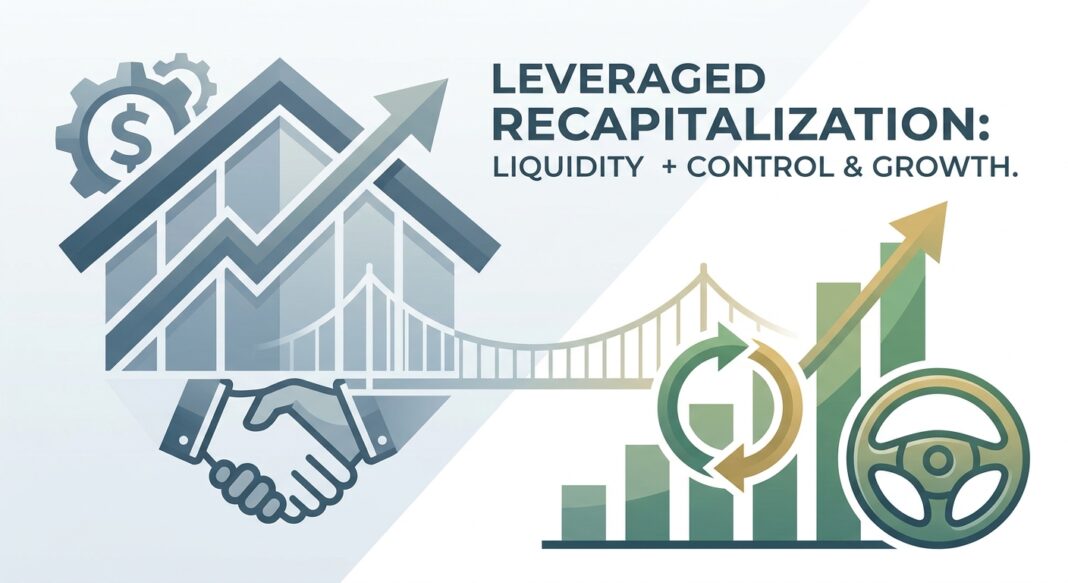
Option 3: Leveraged Recapitalization. Take on structured debt alongside a PE partner, extract partial liquidity now, retain a significant equity stake, and continue running the business through a defined growth cycle — positioning for a larger second exit later.
DeVore chose the third path. In November 2022, he partnered with Shoreline Equity Partners, a Jacksonville-based lower middle market PE firm that targets profitable enterprises valued between $25 million and $250 million, investing out of an inaugural $300 million fund. Shoreline made a recapitalization investment structured to fund both organic growth and an active acquisition program — while DeVore retained a significant ownership stake and remained in the CEO seat.
The structure achieved what a full sale never could: partial liquidity today, preserved upside tomorrow, and continued operational control throughout. As Sofer Advisors describes the mechanics, a leveraged recapitalization is a transaction in which an owner “receives cash without selling the business outright, while retaining operational control and a continuing equity stake.” The debt goes on the company’s balance sheet. The liquidity goes to the founder.
According to the Pepperdine Private Capital Markets Report (2024), lower middle market leveraged recapitalizations typically close at 3x to 5x EBITDA in total debt — with pricing tied to prevailing senior secured rates plus a risk-adjusted margin. For a business with strong recurring revenue and a multi-state customer base, Core Roofing fit the profile precisely.
The Outcome: Platform, Not Just Payout
What happened after the recap is where the story gets genuinely instructive.
Core Roofing did not simply bank the liquidity and maintain its prior trajectory. The recapitalization created the structural conditions for an accelerated acquisition strategy — one that a bootstrap operator with no institutional capital could not have executed at the same pace or scale.
The results were visible in public deal announcements. In September 2023, Core Roofing partnered with McCurdy-Walden, Inc., a 37-year-old commercial roofing firm headquartered in Jacksonville, Florida, extending Core’s reach into the Greater Jacksonville market. Then came Norman Roofing, extending the platform into the Gulf Coast region — Core’s third acquisition since the November 2022 recapitalization. Later, a partnership with Peck Brothers, LLC (PB Roofing) pushed the platform into the Northeast and Mid-Atlantic, with PB Roofing’s management reinvesting a meaningful portion of proceeds — a direct signal of operator confidence in the platform thesis.
By the time these deals were announced publicly, Core Roofing had grown to more than 285 employees and had transformed from a strong regional operator into a multi-regional commercial roofing platform with a proven acquisition playbook.
The counterfactual matters here. A founder who sells outright in Year 1 collects one check — likely at a multiple reflecting the business’s value at that single moment in time. DeVore’s retained equity stake, by contrast, is now priced against the value of a national platform with institutional infrastructure, a multi-regional footprint, and a demonstrated ability to integrate acquisitions. That is a meaningfully different asset than what existed in November 2022 — and it is an asset he still owns.
As Bond Capital’s editorial desk noted previously: “The founder who takes partial liquidity and retains meaningful equity through a growth cycle may receive a far larger total payout across two events — with full operational control of the value creation between them.”
The Lessons: What the Core Roofing Story Really Teaches
1. Liquidity and ownership are not a binary trade-off.
The dominant narrative in founder finance frames the choice as sell vs. hold. The leveraged recapitalization breaks that binary. A well-structured recap allows an owner to extract real, diversified wealth today while retaining meaningful upside exposure to the company’s next chapter. These outcomes are not mutually exclusive — they are sequential.
2. Debt deployed for growth is categorically different from debt deployed to cash out an exiting owner.
The Core Roofing recap was not structured to maximize the payout at close. The leverage was put to work for platform acquisitions, organic expansion, and institutional infrastructure — with DeVore still in the seat executing the plan. That alignment is the difference between a growth-oriented recap and a financial engineering exercise that saddles a business with debt service while leadership walks out the door.
3. Partner selection is a structural decision, not just a relationship one.
DeVore explicitly cited values alignment as his defining criterion when selecting Shoreline. Shoreline’s stated philosophy centers on “honesty, incentive alignment, and creating bigger, better businesses without relying on financial engineering or cost cutting to generate returns.” A misaligned sponsor imposes a hidden cost that no term sheet line item captures: it erodes the founder’s operating authority at precisely the moment that authority is most valuable.
4. This market is bigger than it looks.
Core Roofing’s story is not a niche outlier — it sits inside a massive and accelerating market trend. According to PitchBook LCD data, leveraged loan issuance tied to sponsored dividend recapitalizations grew 11% year-over-year to $74.3 billion in 2025 — itself following a 326% surge in 2024. The full-year 2025 dividend recap total was the highest annual figure on record. The mechanism is mainstream. The question is not whether recaps are a viable path — it is whether a given founder’s business and risk profile make it the right one.
5. The framework for evaluating a recap is built on four questions.
Founders considering a leveraged recapitalization should interrogate four variables before engaging an advisor or running a process:
- Cash flow quality: Does the business generate stable, predictable EBITDA that can service structured debt without operational strain? Private credit providers underwrite against recurring revenue and contracted cash flow visibility — irregular cash flows or long sales cycles tighten available terms significantly.
- Growth thesis: Is there a credible platform strategy — acquisition targets, organic expansion vectors, or margin improvement levers — that structural capital can accelerate? Without a growth thesis, leverage creates risk without commensurate upside.
- Sponsor alignment: Is the PE partner’s investment thesis, hold period, and operational philosophy genuinely compatible with the founder’s vision? The answer to this question determines whether the retained equity stake compounds or gets compromised.
- Personal financial objectives: What does the founder actually need from a liquidity event today? Research on operator behavior suggests that founders with meaningful personal financial security make fewer reactive decisions in downturns — the partial liquidity from a recap is not just a wealth event, it is a decision-quality investment.
Key Insights
- The recap is a partial exit and a growth catalyst simultaneously. Dusty DeVore unlocked personal liquidity in 2022 and used the same transaction to fund three acquisitions and a multi-regional expansion — outcomes that a full sale would have handed entirely to the buyer.
- Retained equity compounds differently than exit equity. The value of DeVore’s remaining stake is benchmarked against a national platform with institutional infrastructure — not the regional operator that entered the 2022 recap. The second check is written against a fundamentally different asset.
- The leveraged recap market is at historic scale. Full-year 2025 sponsored dividend recap volume hit a post-GFC record, with PE-backed companies borrowing roughly $94 billion in leveraged loans and high-yield bonds to fund owner distributions, according to Moody’s. This is no longer an alternative path — it is the primary liquidity mechanism in a constrained exit environment.
- Debt used to grow is not the same risk as debt used to extract. The risk profile of the Core Roofing structure — leverage funding acquisitions with an operating founder still driving execution — is categorically lower than leverage applied to a business where the operator has already cashed out and walked away.
- Alignment selection is the single most important variable. Term sheets are negotiable. Hold periods are negotiable. Valuation multiples are negotiable. The values and operating philosophy of the partner sitting across from you at the board table for the next five years are not. Choose accordingly.


