
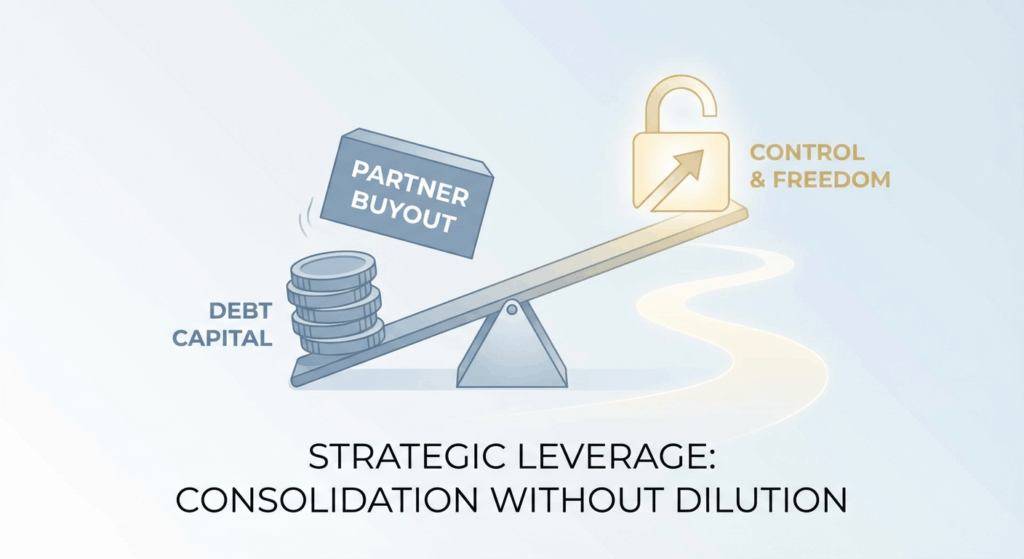
The “Partner Problem” and the $5 Million Solution
For many founders, the existential threat to their business isn't a competitor or a market crash—it's an internal misalignment. One partner wants to double down on growth; the other wants to buy a house in Cabo and retire.
This friction often triggers a premature sale. Investment bankers will argue that the cleanest solution is to sell the whole company to Private Equity, giving everyone liquidity but stripping the operating founder of control.
However, recent market activity highlights a third path: the leveraged recapitalization.
A case study published in late February 2026 involving a building products manufacturer serves as a prime example of how debt can be used not just for growth, but for governance—buying out a departing partner to consolidate control without selling a single share of equity.
The Scenario: Growth vs. Liquidity
The company, a mid-market manufacturer of building products, was at an inflection point. Following an acquisition in 2023, the business had secured a pipeline of high-value contracts, including a major luxury condominium development slated for imminent construction.
The tension was classic: The business needed to reinvest cash to fulfill these massive orders. Simultaneously, one of the acquisition partners wanted to exit.
According to the deal details released by Fora Financial, the remaining owners were stuck. They couldn't access a new Asset-Based Lending (ABL) facility—essential for working capital—until the ownership structure was cleaned up. The departing partner’s stake was the bottleneck.
The Decision: Equity vs. Debt
The operators faced a binary choice familiar to many in the middle market:
- Option A (Equity/Sale): Bring in an outside equity investor or a PE firm to buy the partner's stake.
Cost: Permanent dilution, loss of autonomy, and a new boss at the board meeting. - Option B (Debt Recap): Borrow against the company’s future cash flows to buy out the partner.
Cost: Interest payments and leverage on the balance sheet.
They chose Option B. The math suggested that the cost of debt service was significantly lower than the long-term cost of giving up 20–30% of the capitalization table to a new equity partner.
The company structured a $5 million capital injection. This wasn’t standard bank financing, which typically moves too slowly for a partner dispute or a time-sensitive buyout. The deal was structured to move at the speed of the opportunity.
The Outcome
The speed of execution was the critical variable. Within 48 hours of the initial package, the financing partner approved $5 million in non-dilutive debt.
The capital was deployed in two tranches to match the deal dynamics:
- $600,000 immediately to initiate the buyout process and bind the agreement.
- $4.4 million five days later to close the partner exit and consolidate ownership.
The ROI of Control:
By removing the misalignment, the remaining owners achieved three things that equity financing would have complicated:
- Total Control: They consolidated 100% of the decision-making power.
- Unlocked Working Capital: Cleaning up the cap table satisfied the requirements for a separate ABL facility, providing the liquidity needed for the luxury condo project.
- Equity Preservation: When the company eventually exits, the remaining founders will capture the full upside of the growth they are currently engineering, rather than splitting it with a PE sponsor who entered in 2026.
Broader Lessons: When to Use Leverage for Buyouts
This manufacturing case study mirrors the logic seen in software sectors, where founders are increasingly wary of dilution. For example, retail sales platform Myagi utilized non-dilutive capital to bridge itself to an acquisition. As noted in a retrospective on the deal, the company used a $2.5 million facility to fuel growth in 2021, leading eventually to a strategic acquisition by Rallyware rather than a desperate fundraising round.
The principle holds across industries: Debt is rental capital; Equity is ownership capital.
For founders facing a “Partner Problem,” leverage offers a mechanism to solve a governance issue without altering the company’s DNA. If the business has predictable cash flows (like a manufacturer with a signed contract pipeline), those cash flows can often “buy” the company back for the remaining operators.
Framework for the Decision
Before choosing a debt recap over a PE buyout, ask:
- Is the liquidity need temporary or permanent? Buying out a partner is a one-time cash event. Paying for it with permanent equity is often the most expensive way to solve a temporary problem.
- Can the cash flows service the “rental”? In the building products case, the new contracts provided clear visibility on revenue to service the $5M debt.
- Does consolidating control unlock value? If removing a partner allows you to move faster or unlock cheaper working capital (like the ABL facility), the leverage pays for itself.


