
The Story: Twelve Years In, and Not a Dollar to Show for It
By 2024, Marcus Holden had built something rare. His Houston-based B2B logistics software company, FreightAxis, was generating $18M in annual recurring revenue, growing at 22% year-over-year, and carrying EBITDA margins north of 38%. He had never taken a dollar of outside capital. He owned 100% of the company. And he was, by every conventional measure, broke.
Not broke in the literal sense. FreightAxis was worth somewhere between $90M and $110M depending on the comp set you used. But Marcus’s net worth existed entirely on paper — locked inside a private company with no liquidity event on the horizon. His house was mortgaged. His investment accounts were thin. His wife had quietly started asking questions about retirement timelines. At 51, Marcus was asset-rich and cash-poor in a way that felt increasingly unsustainable.
He’d had three inbound acquisition approaches in the prior 18 months — two from mid-market PE shops and one from a strategic acquirer. Each conversation followed the same arc: the buyer would get excited about the recurring revenue, the retention rates (net revenue retention sat at 118%), and the defensible niche. Then they’d table an offer. Then they’d want control. Then they’d want Marcus to roll 20–30% of his equity back in at a valuation Marcus considered a discount to his own long-term view of the business. Every conversation ended the same way — with Marcus walking away.
He wasn’t ready to sell. But he desperately needed liquidity. That tension is where his capital story begins.
The Decision: Three Paths, One Clear Winner
Marcus’s M&A attorney introduced him to the concept of a leveraged recapitalization — a transaction structure in which a company borrows against its cash flows, and the proceeds are distributed to existing shareholders as a dividend or share redemption. No new equity is issued. No shares change hands. No board seats are surrendered.
His options, laid out side by side, told a stark story:
- Option A — Sell to PE: Accept a $95M acquisition offer. Roll 25% of proceeds back into the new PE-controlled entity. Walk away with approximately $71M pre-tax, but give up the company and the upside.
- Option B — Raise a Growth Equity Round: Bring in a minority investor at a $90M pre-money valuation, sell 20% for $18M. Retain 80% ownership but give up a board seat and accept liquidation preferences, drag-along rights, and a five-to-seven year exit pressure clock.
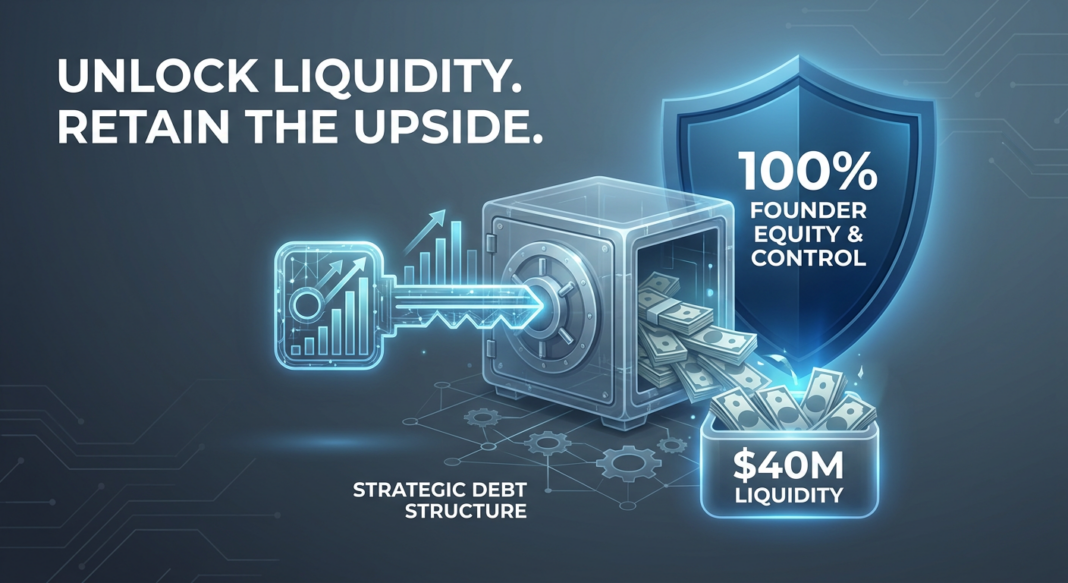
- Option C — Leveraged Recapitalization via Private Credit: Borrow 3.5x EBITDA (approximately $24M, with FreightAxis generating ~$6.8M EBITDA at the time) from a direct lending fund at SOFR + 575 basis points (approximately 10.9% all-in as of mid-2024). Layer in a second-lien tranche for an additional $16M. Total raise: $40M. Distribute $38M to Marcus as a dividend (after transaction costs). Keep 100% of the equity. Keep all board seats. Keep all upside.
The annual debt service on $40M at blended rates came to roughly $4.4M — comfortably covered by FreightAxis’s $6.8M EBITDA, leaving a debt service coverage ratio of approximately 1.55x. Tight, but executable for a business with sticky SaaS-like recurring revenue and minimal capital expenditure requirements. Marcus chose Option C.
The Outcome: Liquidity, Leverage, and the Long Game
Eighteen months after closing the recap, FreightAxis’s ARR had grown to $22.4M — a 24% increase driven in part by two bolt-on feature expansions Marcus had been planning for years but hadn’t prioritized under the psychological weight of feeling illiquid. The EBITDA margin compressed modestly to 34% as the company invested in a new enterprise sales team, but absolute EBITDA grew to approximately $7.6M, improving the coverage ratio to 1.73x and reducing the effective leverage multiple from 3.5x to approximately 2.9x on a trailing basis.
Marcus had deposited $38M into a diversified investment portfolio. He had paid off his mortgage. His retirement question was answered. And he still owned every share of a company now worth, by most comp analyses, north of $120M.
Compare that to Option A: had he sold to PE and rolled 25% back in, his liquid proceeds would have been approximately $71M — but his remaining 25% stake in the PE-backed entity would have been subject to a new capital structure, management fees, and the expectation of a sale within five to seven years, likely at a valuation driven by the PE fund’s return requirements rather than Marcus’s view of long-term value. The compounding ownership he preserved under Option C — in a business he believes could reach $200M+ in enterprise value within five years — represents tens of millions in preserved upside that no acquisition offer could have replicated.
Note: FreightAxis is a hypothetical scenario constructed to illustrate the mechanics of a leveraged recapitalization. Financial metrics are modeled on realistic 2024 private credit market conditions and mid-market software company benchmarks.
The Lessons: When a Leveraged Recap Is the Right Move
The FreightAxis story isn’t a fairy tale about debt being riskless. It’s a story about matching the financing instrument to the founder’s actual problem. Marcus didn’t need growth capital. He needed personal liquidity. Those are different problems that require different solutions — and most founders make the mistake of reaching for equity financing when what they really need is a cash extraction mechanism.
A leveraged recapitalization works best when four conditions are met:
- Stable, Predictable Cash Flows: Lenders underwrite debt service coverage. Businesses with recurring revenue, high retention, and low customer concentration are ideal candidates. Cyclical or project-based revenue models carry significantly higher refinancing and covenant risk.
- Moderate Existing Leverage: A company carrying 4x EBITDA in existing debt is not a recap candidate. A clean-balance-sheet founder-owned business, like FreightAxis, is the ideal starting point.
- A Founder Who Doesn’t Want to Sell — Yet: The recap buys time and liquidity simultaneously. It’s the right tool for founders who believe deeply in their long-term value creation thesis but need to solve a personal financial problem in the near term.
- Sufficient EBITDA Scale: Private credit lenders in the direct lending market are generally active at $3M EBITDA and above. Below that threshold, the deal economics rarely work for either side.
The private credit market as of early 2026 remains active and well-capitalized. According to data from Preqin and industry reporting through early 2026, direct lending AUM has crossed $1.7 trillion globally, and spread compression has made mid-market founder recaps increasingly accessible at SOFR + 475 to 600 basis points depending on business quality. The infrastructure to execute a Marcus-style recap exists at scale. The question isn’t whether the market can accommodate these deals — it’s whether founders know to ask for them.
Key Insights
- 🔑 Liquidity and exit are not the same transaction. Founders conflate the two constantly. A leveraged recap solves the liquidity problem without triggering the exit — preserving all future upside.
- 🔑 Equity dilution is permanent; debt is temporary. A 20% equity stake sold to a growth investor at $90M is gone forever. A $40M debt load at 3.5x EBITDA, in a growing business, is typically retired or refinanced within four to six years.
- 🔑 Coverage ratios matter more than leverage multiples. Lenders — and founders — should focus on DSCR (debt service coverage ratio) as the operative risk metric. A 1.5x+ DSCR on predictable recurring revenue is a fundamentally different risk profile than the same leverage on lumpy project revenue.
- 🔑 The private credit market has matured enough to serve founders, not just PE sponsors. Direct lenders have increasingly structured founder-friendly recaps without requiring equity co-investment or board participation. This is a structural shift worth understanding.
- 🔑 The real cost of equity is optionality, not dilution percentage. When founders sell equity, they don’t just give up a percentage — they give up the right to decide how and when the company is sold, at what price, and to whom. Debt preserves all of those decisions.


