
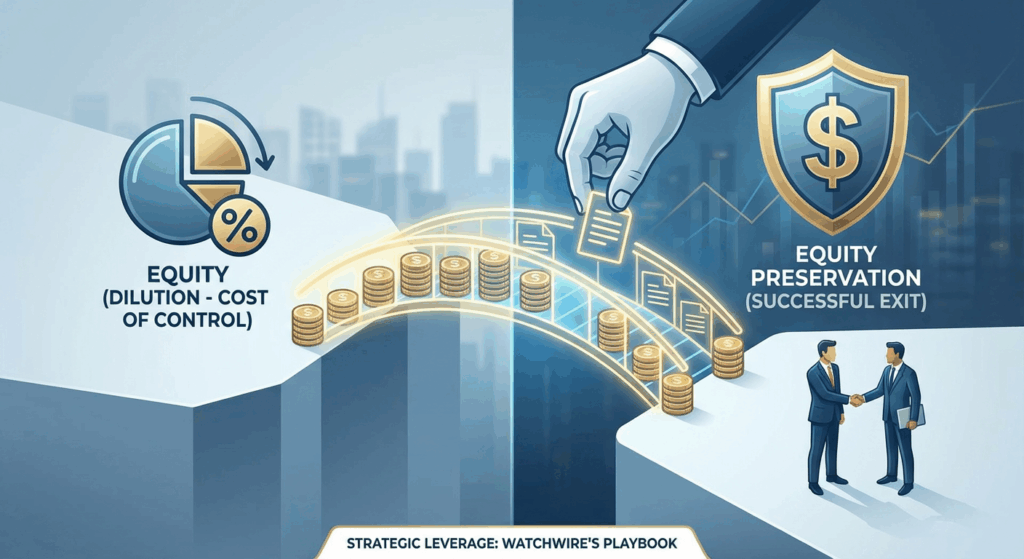
The Dilemma: Dilution vs. Destiny
In the high-octane environment of 2021, SaaS founders faced a tantalizing but dangerous problem. Valuations were soaring, and venture capital was abundant. For Andy Anderson, then-CEO of WatchWire (formerly EnergyWatch), the market signals were flashing green. The energy and sustainability management sector was heating up, and larger players were prowling for acquisitions.
The traditional playbook would have been to raise a Series B or C, dilute the cap table by 20-30%, and chase “growth at all costs” to justify the new valuation. But Anderson and his executive team had a different vision. They had already bootstrapped through a pivot from consulting to a SaaS platform, testing product-market fit without initially handing over the keys to external investors.
As detailed in a retrospective by their capital partner, TIMIA Capital, the WatchWire team wanted to capture the upside of the market momentum without suffering the dilution that usually funds it. They needed a bridge to an exit, not a marriage to a new board of directors.
The Decision: The Non-Dilutive Bridge
The capital decision WatchWire faced is one that defines the modern founder’s journey: Cost of Capital vs. Cost of Control.
Equity is expensive. It costs future profits and current control. Debt, while requiring cash flow service, is finite. Once repaid, the obligation ends, and the equity value remains with the founders.
Anderson opted for a debt facility rather than an equity round. The strategy was precise: use the capital to invest strictly in “pipeline growth”—people, processes, and technology—that would make the company attractive for a strategic acquisition within a short horizon. “Non-dilutive capital was key for us,” Anderson noted in the case study. “Even if it’s just a bridge to something bigger… [it] will help us get to the next stage without giving up more of our company.”
This parallels the strategy used by Myagi, a retail sales enablement platform. Facing a similar juncture, Myagi’s co-founder Simon Turner utilized a $2.5 million investment facility to bridge the gap between a COVID-19 induced pivot and a strategic exit. As reported in their deal retrospective, the debt allowed them to juice revenue and market position just enough to attract an acquirer (Rallyware) without bringing in a heavy-handed VC partner late in the game.
The Outcome: Selling on Their Terms
For WatchWire, the bet paid off. By sticking to their roadmap and using debt to fuel targeted growth rather than speculative moonshots, they solidified their leadership in carbon accounting and energy management. In 2023, just two years after securing the debt facility, WatchWire was acquired by Tango Analytics, a portfolio company of Berkshire Partners.
Because they hadn’t diluted themselves in 2021, the founders and early shareholders retained a significantly larger portion of the exit proceeds. The debt was repaid from the acquisition/cash flow, and the “equity shield” remained intact.
This stands in stark contrast to the current headlines we see today in 2026. Take Applied Digital (APLD), which recently raised massive sums—$2.15 billion in speculative-grade debt—to fund infrastructure build-outs. As noted in recent market reports, while this fuels growth, the sheer magnitude of the leverage introduces existential risk, underscored by insiders selling shares while the debt load balloons. WatchWire’s approach represents the opposite end of the spectrum: Smart Leverage. It was not a bet on infinite future capacity, but a calculated bridge to a liquidity event.
The Lessons: Constructing the Equity Shield
The WatchWire and Myagi examples illustrate a critical framework for founders today, particularly as private credit becomes more accessible than traditional VC.
- The Control Premium: Debt covenants may be strict, but they rarely demand a seat on the board. For founders looking to exit in 12-36 months, retaining voting control often matters more than interest rates.
- Unit Economics Matter: Leverage works when you are pouring fuel on a fire that is already burning efficiently. WatchWire used the cash for a proven sales pipeline. In contrast, using debt for unproven product-market fit (R&D) is often fatal.
- The “Bridge” Mindset: Founders should view debt not just as “runway” (survival) but as a “bridge” (transition). If the capital doesn’t directly correlate to a valuation step-up or an exit event, equity might be the safer (albeit more expensive) path.
Key Insights
- Dilution is Permanent: Interest payments are temporary; lost equity is gone forever.
- Alignment of Authority: Debt keeps the founder in the driver’s seat during exit negotiations, whereas VCs may block a sale to hold out for a “fund returner” valuation.
- Specific Use of Proceeds: Successful leveraged growth (like UnityLab’s 10x expansion) targets repeatable revenue activities, not speculative R&D.
- The Exit Horizon: This strategy is most effective when an exit or recapitalization is visible within 2-3 years.
- Market Timing: Raising debt when the sector is hot (like Cleantech in 2021) allows founders to leverage sector beta without selling the alpha.


