
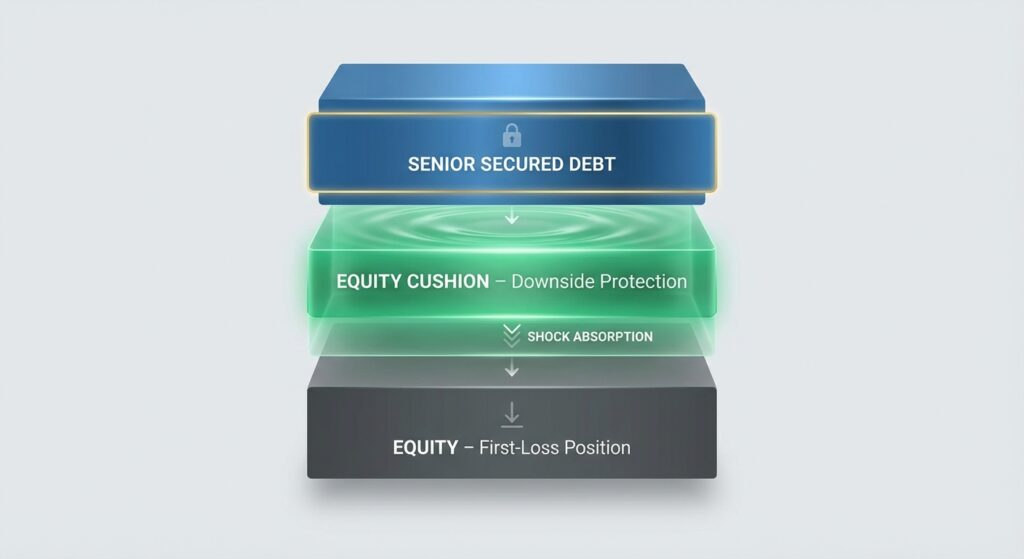
Understanding Your Place in Line: The Capital Stack and Equity Cushion
In the world of private credit, return on investment is inextricably linked to one often-overlooked concept: Priority. Whether you are an institutional investor seeking yield or a business owner seeking capital, understanding where a specific dollar sits in the “Capital Stack” is the single most important factor in assessing risk.
The capital stack serves as the blueprint for how a company is financed. It dictates who gets paid first when things go well, and more importantly, who absorbs the losses when they don’t. While public markets fixate on daily price fluctuations, private credit fundamentals focus on structural protection.
This article breaks down the mechanics of Senior Secured Debt and the Equity Cushion—the primary safeguards that define private credit’s risk-reward profile compared to traditional equity investing.
The Concept: The Waterfall and The Cushion
Imagine a company’s financial structure as a waterfall. Cash flows from operations pour over the top. The first buckets to be filled are the senior-most obligations. Only after these buckets are overflowing does any remaining capital flow down to the next tier.
In a typical private credit transaction, the structure looks like this, from top to bottom:
- Senior Secured Debt: This is the top bucket. It has the first claim on cash flows and assets. It is “secured” by collateral (inventory, receivables, intellectual property). It typically offers a floating rate coupon.
- Junior/Mezzanine Debt: Sitting in the middle, this layer takes more risk for a higher return. It only gets paid after senior debt is satisfied.
- Equity (Common & Preferred): This is the bottom bucket. Equity holders own the upside potential of the business but sit in the “first-loss” position.
The Equity Cushion is the value of the business that exceeds the debt. It acts as a shock absorber. If a business is worth $100 million and carries $40 million in debt, there is a $60 million equity cushion. The enterprise value would have to drop by more than 60% before the debt principal is at risk.
How It Works: The “TechFlow” Example
To see the mechanics of subordination and protection in action, let’s look at a hypothetical acquisition of a logistics software company, “TechFlow,” valued at $100 million.
A private equity sponsor wants to acquire TechFlow using a mix of their own cash and private credit.
The Capital Structure
- Enterpise Value (EV): $100,000,000
- Senior Secured Loan (Private Credit): $45,000,000 (45% LTV)
- Sponsor Equity: $55,000,000 (55% Equity Cushion)
Scenario A: Success (Base Case)
The company grows and is sold 5 years later for $150 million.
The Private Credit lender receives their principal back ($45M) plus the interest collected over 5 years. The Equity sponsor takes the remaining $105 million ($150M sale – $45M debt), realizing all the upside appreciation.
Scenario B: Downside Protection
The market turns, and TechFlow struggles. It is forced to liquidate or sell at a distressed price of $60 million (a 40% drop in value).
Because of Senior Priority, the Private Credit lender still receives their full $45 million principal repayment first. The risk was absorbed entirely by the Equity Cushion. The Sponsor receives only the remaining $15 million, taking a substantial loss on their initial $55 million investment.
This math explains why private credit yields (typically 8-12%) are lower than targeted equity returns (20%+): the lender trades upside participation for downside protection.
Current Market Relevance
In the current vintage of 2025-2026, the structure of these deals has evolved. Specifically, the market has seen a shift toward Unitranche financing and a focus on “Defensive Income.”
According to Blackstone’s Essentials of Private Credit, private loans are typically structured with meaningful cushions below the debt, designed to provide principal preservation. This “Defensive Income” model has become increasingly relevant as investors seek stability amidst public market volatility.
Furthermore, the NAIC 2024 Private Credit Primer notes that direct lending now accounts for approximately 40% of the U.S. private credit market. This dominance highlights that middle-market companies are bypassing banks for structures that offer certainty of execution over the lowest possible rate.
Umbrex’s Industry Primer highlights that modern “Unitranche” loans combine senior and junior tranches into a single instrument. For operators, this simplifies the capital stack—dealing with one lender group rather than separate senior and mezzanine creditors—while maintaining the same fundamental seniority protections for the lender.
Decision Framework
For Investors: Evaluating the Cushion
When reviewing a private credit opportunity, the yield is secondary to the structure. The primary question is: How thick is the equity cushion?
- Loan-to-Value (LTV): Look for LTV ratios typically between 40-60%. An LTV of 45% implies a 55% equity cushion.
- Sponsor Quality: Who owns the equity below you? A top-tier private equity firm with a history of supporting their portfolio companies adds an implicit layer of safety.
For Operators: The Cost of Dilution
Business owners often hesitate at the higher interest rates of private credit compared to bank debt. However, the decision framework should solve for Cost of Equity vs. Cost of Debt.
- Minimizing Dilution: If you need $50 million for an acquisition, raising it all as equity requires giving up significant ownership (and future upside).
- Strategic Leverage: Using senior debt allows you to retain more equity. While the interest expense is a cash cost today, it is often cheaper than the 20-30% IRR expected by equity investors.
Key Takeaways
- Seniority is Safety: Senior secured debt sits at the top of the waterfall, getting paid before any equity holder sees a dime.
- The Cushion Absorbs Shock: The equity layer below the debt acts as a first-loss tranche, protecting lenders from valuation drops.
- Trade-off Logic: Lenders accept capped upside (interest payments) in exchange for structural protection; Equity takes unlimited upside in exchange for first-loss risk.
- Unitranche Efficiency: Modern structures often blend senior and junior debt into one instrument for speed and simplicity.
- Anti-Dilution: For founders, debt is non-dilutive capital. It preserves ownership value as the enterprise grows.


