
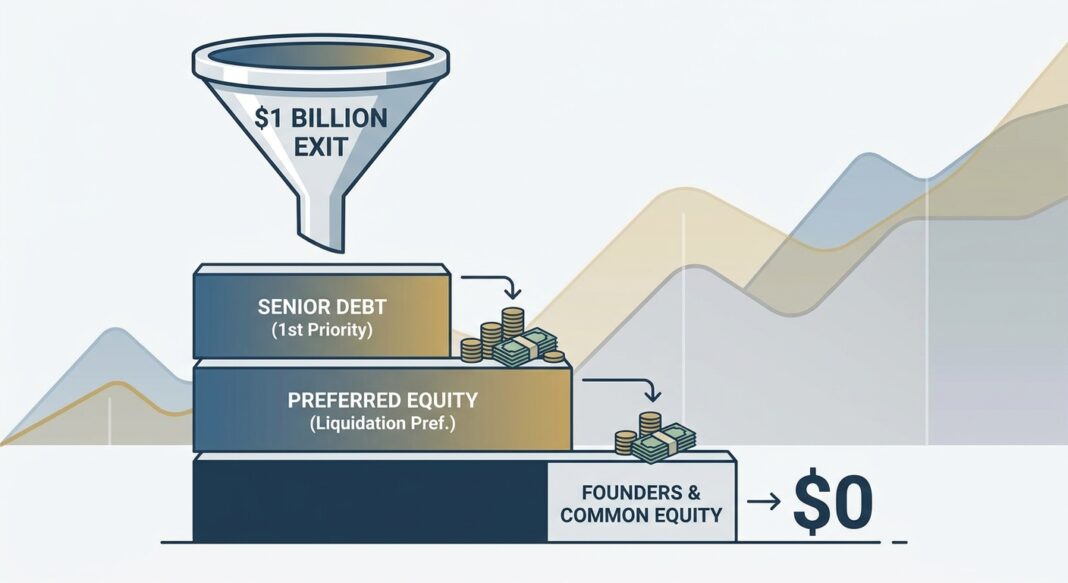
The Story: A Billion-Dollar Exit, A Zero-Dollar Check
On January 22, 2025, a letter went out to Divvy Homes shareholders. It was the kind of letter founders dread writing. CEO and co-founder Adena Hefets confirmed the news: Divvy Homes was being acquired by Maymont Homes, a division of Brookfield Properties, for approximately $1 billion. A headline number that would make any founder’s pulse quicken.
Then came the sentence no one wanted to read.
“After repaying its outstanding indebtedness, transaction costs, and liquidation preference to preferred shareholders, we unfortunately estimate that neither common shareholders nor holders of the Series FF preferred stock will receive any consideration.”
— Adena Hefets, CEO & Co-Founder, Divvy Homes (letter to shareholders, January 2025, as reported by TechCrunch)
Series FF preferred stock is the class typically awarded to founders. In plain language: the founders of a company that sold for one billion dollars received nothing. The employees who built it received nothing. Many of the investors who believed in it received nothing.
This is not a story about a failed startup. Divvy Homes was founded in 2016 and had raised over $700 million from well-known investors including Tiger Global Management and Andreessen Horowitz. It was a proptech darling at the peak of the ZIRP era, last valued at $2.3 billion in 2021. It had helped more than 2,000 families become homeowners. By most measures, it was a real business that did real things.
The outcome wasn’t caused by bad founders. It was caused by a capital structure — assembled round by round, in the heat of growth — that quietly guaranteed one particular outcome when the music stopped.
The Decision: Round by Round, the Stack Was Built
Divvy’s business model was capital-intensive by design. The company had raised more than $700 million in debt and equity from investors including Tiger Global, GGV Capital, and Andreessen Horowitz. It needed scale to win in residential real estate — and scale meant buying homes, which meant raising money aggressively and fast.
Each funding round solved an immediate problem. Divvy’s last known funding round was an August 2021 Series D of $200 million led by Tiger Global and Caffeinated Capital — announced just six months after a $110 million Series C. Each round came with preferred equity, which carries liquidation preferences. Those preferences are contractual guarantees: preferred investors get their money back first — often at 1x, sometimes with participation rights — before common shareholders or founders see a dollar.
Then, separately, in October 2021, Divvy took on roughly $735 million of debt financing to fund its home portfolio — the operational backbone of its rent-to-own model. That debt sat at the very top of the payout waterfall, senior to every equity holder including preferred investors.
The capital stack that emerged looked like this:
| Priority | Claim | Approx. Amount |
|---|---|---|
| 1st | Senior Debt Holders | ~$735M+ |
| 2nd | Transaction Costs | Estimated tens of millions |
| 3rd | Preferred Equity Liquidation Preferences (Series A–D) | Consumed remaining proceeds |
| 4th | Common Shareholders, Founders, Employees | $0 |
On paper, it was a billion-dollar acquisition. In practice, the $1 billion exit price was structurally below the total claims against it before founders and employees could receive a cent. Common shareholders and holders of Series FF preferred stock — the class typically awarded to founders — were not expected to receive consideration from the sale.
The structure wasn’t reckless or unusual for a VC-backed company of its era. It was the logical, compounding result of solving each capital need with the most available instrument — without designing the capital stack around the exit outcome from the start.
The Outcome: When the Waterfall Runs Dry
When interest rates surged in 2022, Divvy’s model broke. Three rounds of layoffs followed. By 2023, they had paused new home acquisitions entirely. The rate environment that had made cheap debt financing possible in 2021 reversed — and with a portfolio of physical homes financed by $735 million in debt, there was no way to simply pivot.
The Brookfield acquisition in January 2025 looked like a rescue from the outside. It was, in many respects, a rational outcome — Brookfield’s acquisition brought Divvy’s operations under the umbrella of Maymont Homes, a Brookfield unit operating in over 40 U.S. markets. The homes were preserved. Some renters continued their path to ownership.
But inside the waterfall, the math was brutal and entirely predictable. Debt senior secured claims absorbed the first and largest share of proceeds. Preferred equity liquidation preferences from Series A through Series D consumed what remained. After repaying outstanding indebtedness, transaction costs, and liquidation preferences to preferred shareholders, neither common shareholders nor founders’ preferred stock would receive any consideration — confirmed by Hefets in writing.
Now consider the counterfactual. Had Divvy’s founders structured even a partial liquidity event earlier — via a leveraged recapitalization or dividend recap at a point when the company was growing and lenders were eager — they could have taken chips off the table on their own timeline, while retaining operating control. Lower middle market leveraged recapitalizations typically close at 3x to 5x EBITDA in total debt, structured as a dividend or equity repurchase — with ownership percentages unchanged. A leveraged recapitalization returns cash to shareholders through debt issuance rather than earnings or asset sales — maintaining ownership control while providing partial liquidity.
Divvy’s founders could not easily access this structure, because the preferred equity stack above them — combined with the debt they held — left no clean runway for a traditional recap. This is the double bind: with each VC round accepted, the cost of future liquidity on founder-friendly terms rises.
The Lessons: Capital Structure Is Exit Strategy
The Divvy Homes outcome illustrates what experienced capital structure architects already know: how you raise money determines who wins at the exit. This is not speculation — it is waterfall math, and it is contractually fixed from the moment each term sheet is signed.
Lesson 1: Every preferred round is a silent lien on your exit
According to Carta’s State of Private Markets data, median dilution in 2025 sits at approximately 19.5% for seed rounds and 18% for Series A rounds — higher than peak 2021 levels, reflecting a market where investors are demanding more ownership for the risk they take on. After stacking dilution from a seed round, a Series A, and an employee option pool, founders typically hold around 50% of the company post-Series A. By Series C or D, that number — and any meaningful exit participation — can erode dramatically further once liquidation preferences are applied.
Lesson 2: Debt has a defined cost. Preferred equity has a hidden one.
The conventional wisdom frames debt as risky and equity as safe. But the equity financing model is predicated on liquidity — equity investors invest based on the goal of companies being acquired or going public within a relatively short time period, subjecting founders to forced liquidity timelines. Debt, by contrast, has a known cost, a defined maturity, and no seat at the board table. When properly structured against durable cash flows, it is often the more founder-aligned instrument.
Lesson 3: The leveraged recap window is open — but use it on your terms
For profitable, cash-generative businesses, the leveraged recap is one of the most powerful tools available. Total dividend recap volume climbed 128.8% year-over-year in 2024 and another 22.8% in 2025. The $50.2 billion full-year total for 2025 was the highest annual figure on record. Founders with stable recurring revenue and predictable cash flows can access this market to achieve partial liquidity — taking personal risk off the table — while retaining 100% of their operating control and equity ownership percentage.
The Framework: Before You Sign the Next Term Sheet, Ask Four Questions
- What does the waterfall look like at a 1x exit? Model the scenario where you sell for exactly what you’ve raised. Who wins? If the answer isn’t you, redesign the structure before accepting capital.
- Does my business have the cash flow profile to support structured debt instead of another equity round? Adding six to twelve months of runway via venture debt might cost you just 2–4% of your company instead of 15–25% through a new equity round.
- Have I negotiated carve-out provisions? Many experienced founders negotiate carve-out provisions into their term sheets upfront, precisely because they understand the waterfall math before it becomes a crisis.
- Is there a leveraged recap available to me now, before I need it? For founders 5–15 years from a full exit, a leveraged recap is often the smartest move — partial liquidity now, bigger exit later. Waiting until a forced sale removes all negotiating leverage.
Key Insights
- Capital structure is exit strategy. The waterfall is built round by round, years before the exit. Every preferred term accepted today is a contractual claim against your future liquidity event — and it is senior to your common equity.
- A $1 billion headline can mask a $0 founder outcome. Divvy Homes is not an edge case. In any exit where total proceeds fall below the sum of debt obligations plus liquidation preferences, founders and employees receive nothing — regardless of how large the acquisition price appears.
- Leveraged recapitalizations offer a founder-controlled alternative path to liquidity. For businesses with stable, predictable cash flows, a leveraged recap can provide partial personal liquidity at 3x–5x EBITDA in total debt — without selling equity, surrendering a board seat, or starting a forced-exit clock.
- The venture debt and dividend recap markets are large and active. Sponsored dividend recap volume reached a record $50.2 billion in 2025, and the broader venture debt market hit $53 billion in 2024. Founders with the right business profile have genuine alternatives to the traditional VC equity stack.
- The cost of equity is invisible until the exit — then it is everything. Interest on debt appears on the income statement every quarter. Liquidation preferences do not. This accounting asymmetry causes founders to systematically underprice the real cost of preferred equity until the moment it is too late to renegotiate.


