
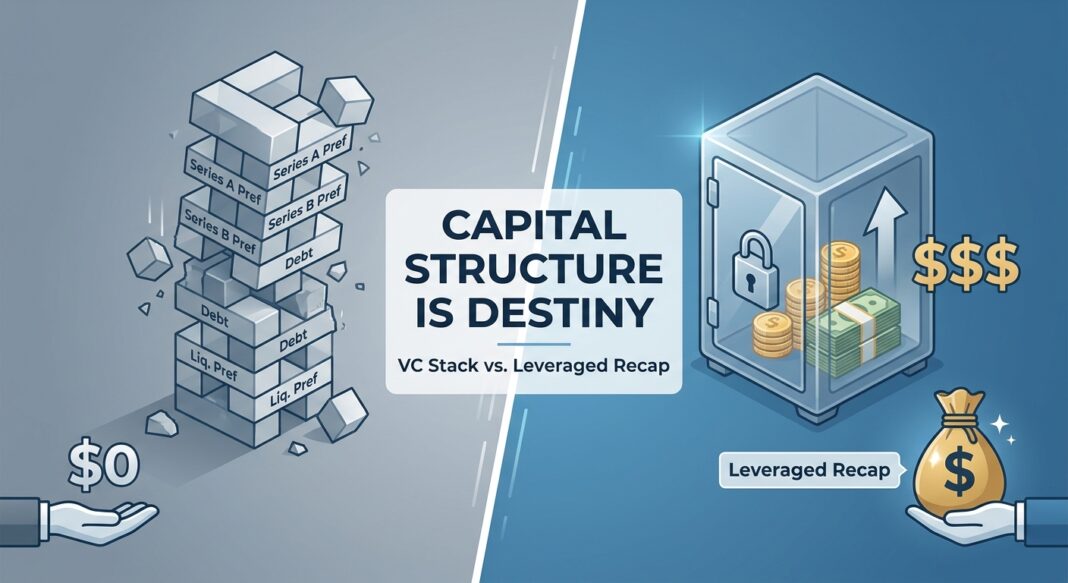
The Story: A Billion-Dollar Exit, Zero for the Founders
In January 2025, Adena Hefets — co-founder and CEO of Divvy Homes — sent a letter to shareholders that said everything, and took everything away in the same breath. Her rent-to-own startup had just been acquired by Brookfield Properties’ Maymont Homes division for approximately $1 billion. On paper, a remarkable outcome for a company that had once helped over 15,000 renters start their path to homeownership across twenty U.S. cities.
But the letter carried a stunning coda. After repaying outstanding debt, covering transaction costs, and fulfilling liquidation preferences for preferred shareholders, neither common shareholders nor holders of the Series FF preferred stock — the class typically awarded to founders — would receive any consideration. Founders, early employees, and most equity investors walked away with nothing.
“While I am not proud of the financial outcome, I am proud of the impact we had on our customers’ lives,” Hefets wrote. It was a graceful note from someone who had built something real. But the financial outcome was structurally predetermined long before Brookfield made its offer. It was baked into the capital stack the day Divvy agreed to its first term sheet with a liquidation preference — and compounded with every subsequent round thereafter.
Founded in 2016, Divvy had raised more than $700 million in debt and equity from investors including Tiger Global Management, GGV Capital, and Andreessen Horowitz. Its peak valuation had touched $2.3 billion in 2021. The $1 billion sale price was less than half of that peak. And in the brutal arithmetic of VC liquidation stacks, less than half was not nearly enough.
The Decision: What the Capital Stack Actually Said
Divvy’s story is often retold as a cautionary tale about interest rate risk or the fragility of the proptech model. Those factors matter. But at its core, this is a capital structure story — and a masterclass in how the terms a founder accepts in growth stages determine who wins at the exit, regardless of what the company actually built.
Divvy’s capital stack at the time of sale had two layers of prior claim. First came $735 million in debt, taken on primarily to fund the acquisition and lease-back of its home portfolio. On top of that sat hundreds of millions in preferred equity carrying its own liquidation preferences. The equity structure itself was a layered tower: six distinct preferred classes, each with escalating seniority and downside protections.
Each preferred round came with a liquidation preference — a contractual guarantee that investors recover their capital (sometimes at 1x, sometimes at multiples) before any common holder sees a dollar. Successive down rounds triggered a cascade of liquidation preferences and anti-dilution resets, turning employee options and early equity into ghost shares. By the time the acquisition closed, the exit waterfall was simple and merciless: debt repaid first, transaction costs second, preferred liquidation preferences third — with nothing left for the founders and common equity holders who had built the business.
The alternative was always available. It just requires a different philosophy from day one. A leveraged recapitalization is a capital structure transaction in which a company replaces a portion of its equity with new debt and pays the proceeds to shareholders — the owner extracts cash from the business without selling to a third party, while the company assumes a higher debt-to-equity ratio and accepts the ongoing interest burden. Critically, the ownership percentage and voting control remain intact. No liquidation preferences. No preferred stack. No invisible tax on your equity that only becomes visible the day you sell.
The Outcome: Two Founders, Same Era, Opposite Results
Now contrast Divvy’s outcome with a parallel story from the same period. Around the same time as Divvy’s acquisition, a father-son team in Florida quietly completed their fourth successful exit in fifteen years — using a $1 million non-dilutive debt facility to triple monthly recurring revenue before selling to a Nasdaq-listed public safety firm. Their investors made money. Their team made money. They made money.
The difference was not product quality, market size, or founder talent. It was the absence of a preference stack. When you finance growth through structured debt rather than successive preferred equity rounds, the exit waterfall is clean. Debt is repaid — a known, finite obligation — and what remains belongs to the equity holders proportionally, without a line of investors with senior contractual claims ahead of you.
The mathematics of VC dilution are relentless even before an exit stress-test applies. In 2025, median dilution was approximately 19.5% for seed rounds and 18% for Series A rounds, according to Carta data. By the time a company has raised through Series A with an option pool, founders and early stakeholders typically retain around 50% ownership — and dilution compounds with each subsequent round. Multiply that across a Series B, C, and D, each carrying its own liquidation multiplier, and the founder’s effective share of any exit outcome shrinks dramatically.
The leveraged recap operates on an opposite logic. According to the Pepperdine Private Capital Markets Report (2024), lower middle market leveraged recapitalizations typically close at 3x to 5x EBITDA in total debt, with pricing tied to prevailing senior secured rates plus a margin based on risk profile. A company generating $3M in EBITDA can responsibly borrow $9M–$15M, distribute a meaningful dividend to its founders, and continue operating with full equity ownership intact. The debt is a cost of capital, not a claim on ownership. When the eventual exit comes, there is no preferred stack waiting ahead of you in line.
The Lessons: What Founders Facing a Capital Decision Can Take From This
The Divvy story is not an indictment of debt itself. Divvy’s problem was not that it borrowed — it is that the debt it borrowed was structurally mismatched to a model that depended on persistently low interest rates, layered on top of an already punishing preferred equity stack. The $735 million in facility debt was asset-level borrowing against homes, not cash-flow lending against a durable operating business. When rates rose, the model’s economics inverted and the entire capital structure collapsed inward.
The lesson is precision, not avoidance. The question every founder should ask is not “debt or equity?” but rather: “Which form of capital preserves the most optionality and ownership at the moment I need it most?”
The market has answered this question with record volumes. Combined, dividend recap activity for 2024 and 2025 neared $200 billion — more than five times the level of the prior two years. Private equity sponsors use leveraged recaps constantly and systematically to extract liquidity from their best-performing portfolio companies without triggering a sale. Leveraged loan issuance tied to sponsored dividend recaps grew 11% year-over-year to $74.3 billion in 2025, after rising 326% in 2024, according to PitchBook’s Interactive Leveraged Loan Volume Report. Sponsors use this mechanism because it works — and it works because it does not touch equity ownership at all.
Founder-operators can access the same tool. A leveraged recapitalization provides partial liquidity without forcing a complete exit or company sale, allows investors to diversify their wealth while maintaining upside exposure, and signals management confidence in future cash generation — since the company must service new debt obligations. It also does something the VC model structurally cannot: it keeps the ownership table clean for the eventual exit.
The private credit market has made this genuinely accessible at the founder-owned level. From roughly $250 billion in 2008 to $2.1 trillion today, private credit has compounded at a global CAGR of approximately 22% per year over the past decade. A wealth of opportunity lies at the smaller end of the lending market, where terms on loans to founder-owned and family office companies can be particularly attractive — especially as large direct lending funds focus on ever-larger PE-sponsored transactions and leave the lower middle market comparatively underserved.
The Framework: When to Recap vs. When to Raise Equity
| Scenario | Preferred Tool | Why |
|---|---|---|
| Stable, cash-generative business needing founder liquidity | Leveraged Recap (3–5x EBITDA) | No equity dilution, no preference stack created, clean exit waterfall preserved |
| Pre-revenue or early-stage startup with no cash flow | Venture Equity (with eyes open) | Debt service not serviceable; VC necessary — but negotiate hard on liquidation terms |
| Growth-stage company with revenue but needing expansion capital | Venture Debt / Direct Lending | Extend runway or fund growth without dilutive equity round; no preference added |
| Partner buyout or estate planning liquidity | Leveraged Recap (Unitranche or Senior Secured) | Clean mechanism to resolve ownership disputes without a full sale event |
| Asset-heavy model dependent on macro rates (e.g., real estate, leasing) | Caution with all leverage; structure matching critical | Divvy’s mistake: asset-liability mismatch destroyed the equity cushion when rates rose |
Key Insights
- Capital structure is destiny at exit. Divvy Homes sold for $1 billion and its founders received nothing. The exit price was not the variable — the preference stack was. Every round of VC preferred equity you accept is a prior claim on your exit proceeds, invisible until the day it matters most.
- A leveraged recap converts business equity into personal liquidity without giving away ownership. The mechanics are straightforward: borrow against your cash flows, distribute the proceeds as a dividend, retain 100% of your equity. The debt is finite and serviceable; the ownership is permanent and unencumbered.
- Private equity sponsors already know this — and they use it relentlessly. Sponsored dividend recap volume reached $74.3 billion in 2025, a post-GFC record. PE firms extract cash from their best assets using structured debt while preserving equity upside. Founder-operators have the same playbook available to them.
- The private credit market is now genuinely founder-accessible. At $2.1 trillion in assets globally, private credit has moved well beyond sponsor-backed LBOs. Direct lenders are increasingly serving founder-owned businesses with tailored debt structures — and the lower middle market remains comparatively underserved, meaning better terms for qualified borrowers.
- Debt is not inherently dangerous — mismatched debt is. Divvy did not fail because it borrowed; it failed because its debt was structurally tied to an interest-rate-sensitive asset model and stacked on top of an already punishing equity preference stack. Cash-flow-based debt, correctly sized, matched to your operating model, and used in place of dilutive equity rounds, is not a risk. It is a discipline.


