
The Underwriting Question Every Lender Must Answer Before Closing
Imagine you have underwritten a $45 million senior secured term loan to a specialty manufacturing company at 4.5x Debt/EBITDA, with a $10 million EBITDA base. The business has a five-year operating history, moderate customer concentration, and meaningful exposure to industrial end-markets. Eighteen months after close, a demand contraction clips EBITDA by 22%. Interest expense is fixed. CapEx obligations remain. The revolving credit facility is 70% drawn.
Does this credit survive? Does it breach maintenance covenants? Does it trip a default? Can management service debt from free cash flow, or does it need to draw further on liquidity reserves?
These are not hypothetical questions — they are the stress tests every underwriter should run before signing a credit approval, not after the portfolio goes sideways. Cash flow stress testing is the analytical backbone of disciplined leveraged credit underwriting. Yet in practice, it is frequently compressed into a single downside case with optimistic assumptions baked in. This guide corrects that discipline gap.
The Analytical Framework: Three-Scenario Stress Architecture
Institutional lenders and rating agencies evaluate credit resilience across a range of operating environments, not a single base case. Fitch Ratings, for instance, uses a three-to-five year projection horizon that spans at least one economic cycle, combining historical operating data with forward-looking stress assumptions calibrated to the sector’s inherent volatility — including competitive intensity, cyclicality of demand, and capital intensity. [fitchratings.com]
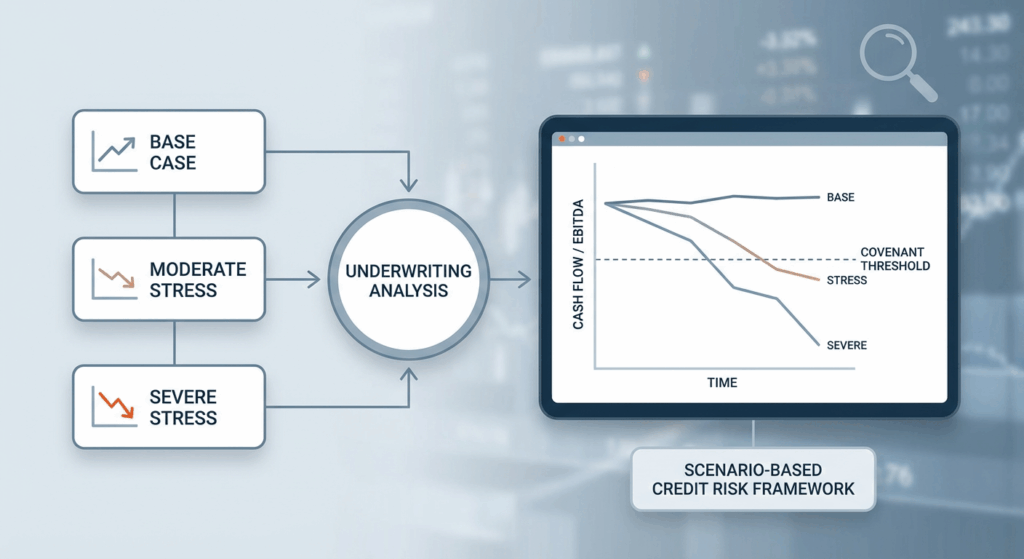
For mid-market underwriting, a practical three-scenario architecture works as follows:
- Base Case: Management projections, modestly haircut. Revenue growth in line with sector averages, margins stable, CapEx at guided levels.
- Stress Case (Moderate Decline): Revenue down 10–15%, EBITDA margins compressed 150–250 basis points due to operating leverage, working capital deteriorating. This reflects a sector softening or single-customer churn event.
- Severe Stress Case (Recession/Structural Shock): Revenue down 20–30%, EBITDA margins compressed 400+ basis points, CapEx deferred but fixed charges remain. This stress level is consistent with historical mid-cycle downturns in industrial and cyclical sectors.
Each scenario feeds directly into three coverage ratios that lenders monitor throughout the hold period: Total Leverage (Debt/EBITDA), Interest Coverage (EBITDA/Interest Expense), and Fixed Charge Coverage Ratio (FCCR). The Fitch corporate rating framework similarly anchors its quantitative analysis to EBITDA-based leverage and coverage metrics as primary credit discriminators. [fitchratings.com]
Walking Through the Calculations: A $10M EBITDA Manufacturing Credit
Return to our specialty manufacturer. At close, the capital structure is $45M senior secured term loan at a blended all-in rate of 10.5% (consistent with current mid-market pricing of 9–11% for quality credits per current market benchmarks). [ibinterviewquestions.com] Annual interest expense is $4.73M. Mandatory amortization is 5% per annum, or $2.25M. Maintenance CapEx is $1.5M.
Base Case (EBITDA: $10.0M)
- Debt/EBITDA: 4.5x
- Interest Coverage (EBITDA/Interest): 2.11x
- FCCR: (EBITDA – CapEx – Taxes) / (Interest + Amortization) = ($10.0M – $1.5M – $0.9M) / ($4.73M + $2.25M) = $7.6M / $6.98M = 1.09x
The FCCR of 1.09x in the base case is uncomfortably thin. Lenders typically require a minimum FCCR of 1.0x–1.2x, with 2.0x or higher preferred for quality credits. [ibinterviewquestions.com] A base case coverage near the floor means any operational deviation immediately creates distress.
Stress Case (EBITDA: $8.0M — 20% Decline)
- Debt/EBITDA: 5.6x — breaches a typical 5.5x maintenance covenant
- Interest Coverage: 1.69x — approaches many lenders’ 1.75x minimum threshold
- FCCR: ($8.0M – $1.5M – $0.5M) / $6.98M = $6.0M / $6.98M = 0.86x — below 1.0x floor, indicating a cash shortfall of approximately $980K annually
A sub-1.0x FCCR is a covenant breach trigger in most senior credit agreements. At this point, the borrower cannot service fixed charges from operating cash flow without drawing on revolver capacity or receiving an equity cure injection from the sponsor.
Severe Stress Case (EBITDA: $6.5M — 35% Decline)
- Debt/EBITDA: 6.9x
- Interest Coverage: 1.37x
- FCCR: ($6.5M – $1.5M – $0M) / $6.98M = 0.72x — deep breach, requiring approximately $1.97M in external liquidity support annually
At this stress level, revolver capacity becomes the critical survival variable. If the revolving credit facility is already 70% drawn at close, the remaining $3M of capacity provides approximately 18 months of buffer before a restructuring event.
What Institutional Lenders and Rating Agencies Look For
Moody’s Analytics portfolio modeling framework emphasizes that even in aggregate, credit loss variability cannot be eliminated through diversification alone — individual borrower cash flow stress must be modeled explicitly, accounting for correlations to the macro environment. Delinquency rates on commercial and industrial loans demonstrated sharp cyclical spikes in 1991, 2001, and 2008–2009, reinforcing that mid-cycle downturn assumptions are not theoretical constructs but empirical realities. [moodys.com]
From a structural standpoint, leveraged finance credit analysis must assess the interaction between debt instrument type (bank debt vs. high-yield bonds), covenant protection, and seniority in the capital stack. Bank debt with maintenance covenants provides earlier warning of credit deterioration than incurrence-only covenant structures, which only trigger restrictions on future actions rather than requiring ongoing financial compliance. [thepeoplespension.co.uk]
📊 Key Credit Benchmarks (Current Market, April 2026)
- Total leverage in most mid-market LBOs: 4.0x–5.0x Debt/EBITDA, down from 6.0x+ pre-2022 [ibinterviewquestions.com]
- All-in interest costs for quality mid-market credits: 9%–11% [ibinterviewquestions.com]
- Minimum DSCR required by most senior lenders: 1.25x, with 2.0x preferred for quality credits [ibinterviewquestions.com]
- Minimum FCCR covenant floor in senior credit agreements: typically 1.0x–1.1x
- Sponsor equity contribution in current environment: 45%–55% of purchase price vs. 35–40% in the prior rate cycle [ibinterviewquestions.com]
Common red flags underwriters frequently overlook:
- Single-customer revenue concentration above 25–30%, which can impair the entire debt structure upon customer loss
- Maintenance CapEx consuming more than 15% of EBITDA, dramatically compressing true free cash flow
- Base case FCCR below 1.25x, which leaves near-zero room for any operational variance
- Revolver drawn more than 50% at close, signaling working capital stress or aggressive deal structuring
- EBITDA adjustments (add-backs) exceeding 20% of reported EBITDA, a signal that normalized earnings are unreliable
Cash Flow Stress Testing: Underwriting Checklist
- Establish a clean EBITDA baseline. Reconcile reported EBITDA to cash EBITDA by removing non-recurring add-backs exceeding 10% of the total. Request three years of audited financials plus trailing twelve months management accounts.
- Map fixed charges explicitly. Identify all mandatory cash outflows: interest, required amortization, maintenance CapEx, lease obligations, and tax distributions. These do not flex in a downturn.
- Build three independent scenarios. Base, moderate stress (15–20% EBITDA decline), and severe stress (30–35% EBITDA decline). Each scenario must have internally consistent revenue, margin, and working capital assumptions — not simply a percentage haircut applied to a single line.
- Calculate FCCR and DSCR for each scenario. Identify the EBITDA level at which the FCCR drops below 1.0x. This is your covenant breach threshold.
- Assess revolver availability under stress. Model working capital draws under the stress scenario. Confirm that undrawn revolver capacity covers at least 12 months of FCCR shortfall in the moderate stress case.
- Validate covenant headroom. Confirm that maintenance covenants (leverage, coverage) provide at least 20–25% headroom to the stress case outcome, not just to the base case.
- Document scenario assumptions. Every stress case must have a named economic rationale (demand contraction, customer loss, margin compression from input costs) that is defensible to credit committee.
Key Takeaways
- The base case is not the underwriting case. Lenders are paid to model adversity. A credit that only works in a benign environment is a credit that should not be approved at current leverage levels.
- FCCR is the most revealing coverage metric. Unlike EBITDA/Interest, FCCR captures all mandatory cash obligations and exposes credits where amortization and CapEx consume the majority of operating cash flow.
- Covenant floors must be calibrated to the stress scenario, not the base case. A maintenance covenant set 5% below the base case provides no early warning and no lender protection.
- Revolver availability is a liquidity stress variable, not a comfort item. Model it under stress conditions with realistic utilization assumptions before treating it as a structural safeguard.
- Customer and supplier concentration multiplies cash flow volatility. A 30% revenue concentration in a single customer transforms a moderate stress scenario into a severe one. Underwrite concentration as a structural risk modifier, not a footnote.


