
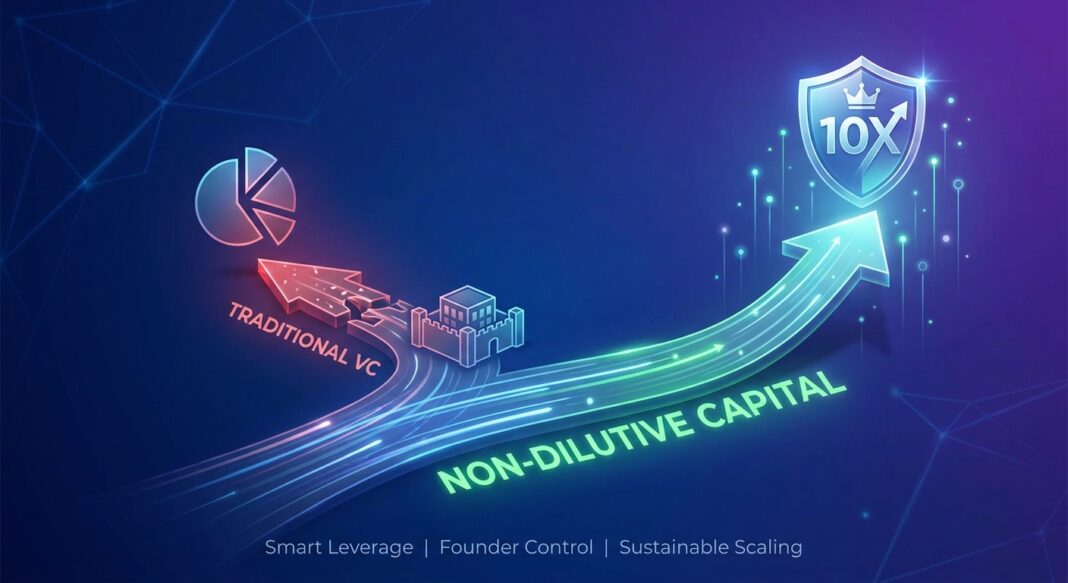
The Story: A Founder Who Kept Saying No to Venture Capital — Until He Said Yes to Something Better
For years, venture capitalists came knocking on Jack Jia’s door. He turned them all away. Jia, the co-founder and CEO of Musely — a direct-to-consumer telemedicine platform specializing in compounded skincare, hair, and menopause treatments — had built his company the hard way: cash-flow positive, capital-efficient, and stubbornly independent. Since a $20 million equity raise in 2014, Musely had not taken a single dollar of outside equity. Not one share sold. Not one board seat given away.
Then, in May 2026, everything changed — but not in the way the VCs had hoped. Musely announced it had secured $360 million in non-dilutive capital from General Catalyst’s Customer Value Fund (CVF). No equity exchanged hands. No ownership stake was surrendered. Instead, the deal was structured as a revenue-share agreement: Musely would repay the funds, plus a fixed, capped percentage of the revenue it generates from deploying that capital. Jia told TechCrunch that when he mathematically modeled the terms against a standard bank loan or a dilutive equity round, the CVF structure won — decisively.
Musely’s trajectory — 50% average year-over-year revenue growth, 1.2 million patients served — illustrates a truth that a growing cohort of founders is discovering: the most powerful leverage isn’t always a bank loan, and the most expensive capital isn’t always the one with the highest interest rate.
The Decision: Three Paths, Three Very Different Futures
To appreciate why non-dilutive financing is resonating so strongly with founders right now, it helps to lay out the options clearly. When a growing, cash-generative company needs capital to scale, three primary paths exist:
- Traditional Venture Capital: Founders sell equity — typically 15–25% per round — in exchange for growth capital. Investors receive board seats, pro-rata rights, and liquidation preferences. The cost isn’t an interest rate; it’s permanent dilution and structural control concessions.
- Traditional Debt: Banks or credit facilities offer loans at fixed or floating interest rates, requiring collateral, personal guarantees, and consistent positive cash flow. Fast-growing companies often don’t qualify — or face restrictive covenants that limit strategic flexibility.
- Revenue-Based or Non-Dilutive Financing: Providers advance capital in exchange for a fixed repayment amount — typically a multiple of the advance — collected as a percentage of monthly revenue. No equity is taken. No board seats are granted. Payments flex with revenue performance.
Jia’s instinct was validated by the math: at Musely’s scale, a traditional equity round would have permanently transferred hundreds of millions of dollars in value to outside investors. CVF’s revenue-share structure capped the total cost of capital at a fraction of that. “When I mathematically modeled it, I found this absolutely compelling,” Jia explained, as reported by TechCrunch. The capital will fund customer acquisition — a perpetually capital-hungry function for DTC brands — without permanently transferring ownership of the customer relationships being built.
The Outcome: What Non-Dilutive Capital Actually Looks Like in Practice
Musely is the headline, but the playbook runs deeper. Across company sizes, industries, and growth stages, founders who chose debt-like structures over equity are reporting strikingly similar outcomes: more control, better alignment, and — critically — more value retained at exit.
Modigi: $400K Unlocks $1.7M ARR With Zero Dilution
Ken Hoppe, CEO of Modigi, a six-person SaaS company serving enterprise clients inside the Salesforce ecosystem, needed working capital to hire his first salesperson and customer success manager. He didn’t need a VC board telling him how to run his business. He turned to Founderpath, drawing an initial $400,000 tranche of revenue-based financing at an 8–12% discount rate over a 12-month payback window — no collateral, no personal guarantees, no equity. The result: $1.7 million in ARR achieved profitably, with 100% ownership retained and the company targeting $3–4 million in EBITDA within 24 months. As Hoppe put it, “Founderpath helped us keep control of the company while still getting the capital we needed to grow,” according to Founderpath’s case study.
SafePointe: Venture Debt Fueled a 9-Month Sprint to Acquisition
Father-son founders Greg and Timothy Holifield had built and sold three companies before SafePointe, an AI-based weapons detection system. They knew the math on equity. When they needed capital to fund hardware inventory and new contracts ahead of an anticipated acquisition, they turned to TIMIA Capital for a $1 million non-dilutive debt facility. Within 12 months, SafePointe was acquired by SoundThinking (Nasdaq: SSTI). The equity investors who came in alongside TIMIA’s debt made 10x in nine months. TIMIA’s debt cost a fraction of that — a testament to what Greg Holifield called “truly fantastic money” compared to equity, as detailed by TIMIA Capital.
Myagi: From $2.4M to $4.4M ARR, Then a Clean Exit
Myagi, a retail sales enablement platform co-founded by Simon Turner, was on the verge of a major equity round in early 2020 when the pandemic reshuffled the deck. Instead of chasing venture capital, Turner secured a $2.5 million non-dilutive facility from TIMIA Capital. Myagi used the funds to enhance its referral-based sales model and expand customer success — growing ARR from $2.4 million to $4.4 million. Two years later, Myagi was acquired by Rallyware. Turner’s reflection, cited by TIMIA Capital, is worth sitting with: “One thing venture capital doesn’t take into account is that many businesses have a natural cadence at which they grow. Growing too fast can be detrimental.”
UnityLab: 10x Growth, a Strategic Acquisition, and a Better Series A
Jonathan Benjamin, founder of UnityLab (formerly Unity Laundry Systems), used revenue-based financing from Sage Growth Capital at three distinct inflection points: first to launch new SKUs in 2020, then to bridge a $750K gap in the acquisition of Hoffman New Yorker in 2022, and again in 2024 to fund international expansion into China and Italy. Each time, the non-dilutive capital preserved his cap table — ultimately enabling a Series A at a significantly higher valuation than would have been possible had he diluted earlier. The business grew more than 10x in four years, as documented by Sage Growth Capital.
The Lessons: A Framework for Founders Facing the Same Decision
These stories aren’t anomalies. They represent a structural shift in how sophisticated operators think about the cost of capital. Here is the framework that emerges from their collective experience:
1. Equity Is Always the Most Expensive Capital — Eventually
A revenue-share agreement with a 15% cost of capital looks expensive next to a 7% bank loan. But it looks cheap against 20% of your company sold at a $10 million valuation that eventually exits at $50 million. The real cost of equity isn’t the percentage — it’s the compounded future value of what you gave away.
2. Non-Dilutive Financing Works Best When Revenue Is Predictable
Every founder in these case studies shared a common trait: recurring or highly predictable revenue. MRR-based SaaS businesses, DTC subscription models, and hardware-enabled software companies with contract revenue all qualify. Lenders underwrite against cash flow visibility, not speculative growth projections. If your revenue is lumpy or unpredictable, this tool may not fit — yet.
3. Use Debt to Prove the Thesis Before Raising Equity
UnityLab’s Jonathan Benjamin demonstrated this elegantly: use non-dilutive capital to acquire Hoffman, integrate it, prove the operational thesis, then raise a Series A at a materially better valuation. The sequencing matters enormously. Equity raised after proof points is always cheaper than equity raised on promises.
4. The Alignment Problem With VC Is Real
Simon Turner’s observation about venture capital’s misalignment with natural business cadence is not anti-VC rhetoric — it’s an honest structural critique. VC fund lifecycles demand exits within 7–10 years. Revenue-share and venture debt providers are repaid from cash flow, not from forcing a liquidity event. That alignment difference changes every strategic conversation that follows the term sheet.
5. Structure the Capital to Match the Use of Funds
Musely is using $360 million to fund customer acquisition — a use of capital with a measurable, recurring payback tied directly to the revenue it generates. Modigi used $400K to hire two people who would directly generate ARR. SafePointe used debt to fund hardware that enabled contracts. In each case, the capital structure matched the cash flow profile of the investment. That discipline is what makes non-dilutive financing sustainable rather than speculative.
Key Insights
- Non-dilutive capital is not a consolation prize: Musely’s $360M CVF deal, Myagi’s clean exit, and UnityLab’s 10x growth prove that revenue-based financing can fund meaningful scale — not just survive between equity rounds.
- The real cost of VC is compounded dilution: SafePointe’s equity co-investors made 10x in nine months on the same deal where TIMIA’s debt cost a fraction. The return disparity illustrates just how much value equity investors extract from successful outcomes.
- Sequencing capital is a strategic skill: Using non-dilutive financing to reach the next proof point — then raising equity at a higher valuation — is a discipline that significantly improves founder outcomes at every stage.
- VC incentives and founder incentives diverge structurally: Venture capital’s fund lifecycle creates pressure to grow at all costs and exit on the fund’s schedule. Revenue-share and venture debt align repayment with cash generation, not with investor liquidity timelines.
- Predictable revenue is the prerequisite: Every non-dilutive deal in these case studies was underwritten against MRR, ARR, or contract-based cash flow. Founders who build recurring revenue models first unlock the broadest capital optionality later.


