
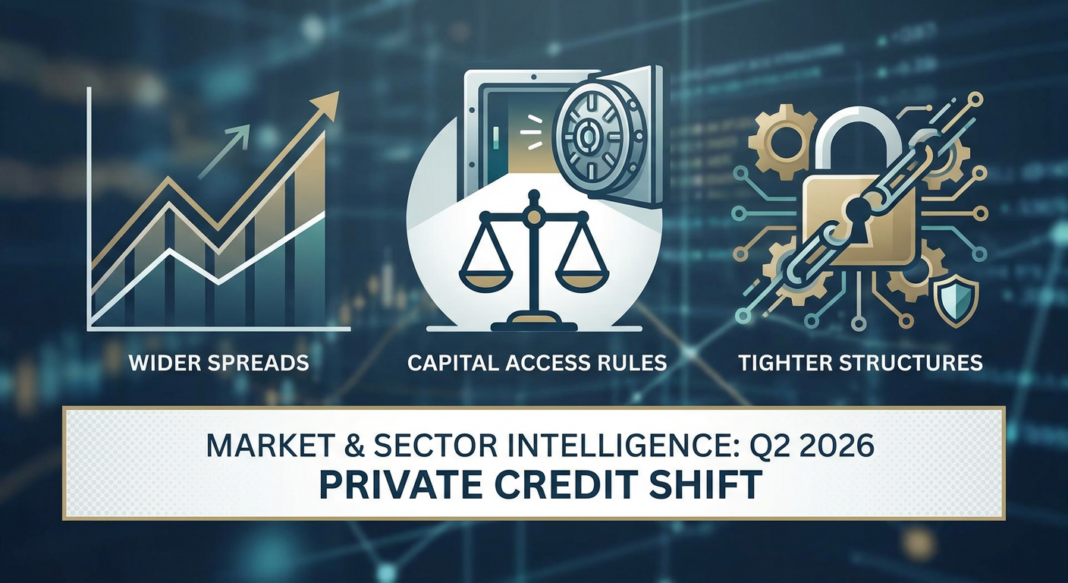
The Lender-Friendly Reset Is Real — And the Data Confirms It
Private credit markets entered 2026 with constructive momentum: ample dry powder, compressing spreads, and a recovering M&A pipeline built on the optimism of H2 2025. By the end of Q1 2026, that narrative had been stress-tested by three compounding shocks — an AI-driven selloff across software and technology credits, renewed Middle East geopolitical tensions injecting upside inflation risk into an already complicated Federal Reserve path, and persistent tariff and trade policy uncertainty suppressing risk appetite across the capital stack. The cumulative effect, documented across institutional data providers and direct lender commentary, is a market that has repriced materially and is now operating on fundamentally more lender-friendly terms.
According to analysis from lordabbett.com, spreads have widened by roughly 50 to 100 basis points since late 2025, while credit structures have simultaneously improved — fewer PIK requests, less aggressive leverage, more covenants, and tighter documentation. This combination of wider spreads and better structural protections represents the most important mid-cycle shift for private credit in at least eighteen months. The macro backdrop reinforcing this shift is unambiguous: as reported by abfjournal.com, the week ending June 6, 2026 crystallized a single, coherent regime — inflation remains too sticky and the labor market too resilient for the Fed to ease, meaning cost of capital stays elevated while risk appetite thins. May nonfarm payrolls came in at 172,000, more than double the 80,000 consensus, decisively repricing the rate path and anchoring base rates near 4.50% for longer than the market had modeled.
For middle market borrowers that underwrote floating-rate debt service assuming SOFR drifting toward 3% in the back half of 2026, the revision is material. Debt service is now heavier than projected, and covenant headroom across the lower-middle market is thinning accordingly, per abfjournal.com.
Quantitative Market Snapshot: Key Credit Metrics as of Mid-June 2026
The table below captures the core pricing and structural metrics defining current market conditions. Each data point is sourced from institutional research and primary market reporting.
| Metric | Current (Q2 2026) | Prior Period | Change | Source |
|---|---|---|---|---|
| Direct Lending 1st Lien Spread (new issue) | ~500–525 bps over SOFR | ~486–497 bps (Oct–Nov 2025) | +25 bps (matrix-wide); wider for tech | bondtv.vaultai.ca |
| Software/Tech Credit AI-Risk Premium | ~+75 bps (above standard spread) | Not formally priced (year-end 2025) | New pricing layer; ~200 bps total sector widening | bondtv.vaultai.ca |
| S&P Leveraged Loan Index Spread | ~487 bps | Tighter in early 2026 | Among widest since April 2025 dislocation | abfjournal.com |
| Total Leveraged Loan Primary Issuance (Q1 2026) | ~$241 billion | Q1 2025 pace | –32% year-over-year | sikich.com |
| Leveraged Loan Repricing Candidate Pool (as of May 8) | $47.2 billion eligible; ~$70B potential | Much larger heading into 2026 | Materially narrowed; skewed to BB+ corporates | pitchbook.com |
| LLI Weighted Average Secondary Bid (May 8, 2026) | 95.40 | 94.17 (early-March 2026 low) | +123 bps recovery; still below January levels | pitchbook.com |
Underlying the spread data are equally significant structural shifts in underwriting expectations. Lenders are demanding lower leverage multiples, fewer covenant-lite structures, and clearer fixed-charge coverage headroom. Borrowers entering the market today are encountering lender expectations more reminiscent of 2022 than the comparatively permissive conditions of 2024–2025, per lordabbett.com.
Sector Analysis: Bifurcation Sharpens Between Winners and the Shut-Out
Software & Technology — Most Restricted
Software credits have become the most constrained segment of the private credit market. Per bondtv.vaultai.ca, spreads in this segment widened approximately 200 basis points from year-end 2025, compounded by an AI-risk premium of roughly 75 bps for borrowers unable to credibly articulate their positioning relative to AI disruption — either as beneficiaries or as defensively insulated businesses. Lower implied enterprise values have pushed loan-to-value ratios higher, forcing lenders into case-by-case credit review rather than programmatic underwriting. The SaaS secondary market, which had served as a liquidity signal for primary underwriting, reflected this repricing sharply. As pitchbook.com reports, while secondary prices have partially recovered from their early-March lows, new-issue spreads remain roughly 50 basis points wide of January levels for both BB- and B-rated credits, and the repricing opportunity set is materially narrower than it appeared at the start of the year.
Higher-Quality, Defensive Sectors — Selectively Open
The credit market remains open — but on a highly selective basis. According to sikich.com, BB-rated or higher borrowers represented a growing share of Q1 2026 issuance while the lowest-rated segment accounted for a historically small portion of M&A-related volume. Defensive industries — healthcare services, infrastructure-linked businesses, essential consumer services, and non-discretionary B2B verticals — are drawing the most consistent lender appetite. In the middle market, direct lenders with committed, locked-up capital are positioned to take share from a more volatile syndicated market, particularly for borrowers that need execution certainty over price optimization, per abfjournal.com.
Energy & Consumer — Structural Stress Accumulating
Energy cost pressures and a strained consumer are populating the restructuring pipeline with weaker balance sheets across consumer-facing and energy-dependent businesses. These credits are facing the combined headwind of higher floating-rate debt service, demand softness, and lender reluctance to extend on existing terms without meaningful covenant or structural concessions, per abfjournal.com.
Strategic Implications: What Borrowers and Lenders Must Recalibrate Now
For Borrowers and Operators
The most immediate operational implication is debt service recalibration. Borrowers that modeled floating-rate obligations against a SOFR path declining toward 3% in H2 2026 are carrying meaningfully heavier fixed charges than their original underwriting assumed. With base rates anchored near 4.50% — per abfjournal.com — FCCR headroom is eroding across the lower-middle market. Operators should stress-test their coverage ratios against a sustained higher-for-longer base rate scenario and prioritize covenant compliance visibility now, before margin compression forces reactive lender conversations. Refinancing windows remain available for high-quality credits, but the cost of delay for weaker credits is rising as maturity pressure concentrates among borrowers with the fewest alternatives, per sikich.com.
For Institutional Lenders and Investors
New capital deployment today benefits from the most structurally protective terms seen in the post-2022 cycle. According to lordabbett.com, the combination of wider spreads and better credit documentation — including more covenants, lower leverage at close, and fewer PIK provisions — makes the current vintage potentially more attractive on a risk-adjusted basis than the tighter-spread environment of six months ago. Portfolio monitoring should prioritize non-accrual rates, PIK usage trends, sector concentration, and 2021–2022 vintage exposure as leading indicators of differentiation between manager quality. Direct lenders with locked-up capital and verified collateral frameworks are structurally advantaged in this environment as CLO demand, while resilient, becomes more selective following record full-year 2025 U.S. broadly syndicated CLO issuance of $472 billion across more than 1,000 transactions per abfjournal.com.
Forward-Looking View: The Next 3–6 Months
The base case for H2 2026 is a market that remains structurally bifurcated but gradually more active on the M&A-origination side as deal pipelines built in 2025 continue to clear. The Federal Reserve’s projected average base rate of approximately 3.3% over 2026–2028 — roughly 15 basis points higher than previously expected — means all-in yields on senior secured private credit will remain attractive in absolute terms even as spreads potentially compress modestly from current levels, per bondtv.vaultai.ca. However, the window for aggressive leverage multiples and covenant-lite structures in mid-market deals has materially narrowed and is unlikely to reopen without a clear shift in either Fed policy signals or AI-sector sentiment. Substantial dry powder remains undeployed across private credit platforms, meaning a stabilization in geopolitical or AI-driven uncertainty could reopen primary markets relatively quickly — but the credits that will benefit first are those with defensible sector positioning, clean FCCR profiles, and transparent AI exposure disclosure.
Key Market Insights
- Spreads are 50–100 bps wider than late 2025, with software credits facing up to 200 bps of sector-specific widening plus a new 75 bps AI-risk premium — the most significant repricing in the private credit cycle since 2022, per bondtv.vaultai.ca and lordabbett.com.
- Structural protections are improving alongside spreads: fewer PIK requests, more covenants, lower leverage at origination, and tighter documentation make the current vintage more lender-friendly than the 2024–2025 environment on a risk-adjusted basis.
- FCCR headroom is thinning across the lower-middle market as base rates anchored near 4.50% exceed original underwriting assumptions — operators and lenders should stress-test coverage ratios against a higher-for-longer scenario immediately, per abfjournal.com.
- Quality bifurcation is the defining feature of current deal flow: BB-rated and defensive-sector borrowers retain meaningful market access while lower-rated, AI-exposed, or cyclically stressed credits face restricted or prohibitively priced capital, per sikich.com and pitchbook.com.
- Direct lenders with locked-up capital and collateral discipline are structurally advantaged: with CLO demand becoming more selective and syndicated markets volatile, execution certainty commands a growing premium — and M&A origination is quietly expanding the opportunity set for disciplined deployers, per abfjournal.com.


