
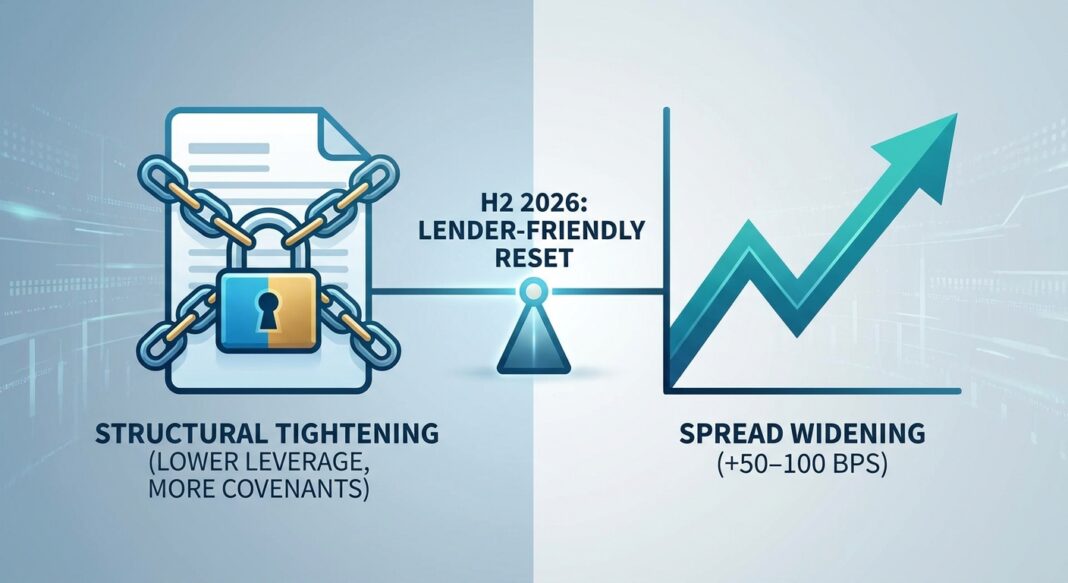
The Reset Is Real — And It Is Structural, Not Just Cyclical
Entering the second half of 2026, private credit markets have undergone a fundamental posture shift that goes well beyond price. The headline is a spread move of approximately 50–100 basis points wider than late 2025 levels across direct lending first-lien instruments — but the more consequential signal, as flagged in Lord Abbett’s 2026 Midyear Private Credit Outlook, is structural. New loans are coming with fewer payment-in-kind (PIK) concessions, tighter documentation, more maintenance covenants, and lower leverage multiples. This is a lender’s market in ways that the raw spread data alone does not fully capture.
Three macro forces catalyzed the shift. First, an AI-driven repricing shock rattled software and technology credits, elevating uncertainty around revenue durability and unit economics in a cohort that had attracted aggressive capital deployment in 2021–2023. Second, renewed Middle East geopolitical tension injected persistent upside inflation risk into Federal Reserve policy deliberations, effectively taking near-term rate cuts off the table. Third, tariff and trade uncertainty suppressed risk appetite across the capital stack — particularly for borrowers with imported input cost exposure. The cumulative effect, per AlixPartners’ Spring 2026 Mid-Market Debt Report, is that five-year SONIA has jumped approximately 80 basis points to 4.3%, EURIBOR has risen roughly 50 basis points to approximately 2.8%, and SOFR has nudged 15 basis points higher to 3.6% — a base rate environment that is materially heavier than many 2021–2022 vintage underwriting models assumed.
Quantitative Snapshot: Key Market Metrics as of Q2 2026
The table below synthesizes current market data across the most relevant credit KPIs for institutional participants:
| Metric | Current Level (Q2 2026) | Prior Period | Direction | Source |
|---|---|---|---|---|
| Direct Lending 1st Lien Spread (middle market) | ~550–600 bps over SOFR | ~475–525 bps (late 2025) | ↑ +50–100 bps wider | lordabbett.com |
| S&P Leveraged Loan Index Spread | ~487 bps | ~430–450 bps (mid-2025) | ↑ Near widest since Apr 2025 | bondtv.vaultai.ca |
| SOFR (base rate anchor) | ~3.6% | ~4.3% peak (2023); gradual easing through 2025 | → Fed on hold; cuts off table | alixpartners.com |
| Private Credit Non-Accrual Rate (Q1 2026) | 1.4% | Below 1% historically | ↑ Elevated; driven by smaller borrowers | heronfinance.com |
| PIK Interest Rate (fund-level, Q1 2026) | 3.9% | Marginal decrease from Q4 2025 | ↓ Slight improvement; still elevated | heronfinance.com |
| Avg. LTV (private credit, fund-level) | ~40% | Stable over 3 years | → Discipline maintained | heronfinance.com |
| Fund-Level Debt/Equity (leverage) | ~1.0x | Rising trend; prior 0.8–0.9x range | ↑ Warrants monitoring toward 1.2x threshold | heronfinance.com |
Sources: Lord Abbett, AlixPartners, Heron Finance / Cliffwater, Bond Capital. Data as of Q1–Q2 2026.
A critical KPI implication embedded in these numbers: floating-rate borrowers who modeled SOFR drifting toward 3% in H2 2026 are now facing materially heavier debt service. Per Bond Capital’s own Q2 2026 analysis, this base rate anchor is compressing fixed-charge coverage ratios (FCCR) across the lower middle market — particularly for credits underwritten on an easing-soon assumption. Lenders should expect covenant headroom to thin on the most exposed 2021–2022 vintage cohorts in H2 2026.
Sector Analysis: Where Lender Appetite Is Opening — and Closing
Software & Technology: This is the sector under the most acute pressure. AI-driven fear has moved further than underlying fundamentals in many cases, creating both distressed situations and selective opportunity. Per Wellington Management’s Midyear 2026 Fixed Income Outlook, bank loans in software and technology — caught up in the same AI disruption fears hitting high yield — have widened enough for spreads to compensate for weaker underwriting standards, opening selective re-entry points for disciplined lenders. However, 2021–2023 vintage software credits with aggressive leverage and rolling PIK structures remain a source of elevated non-accrual risk, as flagged by Lord Abbett.
Healthcare & Biotech: Convertible bond structures in biotech performed strongly through 2025 and retain structural appeal according to Wellington, combining equity participation with downside protection. Direct lending appetite in healthcare services remains constructive, though input cost pressures and reimbursement uncertainty in certain subsectors are prompting tighter covenant packages.
Energy & Industrials: The Middle East energy shock has reintroduced commodity price volatility as a meaningful underwriting variable. Per AlixPartners, high leverage combined with rising energy costs has the potential to squeeze interest coverage in industrials — lenders are scrutinizing FCCR projections more rigorously and stress-testing commodity pass-through assumptions on refinancings.
Bank Re-Engagement as a Structural Variable: A notable medium-term shift: the Bank of England’s Financial Policy Committee voted in late 2025 to lower the appropriate benchmark for Tier 1 capital requirements from 14% to 13%, per AlixPartners. A 1% movement across the size of UK bank balance sheets is material, and is already improving bank appetite for corporate lending — compounding the effect of challenger banks growing their balance sheets aggressively. This dynamic has the potential to reintroduce bank competition into parts of the middle market private credit landscape by 2027, which lenders should factor into longer-dated deployment strategies.
Implications for Institutional Investors and Operators
For Lenders and Investors: The midyear setup is more attractive for new capital deployment than it has been since the 2022–2023 post-rate-hike dislocation — but manager selection is paramount. Lord Abbett notes that portfolio differentiation is now becoming visible: non-accruals, PIK usage, sector concentration, and 2021–2022 vintage exposure are the key indicators separating disciplined managers from the field. Funds with dry powder and the selectivity to deploy it are best positioned. Investors evaluating managers should weight underwriting track record and covenant discipline above headline IRR in this environment. Fund-level leverage trending toward the 1.0x level warrants monitoring — Heron Finance’s Q2 2026 Benchmark Report flags the 1.2x level as a threshold at which losses could amplify materially during stress.
For Borrowers and Operators: The borrower-friendly conditions of 2023–2024 have reversed. Companies without strong EBITDA visibility, credible AI positioning, or conservative leverage profiles are finding the market has effectively narrowed around them. Operators should audit floating-rate exposure immediately — with SOFR anchored at 3.6% and cuts off the table, any underwriting model built on H2 2026 rate relief needs to be stress-tested. Where refinancings are necessary, the AlixPartners analysis suggests acting while liquidity is still available, before tightening lender scrutiny reduces optionality further.
Forward-Looking View: H2 2026 Liquidity and Lending Dynamics
M&A activity remains the key unlock for deal flow acceleration. With valuation gaps persisting and the exit environment constrained, refinancing will continue to dominate deal flow in H2 2026, per AlixPartners. The Q2 2026 Cliffwater/Heron benchmark data suggests that performance softness in Q1 — driven primarily by mark-to-market volatility rather than fundamental credit degradation — may begin to normalize in Q2 as geopolitical risk premiums stabilize. Importantly, Debt/EBITDA ratios at the fund level have been stable over three years with no material upward drift, indicating that the system is not over-levered at the underlying borrower level even if fund-level leverage is creeping higher. The credit cycle is mid-transition: not broken, but repricing meaningfully toward lender discipline. The next 3–6 months will likely see continued portfolio differentiation, selective M&A-driven deal flow, and sustained pressure on weaker 2021–2022 vintage credits — while well-structured new originations represent some of the most attractive risk-adjusted entry points available in the current rate environment.
Key Market Insights
- Spreads are wider and structures are better: Direct lending first-lien spreads are approximately 50–100 bps wider than late 2025, and new loans are coming with tighter covenants, lower leverage, and fewer PIK concessions — a structural improvement that matters more than the price move alone. (lordabbett.com)
- FCCR stress is real in the lower middle market: Borrowers underwritten on a declining-SOFR assumption now face debt service materially above projections, with SOFR anchored at 3.6% and cuts off the table — covenant headroom is thinning on the most exposed vintage cohorts. (bondtv.vaultai.ca)
- Non-accruals at 1.4% signal selective stress, not systemic crisis: Smaller borrowers are driving non-accrual elevation, but ~40% LTVs and ~90% first-lien structures provide meaningful loss cushion — realized losses are expected to remain near the asset class’s ~1% annual historical rate. (heronfinance.com)
- Bank re-engagement is a medium-term competitive variable: Lower UK Tier 1 capital benchmarks and aggressive challenger bank growth are beginning to restore bank appetite in corporate lending — a structural shift that private credit lenders should factor into 2027 deployment strategy. (alixpartners.com)
- Sector dispersion is at multi-year highs: AI disruption and Middle East supply shocks are hitting sectors and issuers unevenly, creating the widest sector-level spread dispersion in years — favoring selective credit picking over broad market exposure. (wellington.com)


