
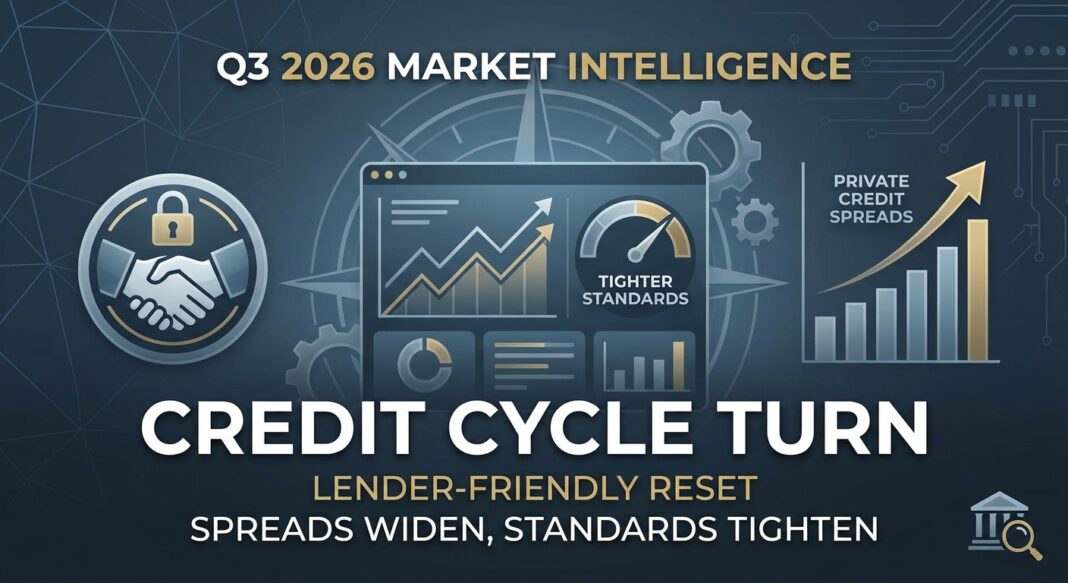
The Credit Cycle Has Turned — And the Reset Is Lender-Friendly
The defining story of Q3 2026 is not a crisis — it is a recalibration. After years of borrower-friendly terms, compressed spreads, and covenant-lite structures, the private credit market has undergone what Lord Abbett, writing in its midyear 2026 outlook, characterizes as a lender-friendly reset. The market has reset in a more lender-friendly direction. That reset is now structural, not cyclical. It is visible in spreads, in documentation, in KPI thresholds — and increasingly, in default data.
The macro catalyst for this shift arrived in early 2026 in compounding waves. Heightened volatility in early 2026, driven by AI-related disruption concerns and geopolitical developments, pushed credit markets back into price discovery mode. Those shocks — a renewed Middle East conflict, a sharp software sector selloff, and elevated redemption pressure at large private credit vehicles — triggered a meaningful repricing of risk. Spreads in private credit are back in the S+500 context, up from the mid-400 bps level seen in prior periods.
The regulatory backdrop has shifted in parallel. On December 5, 2025, the Office of the Comptroller of the Currency (OCC) and the Federal Deposit Insurance Corporation (FDIC) rescinded guidance on leveraged lending activities by banks — a move the agencies characterized as allowing banks to better apply enterprise-wide risk management and potentially create additional competition in the private credit loan market. The rescission also reflects a broader policy objective of the current administration to revise the prudential framework to reduce regulatory and supervisory constraints that had shifted significant portions of leveraged-lending activity outside the bank regulatory perimeter.
The net result entering Q4 2026: a market with better lender protections, rising default visibility, a structurally altered regulatory environment, and an improving M&A pipeline — but also one where dispersion between managers, sectors, and borrower quality is at its widest in years. Discipline, not deployment velocity, is the operative mandate.
Quantitative Market Snapshot — As of September 28, 2026
The table below consolidates six high-signal credit market metrics, each linked to its primary source. Taken together, they confirm a market in mid-to-late cycle reset: spreads wider, defaults rising from historic lows, bank lending standards stable after Q1 tightening, and the base rate environment still meaningfully elevated.
| Metric | Current Value | Prior Period | Source |
|---|---|---|---|
| Overnight SOFR | 3.88% (Sept. 24, 2026) | 3.64% (30 days prior) | SOFRrate.com / NY Fed |
| 3-Month Term SOFR | ~3.68–3.69% (Q2 2026) | ~3.68% (Q1 2026) | VRC Q2 2026 Private Markets Update |
| Middle Market Private Credit Spread (Core MM) | S+500 bps (approx.) | S+450–470 bps (mid-2025) | Hamilton Lane 2026 Private Credit Focus |
| Lower Middle Market Spread Premium vs. Large-Cap | +232 bps over large-cap | Widening trend from 2025 | Avante Capital Partners LMM Playbook |
| IG Corporate OAS / HY OAS (Public Markets) | IG: 79 bps | HY: 280 bps (Sept. 24, 2026) | IG: ~82 bps | HY: ~308 bps (early Mar. 2026) | StreetStats Finance |
| Fitch U.S. Private Credit Default Rate | 6.1% trailing 12 months (July 2026) — record high | Broadly syndicated loan default rate: 1.44% (Mar. 2026) | Angel Investors Network / Fitch via Yardeni |
| Median BDC Non-Accrual Ratio (Top 20) | 2.8% of cost (Q2 2026) | 2.0% (Q1 2026) | ~1.3–1.4% (end-2023 baseline) | Angel Investors Network / Solve / FT data |
Several cross-market dynamics deserve emphasis. As of September 24, 2026, investment-grade corporate bonds yield 5.90% with a spread of 79 bps over Treasuries, while high-yield corporates yield 7.80% with a spread of 280 bps. Against a private credit all-in yield in the 9–11% range for middle market senior secured loans (SOFR ~3.88% + S+500 bps), the illiquidity premium for private credit remains materially intact — particularly in the lower middle market.
Investment-grade corporate bond yields have climbed from 5.14% on June 24 to 5.90%, while spreads have remained within a relatively narrow range, moving from 0.75% on June 24 to a recent high of 0.82% before settling at 0.79%. The spread remains historically tight, reflecting resilient corporate fundamentals and contained default expectations, but provides limited protection against persistent inflation, elevated Treasury yields, or slower economic growth — with the recent increase in yields driven primarily by higher underlying rates rather than materially wider spreads.
On the public leverage side: Octus identified $9.98 billion of debt at cost in nonaccrual status in Q1 2026 — a dramatic 40% jump from $7.12 billion in Q4 2025. Industry non-accrual rates increased meaningfully during Q1 2026, with the acceleration concentrated among a small number of managers rather than reflecting broad-based credit deterioration. The distinction matters for manager selection.
Sector Analysis: Where Capital Is Flowing — and Where It Is Retreating
Healthcare: Dominant, But Concentration Risk Is Building
Healthcare has become the single largest sector for U.S. direct lending, accounting for roughly 22% of all direct lending issuance year-to-date through March 2026, up from 18% in 2025. Private credit has increasingly filled financing gaps for hospitals, physician platforms, behavioral health providers, and post-acute operators — supporting capital projects, acquisitions, technology investments, and balance-sheet refinancing when public markets or tax-exempt debt were less accessible. This growth has been fueled by healthcare’s defensive demand characteristics and predictable cash flows — but as private credit funds face redemption requests and closer oversight, the reliability and cost of this capital source may change, and the very concentration that made healthcare attractive to lenders is now becoming a point of exposure.
Separately, Morgan Stanley maintains a significant underweight to healthcare, which led all sectors in loans placed on non-accrual status over the last year. The divergence between healthcare’s macro tailwinds and its non-accrual concentration is a red flag operators and lenders must hold simultaneously.
Technology & Software: The Fault Line
Performance remains notably weaker in the software sector, where secondary spreads are approximately 245 basis points wider than year-end levels and roughly 229 basis points above the broader B-rated loan index, based on PitchBook LCD data as of June 19, 2026, reflecting continued uncertainty related to AI-driven disruption. Information technology stood out as the sector driving the most significant deterioration in non-accruals in Q1 2026.
Yet the broader technology narrative bifurcates sharply at the infrastructure layer. According to a Reuters analysis of the AI-driven data center boom, Morgan Stanley estimates private credit could supply more than half the $1.5 trillion needed for global data center buildouts through 2028. There is a rise in private credit financing in the technology space where borrowers are tapping private credit keen to support companies with scalable business models and strong growth potential, and private credit has been leading the development of financing structures for large-scale AI-related infrastructure. Lenders must distinguish between AI-disruptable software businesses (widening spreads, rising impairments) and AI-enabling infrastructure companies (strong origination pipeline, improving collateral).
Industrials & Energy: Geopolitical Premium Embedded
Energy-intensive industrials and manufacturing have attracted tighter underwriting following geopolitical disruptions in the Middle East and elevated energy costs. Capstone Partners’ Q1 2026 Middle Market Leveraged Finance Report confirmed that lenders responded to these shocks by tightening underwriting standards for businesses whose leverage was predicated on stable energy costs — and that oil price movements will remain a key variable for deal structuring over the next several quarters.
Infrastructure & Real Estate: Bank Retrenchment Creates Openings
In the real estate sector, private credit is playing a crucial role in financing development projects and acquisitions, particularly in light of tightening bank lending standards. In infrastructure, private credit is being used to fund large-scale projects such as renewable energy developments that require significant capital investment. The Q2 2026 SLOOS shows that bank lending standards to businesses of all sizes were steady during the second quarter, with banks easing CRE lending standards the most since early 2022. This CRE easing represents a near-term competitive dynamic for private lenders in real assets.
Capital Rotation Toward Specialist Strategies
Capital is increasingly shifting toward specialist strategies, including asset-backed finance, non-sponsor lending, and the selective use of leverage, with managers often accepting greater complexity and risk as they enact this shift. Fundraising remains heavily concentrated among a relatively small number of very large managers, whose biggest platforms continue to attract the majority of new capital — much of which ultimately competes for many of the same borrowers and sponsors. Better risk-adjusted opportunities may increasingly exist outside the most crowded segments of the market, particularly where lenders can negotiate tighter structures, stronger documentation, more meaningful covenant protections, and better economics.
KPI Thresholds & Underwriting Standards: What Lenders Require Now
The operative shift in underwriting is not merely directional — it is structural. New loans are increasingly coming with better credit structures: less leverage, more covenants, fewer PIK requests, and tighter documentation.
Fixed Charge Coverage Ratio (FCCR): Lenders are now underwriting to a forward-looking FCCR that incorporates expectations for interest rates — constraining the amount of debt a company can support and reducing available leverage multiples. A forward-looking FCCR stress test — adding 100 bps to floating rate debt and reclassifying 25% of projected capex as maintenance — that yields a ratio below 1.1x is increasingly viewed as insufficient early-warning protection in the current environment.
Loan-to-Value Ratios: Loan-to-value ratios remain conservative across segments, with stable LTVs indicating lenders have not materially loosened underwriting standards in the last three years — allowing for a significant first-loss capital cushion should credit markets deteriorate.
Interest Coverage: The underlying corporate borrower’s interest coverage ratio (EBITDA/interest) improved year-over-year due to lower interest rates and some EBITDA growth, though as borrower size increases, interest coverage ratios decrease. Lenders should apply size-adjusted coverage thresholds rather than uniform standards.
Covenant Structure: Through Q3 2025, nearly half of middle market deals carried two or more maintenance covenants, compared to only 10% for larger transactions — a structural advantage in early credit cycle detection for core middle market lenders.
PIK Stress as a Leading Indicator: The rise in payment-in-kind income is functioning as a canary in the credit mine. Lincoln International data shows 11% of tracked private credit portfolios carried PIK interest as of Q1 2025, of which 6% was classified as distress-driven “bad PIK” — loans amended after origination, with loan-to-value ratios that had risen from 49% to 86%. These borrowers are operationally distressed but do not yet appear in formal non-accrual tables.
Bank Standards (Fed SLOOS): The July 2026 SLOOS showed that, regarding loans to businesses over the second quarter, survey respondents reported basically unchanged standards for C&I loans to firms of all sizes. Banks reported that, on balance, the levels of standards are currently at the tighter end of the range for all loan categories except C&I loans, for which standards are generally easier than their midpoints. The stabilization of bank standards after the Q1 2026 tightening cycle signals a measured, not aggressive, credit contraction in the banking system.
Deal Flow, Fund Dynamics, and the Liquidity Fault Lines
According to Octus’ FY 2025 Direct Lending Analytics, large-cap deal activity surged 37% last year while middle-market deal flow increased 14% compared with 2024. LBO activity showed early signs of recovery in Q1 2026, increasing to approximately 40.3% of total deal volume from 36.2% in Q4 2025. However, in 2026 only 44% of volume has supported leveraged buyouts, with the majority allocated to add-ons, refinancings, recapitalizations and other transaction types — an improvement from a 32% share for buyouts at the same point last year, but still well below the 61% share in 2021.
The retail fund channel remains under structural pressure. Redemption requests at large private credit funds increased from approximately 1.7% of NAV in Q3 2025 to 4.7% in Q4 2025 and reached roughly 10–12% in Q1 2026, well above the typical 5% quarterly liquidity threshold, causing net flows to turn negative in early 2026 compared to average quarterly inflows of over $10 billion during the prior two years. Analysts broadly expect that evergreen retail funds in private credit will remain in net outflows throughout 2026 and likely 2027.
Institutional demand tells a different story. Many long-term allocators, including pension plans and insurers, continue to increase exposure to private credit, attracted by the asset class’s combination of income generation, diversification benefits, and historically attractive risk-adjusted returns in a higher-rate environment. Semi-liquid vehicles for the wealth channel now command almost a third of the $1 trillion U.S. direct lending market, with institutional demand also robust.
The forward M&A pipeline is the most constructive signal for lenders. Corporate M&A activity has remained strong, with transaction value increasing 71% year-to-date to $1.53 trillion in the Americas, according to LSEG, as corporate buyers continue to use M&A to drive scale and consolidation across industries. A strong financing environment, declining cost of capital, an improving IPO market, full banker pipelines, and record private equity backlogs are setting the stage for a broad-based recovery in middle-market M&A in 2026.
Implications for Institutional Investors and Business Operators
For Institutional Investors & Lenders
- Manager selection is paramount: Differences in underwriting standards, leverage levels, portfolio construction, documentation, and valuation assumptions are becoming increasingly important, yet many investors continue to allocate capital in a less differentiated manner. The record Fitch default rate of 6.1% and a near-doubling of BDC non-accruals since 2023 make vintage, sector, and manager-level due diligence non-negotiable.
- The lower middle market is the structural opportunity: The lower middle market spread premium over large-cap has widened to 232 basis points, a divergence most market commentary is missing. For allocators and sponsors focused on the $5M–$25M EBITDA segment, the combination of wider spreads, real covenants, and building deal flow from boomer succession creates a favorable setup.
- Stress-test coverage ratios proactively: With overnight SOFR at 3.88% and the Fed on hold, borrowers with floating-rate exposure and thin FCCR cushions face structural headwinds. Barring any unforeseen macro shock, the combination of declining interest expense and rising EBITDA levels should support improving fundamentals — but the benefit accrues unevenly.
- Monitor PIK income as a leading default indicator: Octus identified 32 borrowers accounting for $1.3 billion in principal that switched a portion or all of their interest to PIK in Q1 2026 after paying all-cash interest in Q4 2025. This cohort is the early warning cohort for the next non-accrual cycle.
For Business Operators & Borrowers
- Document your FCCR cushion before approaching lenders: The new underwriting standard requires a forward-looking stress test. Operators should independently calculate their FCCR under a +100 bps rate scenario before entering any capital raise process.
- Sector context will drive pricing: Conditions in the direct lending market stabilized during Q2 following volatility in March, and despite elevated redemption activity and a more hawkish outlook for interest rates, lending activity remains competitive — particularly for higher-quality deals. Borrowers in defensive sectors (healthcare services, essential infrastructure, government-contracted businesses) will continue to access capital at tighter spreads than those in cyclically exposed or AI-disrupted verticals.
- The bank re-entry creates real choice for upper-middle-market borrowers: As banks have gradually returned to the market in June 2026, they have contributed to increased competition in the upper middle market and alleviated some upward pressure on credit spreads. Banks are likely to interpret the OCC/FDIC rescission as providing additional flexibility to underwrite a wider range of loans — and as a result should be better able to compete with private credit providers. Borrowers with $50M+ EBITDA should run bank and private credit processes simultaneously.
Forward-Looking View: Q4 2026 and Into 2027
The Federal Reserve is expected to remain on hold for the rest of 2026, leaving the rate environment structurally elevated and floating-rate borrowers without near-term relief. Against that backdrop, three forward-looking dynamics will define the next two quarters:
1. Default dispersion, not systemic default: The record Fitch default rate of 6.1% should be read with precision. Despite redemption concerns, underlying credit fundamentals remain sound for seasoned portfolios: default rates and realized losses continue to track at historically low levels, with losses averaging approximately 0.8%–1.1%, and broader indicators such as PIK income and portfolio company performance remain stable. The stress is real but concentrated — in software-exposed credits, highly leveraged 2021-vintage LBO capital structures, and managers who sacrificed documentation quality for deal velocity during the boom.
2. The M&A unlock drives new origination: New deal demand and a large refinancing wave are expected to gradually overtake private credit supply, restoring the origination environment for disciplined lenders. A more active market gives lenders more to choose from — but stronger deal flow is only helpful if a manager has the ability and discipline to say no.
3. Regulatory re-entry by banks is real but bounded: The OCC/FDIC leveraged lending guidance rescission and the stabilization of bank C&I lending standards signal a gradual bank re-entry into the leveraged market. As Europe implements Basel IV, a major shift from bank lending — currently around 70% of total lending in Europe — toward private debt funds is expected, creating a transatlantic opportunity for U.S. private credit managers with European origination capabilities. Domestically, bank re-entry will primarily pressure large-cap private credit spreads, reinforcing the relative value case for the core and lower middle market.
4. The wealth channel stabilizes, but institutional capital leads: As there is a lot of money chasing fewer deals, returns for the next couple of years could become more attractive with better terms and covenants, and institutional fundraising is expected to increase over the next two years as spreads become more compelling. The era of retail-led private credit growth is pausing; the next capital formation cycle will be institutional-led, covenant-informed, and sector-selective.
Key Market Insights
- 🔴 Default rate at a record high, but dispersion is the story: Fitch’s U.S. private credit default rate reached 6.1% in July 2026 — a record — driven by AI-disrupted software credits and 2021-vintage leveraged buyouts. Broad-based systemic stress remains absent; manager and sector selection are the critical risk variables entering Q4.
- 📈 Spreads have reset higher and documentation has improved: Middle market private credit spreads are back in the S+500 bps context (up from mid-400 bps in 2025), and new deals increasingly carry maintenance covenants, reduced leverage, fewer PIK elections, and tighter documentation — a structural improvement in lender positioning.
- ⚖️ The OCC/FDIC deregulatory pivot is a competitive inflection point: The December 2025 rescission of the Interagency Leveraged Lending Guidance removes a decade-long structural tailwind that had pushed leveraged lending out of banks and into private credit. Upper-middle-market borrowers gain more optionality; private lenders must increasingly differentiate on execution speed, structure, and relationship depth.
- 🏥 Healthcare dominates but carries non-accrual concentration risk: Healthcare now accounts for ~22% of all U.S. direct lending issuance YTD through March 2026 — but it also led all sectors in loans placed on non-accrual status over the past year. Lenders and investors must disaggregate sub-sector exposure (physician platforms vs. hospitals vs. behavioral health) rather than treating healthcare as a monolithic defensive category.
- 🔍 Lower middle market offers the best structural risk/reward: With a 232 bps spread premium over large-cap, real maintenance covenants in ~50% of deals, and deal flow driven by demographic succession rather than sponsor optionality, the $5M–$25M EBITDA segment presents the most compelling lender-friendly setup in the current cycle — for managers who have the operational infrastructure to source, underwrite, and manage at that level.


