
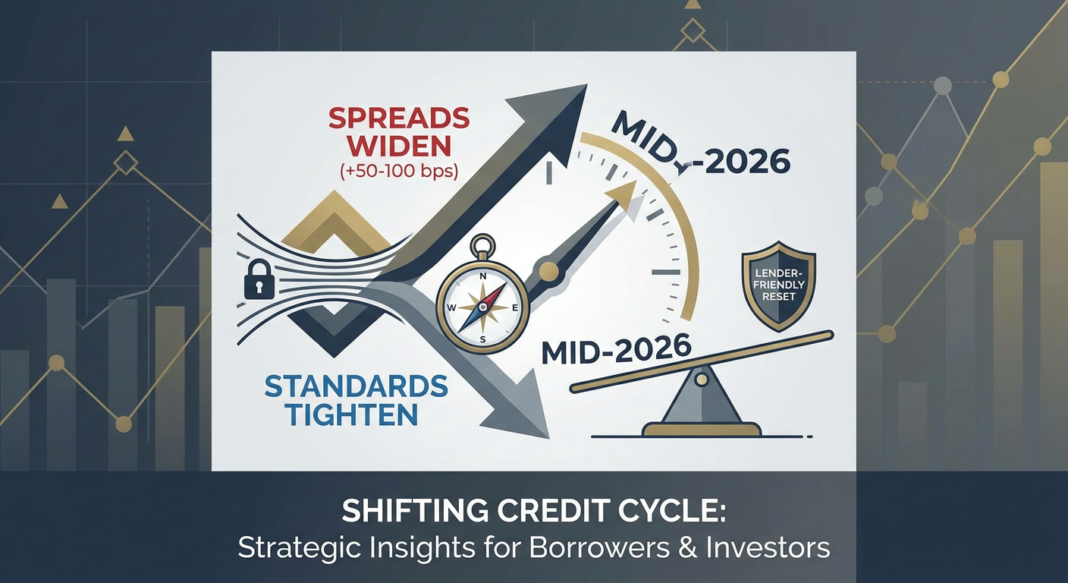
Market Headline: Three Shocks, One Reset — Credit Markets Pivot to Lender-Friendly Terrain
Credit markets entered 2026 on a wave of optimism, with consensus forecasts from Bank of America, Barclays, JPMorgan, and Morgan Stanley projecting a rotation from refinancing activity toward fresh M&A and LBO issuance. That thesis was rapidly stress-tested. As Capstone Partners documented in its Q1 2026 Middle Market Leveraged Finance Update, three converging and largely unforeseeable shocks derailed the momentum: the outbreak of the U.S.–Iran military conflict in late February 2026; an accelerating AI-driven reassessment of software sector credit quality; and a wave of BDC and private credit redemption requests that exposed structural vulnerabilities in retail-oriented fund vehicles.
The net result, as of late June 2026, is a market that has undergone a genuine structural reset — but one that tilts toward lenders rather than toward systemic stress. Lord Abbett’s 2026 Midyear Outlook characterizes the shift precisely: spreads have widened 50–100 basis points since late 2025, new loan structures increasingly feature tighter documentation and fewer PIK concessions, and capital selectivity has materially increased. For the first time in several years, disciplined lenders hold the upper hand in term negotiations.
Critically, this is not a systemic credit crisis. Hamilton Lane’s 2026 Private Credit Focus emphasizes that headline portfolio stress has been company-specific, not market-wide. Equity contributions in leveraged buyouts now stand at approximately 49% of total capitalization — versus roughly 33% in 2007 — meaning today’s credit structures carry meaningfully more equity cushion than prior late-cycle peaks. The operative question for the second half of 2026 is not systemic collapse, but dispersion: where stress concentrates, and whether lenders are structured to capture the current risk premium.
Quantitative Market Snapshot
The table below synthesizes current market metrics drawn from Federal Reserve SLOOS data, PitchBook LCD, Hamilton Lane, Valuation Research Corporation (VRC), Moody’s, and Capstone Partners. All figures reflect publicly available data as of Q1–Q2 2026.
| Metric | Current Value (Q1–Q2 2026) | Prior Period | Direction | Source |
|---|---|---|---|---|
| Middle Market Private Credit Spread (Direct Lending) | ~S+500 bps (SOFR + 500) | Mid-400 bps range (mid-2025) | ▲ Wider by ~50–100 bps | Hamilton Lane, Apr 2026 |
| B-Rated Secondary Loan Spreads | ~67 bps wider than year-end 2025 | Year-end 2025 baseline | ▲ Widening | VRC Q1 2026 Update |
| Direct Lending First Lien All-In Yield (Floor) | 8.0%–8.5% | 8.5%–9.5% (2024) | ▼ Slight compression from rate normalization, offset by wider spreads | Morgan Stanley IM, Dec 2025 |
| Fed SLOOS: Net % of Banks Tightening C&I Standards (Large & Mid-Market Firms, Q2 2026) | 8.1% | ~3–4% (Q4 2025) | ▲ Tighter | FRED / Federal Reserve SLOOS, May 2026 |
| Net % of Large Banks Tightening C&I Standards (Q2 2026) | 10.0% | Approx. 5% (Q4 2025) | ▲ Tighter | FRED / Federal Reserve SLOOS, May 2026 |
| Institutional Leveraged Loan Volume (Q1 2026 YoY Change) | ▼ −22.5% YoY | Q1 2025 | ▼ Material decline | Capstone / PitchBook LCD, May 2026 |
| HY Bond Spread (Investment Grade Corporate OAS, early 2026) | ~285 bps (HY); ~80 bps (IG) | HY ~250 bps (Nov 2025) | ▲ Modest widening in HY | InvestmentGrade.com, May 2026 |
| Private Credit Estimated Default Rate (incl. distressed exchanges) | ~1.6%–4.7% | <2% headline (2024) | ▲ Rising when LMEs included | Moody’s, Apr 2026 |
| LBO Equity Contribution (2025 vs. 2007) | ~49% equity / total cap | ~33% in 2007 | ▲ Structurally stronger equity cushion | Hamilton Lane, Apr 2026 |
Data as of Q1–Q2 2026 unless noted. Sources linked above. All metrics for informational purposes only.
FCCR and Leverage Multiple Context
The higher-for-longer rate environment is imposing measurable pressure on borrower-level fixed charge coverage ratios (FCCR). Lincoln International’s analysis notes that lenders are now underwriting to a forward-looking FCCR that incorporates sustained rate expectations, constraining the amount of debt a company can structurally support and, by extension, compressing achievable leverage multiples. Average leverage for lower middle-market companies (sub-$250M EV) is currently tracking at approximately 3.2x EBITDA, compared with 5.9x for companies above $1 billion in enterprise value, according to J.P. Morgan Asset Management data cited by CapitalPad. Meanwhile, the April 2026 SLOOS confirmed that moderate-to-significant net shares of banks reported tighter loan covenants and higher premiums on riskier C&I loans — underscoring that structural underwriting discipline is now a cross-market phenomenon, not a private credit anomaly.
Sector Analysis: Divergent Lender Appetite Across Key Industries
Software & Technology: Structurally Repricing
Software is the single most consequential sector story in credit markets today. Lord Abbett’s Midyear Outlook notes that software represents approximately 20% of private market leveraged credit exposure — versus roughly 13% in the broadly syndicated loan market — making the sector’s AI-driven dislocation an outsized risk for private portfolios. A large cohort of enterprise software transactions financed between 2019 and 2022 during the zero-rate era are now facing deteriorating free cash flow dynamics as AI-driven disruption pressures revenue retention. Bain & Company’s PE Midyear Report 2026 quantifies the deal fallout: tech deal value dropped 70% from Q4 2025 to Q1 2026, driven by valuation uncertainty. VRC’s Q1 2026 pricing matrix increased spread ranges by 25 bps across all credit instruments, with technology and software loans pricing at wider-than-average premiums due to rising loan-to-value ratios. The January 2026 SLOOS confirmed banks are materially less likely to approve C&I loans to firms adversely affected by AI — a directional signal that private credit lenders are now pricing into deal structures.
Healthcare: Non-Accrual Risk Rises Despite Defensive Appeal
Healthcare presents a bifurcated picture. Structurally, demographic tailwinds and non-cyclical service models continue to attract lender interest in the sector’s recurring-revenue niches. However, Morgan Stanley IM’s Direct Lending team maintains a significant underweight to healthcare, which has led all sectors in loans placed on non-accrual status over the past year. Reimbursement pressures, labor cost inflation, and payor-mix headwinds are compressing EBITDA margins across provider-facing healthcare sub-sectors, eroding FCCR headroom. Selective lenders are differentiating sharply between asset-light healthcare services businesses with long-term contracted revenue versus capital-intensive provider platforms with variable reimbursement risk.
Industrials & Energy-Sensitive Sectors: Macro-Driven Caution
The U.S.–Iran military conflict introduced persistent upward pressure on oil and energy costs that is flowing directly into underwriting for industrial and manufacturing borrowers. Capstone Partners’ Q1 2026 report documents that lenders have tightened underwriting standards for energy-intensive industries and businesses whose leverage was predicated on stable energy costs. Higher transportation and feedstock costs are directly reducing EBITDA and compressing debt capacity for affected borrowers, with lenders stress-testing energy-cost scenarios before committing to new leveraged structures. Conversely, Morgan Stanley IM notes that over the medium term, supply-chain resiliency investment, defense spending, and AI-driven logistics growth should support incremental industrial demand, creating selective opportunities for lenders with sector expertise.
Asset-Backed Finance & Infrastructure: Capital Is Flowing In
The clearest sector beneficiary of the current market reset is asset-backed finance, particularly data center and AI infrastructure lending. IQ-EQ’s 2026 market outlook identifies that the five major hyperscalers alone have announced more than $1.5 trillion in capital expenditure over the next five years, driving demand for flexible, long-dated financing solutions that private credit is structurally positioned to provide. This collateral-backed lending enjoys stronger structural protections and more visible cash flows than corporate cash-flow lending — characteristics that are highly valued in a tightening cycle. ABF Journal’s analysis through May 30, 2026 confirms the structural shift: asset-based and non-bank structures are capturing a growing share of middle-market deal flow as banks continue to pull back from cash-flow lending.
Implications: What the Reset Means for Borrowers and Investors
For Borrowers and Operators
The borrower-friendly conditions that prevailed from 2023 through mid-2025 — tight spreads, loose covenants, high leverage, and flexible documentation — have materially reversed. Lord Abbett confirms that new loans are increasingly structured with less leverage, more maintenance covenants, fewer PIK concessions, and tighter documentation. Operators seeking capital must now demonstrate durable free cash flow — not just EBITDA — to satisfy forward-looking FCCR thresholds that incorporate a sustained higher rate environment. Businesses reliant on aggressive EBITDA add-backs (restructuring charges, cost-saving synergies, and projected improvements) face heightened lender scrutiny: Private Equity Bro’s covenant guide notes that add-backs representing 30% or more of reported EBITDA erode FCCR’s early-warning value, a dynamic lenders are actively correcting for. For borrowers in the refinancing wave — McKinsey estimates more than $620 billion in high-yield bonds and leveraged loans face maturity in 2026–2027 — early engagement with lenders and proactive covenant management are now strategic imperatives.
For Institutional Investors and Credit Allocators
The structural reset creates a compelling asymmetry for disciplined private credit allocators. Hamilton Lane’s 2026 analysis frames the dynamic clearly: periods of volatility cause banks to retrench, creating better pricing and structural protections for private credit lenders. Spreads returning to the SOFR+500 context — up from mid-400s in 2025 — are yield-enhancing, particularly for senior secured, first-lien direct lending strategies. However, the Financial Stability Board’s May 2026 report on private credit vulnerabilities raises important structural cautions: evolving structures including covenant-lite documentation, PIK income, NAV-based lending, and layered fund-level leverage can obscure underlying risk. Moody’s notes that PIK income as a share of public BDC investment income continues to rise, and that average PD-implied risk for public BDCs now exceeds that of Baa-rated public corporates by the widest margin since post-pandemic normalization. Manager selection and vintage-year analysis are not optional — they are the primary determinants of realized return in this environment.
Forward-Looking View: Liquidity, Lending Dynamics, and H2 2026
The second half of 2026 will be defined by dispersion rather than direction. Lord Abbett’s Midyear Outlook frames the H2 2026 question as not whether stress will emerge, but where it concentrates and whether lenders are adequately compensated and structurally protected. Portfolios with exposure to 2021–2022 software-heavy vintages, high PIK income, and aggressive EBITDA add-back structures face the highest discrimination risk. Conversely, senior secured lenders in core middle-market, non-cyclical sectors stand to benefit from a supply-demand imbalance that is increasingly tilting in their favor.
The regulatory environment adds a further dynamic. The OCC and FDIC’s December 2025 rescission of the 2013 Interagency Leveraged Lending Guidance — as noted by Chambers & Partners’ 2026 Private Credit Guide — grants private credit lenders greater flexibility to underwrite a broader range of loans and to establish institution-specific definitions of leveraged lending. Simultaneously, proposed relaxation of bank capital rules under Basel III Endgame could re-energize bank competition in large-cap financing — a dynamic already visible in JPMorgan’s $20 billion acquisition financing for Electronic Arts. The tug-of-war between banks and private credit is just beginning, and the battleground will be the mid-market, where private lenders retain the structural advantages of speed, covenant flexibility, and relationship capital that banks cannot easily replicate.
Moody’s baseline economic forecast places 2026 GDP growth at roughly 1.5% — just above the historical “stall speed” below which defaults tend to accelerate — leaving a narrow margin of safety. Markets have sharply reduced expectations for Federal Reserve rate cuts, reinforcing the higher-for-longer environment that disproportionately pressures floating-rate borrowers. For credit allocators, the structural case for private credit remains intact — but the alpha increasingly resides in manager discipline, sector selection, documentation quality, and the willingness to say no.
Key Market Insights
- Spread Reset Is Real and Lender-Favorable: Middle-market private credit spreads have moved from the SOFR+400s back into the SOFR+500 context — a 50–100 bps widening since late 2025 — alongside tighter documentation and fewer PIK concessions. This structural improvement in loan terms may matter more than the spread move itself for long-run risk-adjusted returns. (Hamilton Lane; Lord Abbett)
- Bank Tightening Accelerates Private Credit Opportunity: The April 2026 SLOOS confirmed tighter C&I lending standards across banks of all sizes — with 10.0% of large banks net tightening for large and mid-market firms — and the April SLOOS also documented tighter standards across all categories of NDFI (non-depository financial institution) loans, including to private equity funds. This tightening structurally widens the private credit opportunity set in the middle market. (FRED / Federal Reserve SLOOS; April 2026 SLOOS)
- Software Is Not a Monolith — Underwriting Must Differentiate: With software representing ~20% of private credit portfolios, AI disruption is a top-tier risk. But outcomes will be company-specific. Mission-critical, deeply entrenched SaaS platforms with contracted revenue and low churn are fundable at lender-friendly terms; general-purpose software models exposed to agentic AI displacement are facing materially tighter access to leverage and higher risk premiums. (Hamilton Lane; Lord Abbett)
- FCCR and Covenant Integrity Are the New Credit Alpha: In a higher-for-longer environment, forward-looking FCCR thresholds — not backward-looking EBITDA multiples — are the primary constraint on leverage capacity. Operators and sponsors relying on large EBITDA add-backs (some representing 30%+ of reported earnings) should expect heightened lender scrutiny. Lenders re-establishing maintenance covenants are regaining early-warning capability that was systematically stripped from covenant-lite structures during the post-2020 easy-money cycle. (Lincoln International; Private Equity Bro)
- The $620B+ Refinancing Wave Defines the Next 18 Months: More than $620 billion in high-yield bonds and leveraged loans are approaching maturity in 2026–2027, creating a large-scale demand event for flexible private credit solutions. Borrowers that can demonstrate durable free cash flow, manageable leverage at current rates, and clean documentation will access capital at competitive terms. Those that cannot will face materially higher pricing, tighter covenants, or may be redirected toward asset-backed structures — or distressed channels. (IQ-EQ / McKinsey; ABF Journal)


