
Market Headline: The Credit Cycle Has Turned — Lenders Are Back in the Driver’s Seat
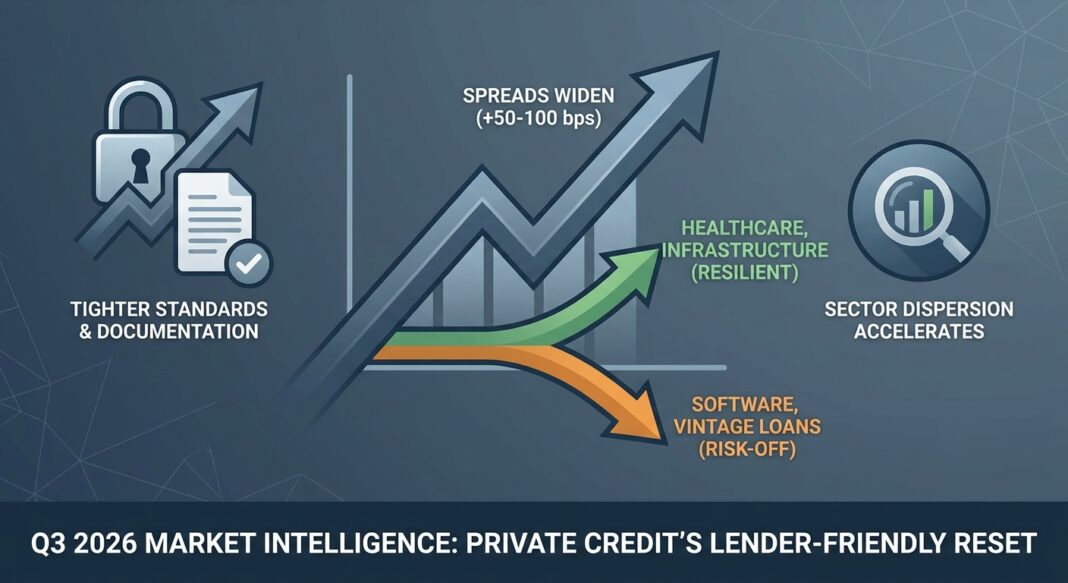
Midway through 2026, the private credit market has undergone a decisive regime shift. After a prolonged period of spread compression driven by a capital supply glut, the market is resetting in a structurally more lender-favorable direction — and the data confirm it is not a transient blip. According to Lord Abbett’s Midyear 2026 Outlook, spreads have widened by roughly 50 to 100 basis points since late 2025, while new loans are increasingly structured with tighter documentation, fewer PIK requests, and more conservative leverage.
The macro backdrop reinforces this posture. The Federal Reserve’s April 2026 SLOOS confirmed that banks tightened lending standards for C&I loans across all firm sizes in Q1 2026, while simultaneously tightening all terms on loans to non-depository financial institutions — a signal that regulatory pressure is constraining bank capacity precisely as private lender discipline is increasing. By Q3 2026, the Fed’s SLOOS showed a net zero reading for C&I standards applied to large and middle-market firms, suggesting stabilization — but small business lending remains under mild tightening pressure, with a +1.8% net tightening reading as of August 2026.
Geopolitical shocks — including the coordinated military operation against Iran in early 2026 — introduced decision-making paralysis across multiple sectors, stalling primary lending markets in March 2026 and triggering risk-off repricing in software and technology credits. However, conditions stabilized in Q2, with deal flow recovering and higher-quality borrowers continuing to access competitive pricing.
The net result: disciplined lenders with available capital are operating in the most structurally favorable origination environment since 2022. The market is bifurcating sharply — between high-quality, covenant-rich credits in resilient sectors and aggressively structured 2021–2022 vintage loans facing non-accrual and restructuring pressure. Understanding where each borrower sits in that distribution is the central underwriting challenge of the current cycle.
Quantitative Market Snapshot — Key Metrics as of September 26, 2026
| Metric | Current Level | Prior Period | Change | Source |
|---|---|---|---|---|
| SOFR (Overnight) | 3.88% | 3.68% (3-mo Term SOFR, Q2 2026) | +~20 bps | NY Fed, Sept 24, 2026 |
| Middle Market Unitranche Spread | SOFR + 475–550 bps | SOFR + 450–525 bps (Q4 2025) | +~25 bps (QoQ); +50–100 bps vs. late-2025 trough | VRC Q2 2026; Lord Abbett Midyear 2026 |
| LMM Unitranche All-In Yield | 9.7%–11.6% (incl. OID) | ~9.0%–10.5% (year-end 2025) | Wider by ~100–110 bps | CT Acquisitions / Q2 2026 Market Data |
| HY Bond Effective Yield (ICE BofA) | 7.80% (spread: 280 bps over Treasuries) | ~7.0% (July 2026) | +80 bps (July → Sept) | StreetStats Finance, Sept 24, 2026 |
| Private Credit vs. HY Yield Premium | ~150–200 bps (compressed from ~350 bps in 2019) | ~350 bps (2019 historical norm) | Premium compressed by ~150–200 bps over cycle | Owners.pe Private Credit vs. HY Analysis, 2026 |
| BDC Non-Accrual Rate (Top 10, at cost) | 3.95% (Q2 2026) | 1.9% (Q1 2026) / ~1.3%–1.5% (2024 avg.) | +205 bps YTD | Morningstar / PitchBook LCD, Aug 2026 |
| Direct Lending Default Rate | ~5.6%–6.1% (Fitch record high, July 2026) | ~2.0%–2.5% (historical average) | Approx. 2.5–3x above historical norm | Fitch / Yardeni Private Credit Monitor, 2026 |
| Software Sector Secondary Spread Premium | ~229 bps above broad B-rated loan index | ~0–50 bps premium (year-end 2025) | +~180 bps YTD | PitchBook LCD / VRC, June 19, 2026 |
| Fed SLOOS — C&I Standards (Large/Mid Firms) | Net 0.0% tightening (Q3 2026) | Net tighter in Q1 2026 | Stabilized; small firms still face mild net tightening (+1.8%) | FRED / St. Louis Fed SLOOS, Aug 3, 2026 |
Key KPI Context for Underwriters
- Fixed Charge Coverage Ratio (FCCR): Lenders are increasingly requiring FCCR above 1.2x–1.5x at close for new credits. As SOFR has declined from its 2023 peak and EBITDA recovery accelerates among PE-backed borrowers, coverage ratios have improved modestly — but elevated PIK activity and aggressively structured 2021–2022 vintage credits continue to mask underlying coverage weakness in a subset of portfolios.
- Net Leverage: Lord Abbett notes that new loans in 2026 are coming with less leverage, more covenants, and fewer PIK requests — a structural improvement from the covenant-lite environment of 2021–2022. Unitranche leverage multiples for new LMM credits have compressed to the 4.5x–5.5x EBITDA range, down from 5.5x–6.5x at the peak.
- Distressed Ratio: The leveraged loan distressed ratio reached 8.89% in February 2026, signaling elevated leading-indicator stress that disciplined underwriters cannot ignore in forward deal analysis.
Sector Analysis: Lender Appetite, Structural Shifts, and the Dispersion Trade
Healthcare — The Perennial Anchor
Healthcare has cemented its position as the dominant sector in U.S. direct lending. RSM’s Real Economy analysis confirmed that healthcare accounted for roughly 22% of all direct lending issuance year-to-date through March 2026, up from 18% in 2025 — making it the single largest sector by deal share. Critically, healthcare was the only major sector not to see significant year-over-year pricing compression in 2025, with spreads averaging approximately SOFR+500 bps in Q4 2025, according to Octus data.
The risk-adjusted returns in healthcare private credit justify the attention: according to investment consultancy bfinance, via White & Case’s Debt Explorer, specialist private credit healthcare funds have posted median net IRRs of 15%, compared to 11% for generalist U.S. direct lending funds. Demographic tailwinds, non-cyclical service models, and ongoing PE-backed consolidation of physician platforms, behavioral health providers, and post-acute operators continue to generate durable deal flow.
Note: Morgan Stanley maintains a selective underweight to certain healthcare sub-segments citing non-accrual concentration; lender-level diligence on sub-sector differentiation — particularly distinguishing healthcare IT from clinical services — remains essential.
Software & Technology Services — Risk-Off and Repricing
Software represents the most significant structural stress point in the current cycle. VRC’s Q2 2026 Private Markets Report showed that secondary software spreads are approximately 245 basis points wider than year-end levels and roughly 229 basis points above the broader B-rated loan index, reflecting continued uncertainty related to AI-driven disruption. CAIA Association analysis flagged software as approximately 26% of BDC portfolio exposure — the single largest sector concentration across the BDC universe, making it the primary driver of elevated non-accruals.
Lenders are now applying distinct underwriting frameworks: profitable, mission-critical software platforms with demonstrable AI resilience are assessed separately from pre-profitability ARR borrowers or companies facing direct AI substitution risk. Capstone Partners’ Q1 2026 Middle Market Leveraged Finance report notes that lenders have responded by tightening underwriting standards for technology credits perceived as carrying AI displacement exposure.
Infrastructure, Asset-Based Finance & AI Build-Out — The Growth Vectors
Infrastructure and asset-backed credit have emerged as the clearest growth vectors in the current cycle. Morgan Stanley estimates, cited in a Think Realty analysis, suggest that private credit could supply more than half of the $1.5 trillion needed for global data center buildouts through 2028. The AI-driven capex supercycle is creating large, structured financing opportunities that are suited to private credit’s ability to offer bespoke terms and execution certainty — a structural competitive advantage over public debt markets for complex, asset-intensive transactions.
In Europe, as Within Intelligence’s 2026 Outlook notes, the implementation of Basel IV is expected to drive a major shift away from bank lending — currently around 70% of total lending in Europe — toward private debt funds, with Apollo Global Management and Ares Management among those citing a “substantial origination opportunity” on the continent.
Lower Middle Market (LMM) — Structural Premium Intact
The spread divergence between the large-cap and lower middle market is one of the most underreported structural stories of 2026. Avante Capital Partners’ LMM analysis found that the LMM spread premium over large-cap widened to 232 basis points in Q3 2025, and the structural drivers remain intact heading into late 2026: the capital wave of large institutional dry powder has not penetrated the $5M–$25M EBITDA segment, real covenants remain prevalent, and deal flow is building from boomer succession dynamics. For allocators with the origination capability to operate in this segment, the risk-adjusted opportunity set is materially superior to the large-cap market.
Implications: What This Means for Borrowers, Lenders, and Operators
For Borrowers and Operators
The era of covenant-lite terms at compressed spreads is over for most borrowers outside the upper-large-cap tier. Cleary’s 2026 Private Credit Outlook notes that while large-cap borrowers retain meaningful negotiating leverage, mid-market and smaller operators should expect more detailed information requests, stricter covenant packages, and higher pricing for credits perceived as carrying execution or sector risk. Operators with energy-intensive cost structures, AI-exposed software revenue, or heavy 2021–2022 vintage leverage face the most acute refinancing risk as those facilities approach maturity.
Borrowers who can demonstrate FCCR above 1.2x–1.5x, clearly articulate their AI resilience narrative, and present diversified revenue with recurring characteristics will continue to access competitive financing. Capital structure optimization — including proactive amortization, covenant compliance ahead of reset dates, and lender communication cadence — is becoming a strategic operational priority, not merely a treasury function.
For Institutional Investors and Lenders
Lord Abbett’s midyear analysis is direct: the most durable advantage in this market comes from better documentation, more conservative leverage, and the analytical capacity to conduct stress analysis before capital is deployed. Scaled platforms with deep sponsor relationships and broad origination networks are best positioned to take advantage of the improved opportunity set while managing dispersion risk across legacy portfolios.
Morgan Stanley’s Private Credit Midyear 2026 Outlook observes that long-term allocators including pension plans and insurers continue to increase exposure, attracted by income generation and historically attractive risk-adjusted returns in the higher-rate environment. However, Markets Media analysis projects that evergreen retail funds in private credit will remain in net outflows throughout 2026 and likely into 2027 — creating a structural divergence between institutional and retail fund dynamics that warrants careful liquidity management at the fund structure level.
Non-accrual and PIK usage trends, 2021–2022 vintage concentration, and software sector exposure should all be treated as leading indicators, not lagging ones. PitchBook LCD’s August 2026 BDC analysis found that adjusted non-accrual exposure across the top 10 public BDCs reached 5.95% of total debt at cost in Q2 2026 — a 54 bps sequential increase — with the number of borrowers in non-accrual status rising to 101, up by 11 in a single quarter.
Forward-Looking View: H2 2026 Liquidity and Lending Dynamics
The base case for H2 2026 and into 2027 is a market defined by selective credit availability, moderate spread stability, and accelerating performance dispersion. Several forces will shape the trajectory:
Rate environment: Breckinridge Capital Advisors’ Q3 2026 Corporate Bond Market Outlook indicates that the Fed is expected to remain on hold for the rest of 2026, with AI-related capex and sticky inflation keeping growth and rates above target. VRC’s Q2 2026 report confirms that the forward SOFR curve remains roughly 50 basis points above year-end 2025 levels, supporting above-historical all-in yields for new vintage credit — a favorable setup for lenders deploying fresh capital.
Deal flow recovery: Octus data confirm that large-cap deal activity surged 37% in 2025 while middle-market deal flow increased 14% year-over-year. Buyout activity is expected to continue recovering in H2 2026 as PE sponsors address extended hold periods — PitchBook projects that buyout volume will improve but not set records, with M&A broadening across technology, healthcare, industrials, and media.
Regulatory evolution: The Fed’s April 2026 SLOOS introduced new special questions specifically targeting non-depository financial institution (NDFI) lending standards — the first formal monitoring expansion into private credit intermediaries. This signals growing systemic oversight attention that institutional managers should anticipate will result in increased disclosure requirements, tighter bank-to-fund leverage terms, and evolving covenant frameworks over the next 12–18 months.
Manager dispersion: Lord Abbett expects the gap between stronger and weaker portfolios to become more visible as the year progresses, with non-accruals, PIK usage, sector concentration, and 2021–2022 vintage exposure as the primary differentiating indicators. Allocators who conducted rigorous due diligence on manager underwriting discipline — rather than simply chasing headline yield — will be rewarded in the current environment. The market is, in the most constructive sense, becoming more efficient at pricing manager quality.
Key Market Insights — Actionable Intelligence for Bond Capital
- 📊 The lender-friendly reset is real and durable: Spreads are 50–100 bps wider than late-2025 levels, covenants are strengthening, and leverage is being applied more conservatively — particularly for software, technology services, and energy-exposed credits. Disciplined lenders with available capital are operating in the most structurally favorable origination environment since 2022. (Source: Lord Abbett Midyear 2026; Hamilton Lane 2026)
- ⚠️ Software sector risk is idiosyncratic, not systemic — but concentration matters: Secondary software spreads are ~229 bps above the broad B-rated loan index and require case-by-case underwriting. Portfolios with vintage 2021–2022 software concentration face elevated restructuring and non-accrual exposure. Profitable, mission-critical software platforms with demonstrable AI resilience should be evaluated separately from pre-profitability ARR borrowers. (Source: VRC Q2 2026; Lord Abbett Midyear 2026)
- 🏥 Healthcare and LMM remain the highest-conviction sectors for new deployment: Healthcare accounts for 22% of all direct lending issuance YTD through March 2026 and generates specialist fund median net IRRs of 15% vs. 11% for generalist platforms. The LMM spread premium over large-cap remains at ~232 bps — a structural alpha source that the large institutional capital wave has not yet compressed. (Source: RSM Real Economy 2026; bfinance / White & Case Debt Explorer; Avante Capital)
- 📉 Non-accruals are a leading indicator, not a lagging one — act accordingly: BDC adjusted non-accrual exposure reached 5.95% of total debt at cost in Q2 2026, up 54 bps in a single quarter. Direct lending default rates have hit a record 6.1% per Fitch, versus a 2.0%–2.5% historical average. Portfolios must be stress-tested now against a scenario where Morgan Stanley’s projected 8% default rate materializes over the next 12 months. (Source: Morningstar / PitchBook LCD, Aug 2026; Fitch / Yardeni, 2026)
- 🌍 The illiquidity premium over public high yield has compressed structurally — re-underwrite the relative value case: Private credit’s yield premium over public high yield has narrowed from ~350 bps in 2019 to ~150–200 bps today. With the ICE BofA HY index yielding 7.80% at a 280 bps spread (as of September 24, 2026), the return case for private credit must increasingly rest on structural protections, covenant quality, and superior recovery rates — not simply raw yield pickup. Allocators should formally re-underwrite the relative value case in their allocation frameworks. (Source: StreetStats Finance, Sept 24, 2026; Owners.pe, 2026)


