
Market Headline: The Great Recalibration
The U.S. private credit market entered the second half of 2026 in a state of fundamental repricing. After years of compressed spreads and borrower-friendly terms, three convergent shocks — the U.S.–Iran military conflict, an AI-driven reassessment of software credit quality, and a wave of BDC redemption requests — have forced a structural reset that is reshaping lender appetite, deal economics, and underwriting standards across the credit stack.
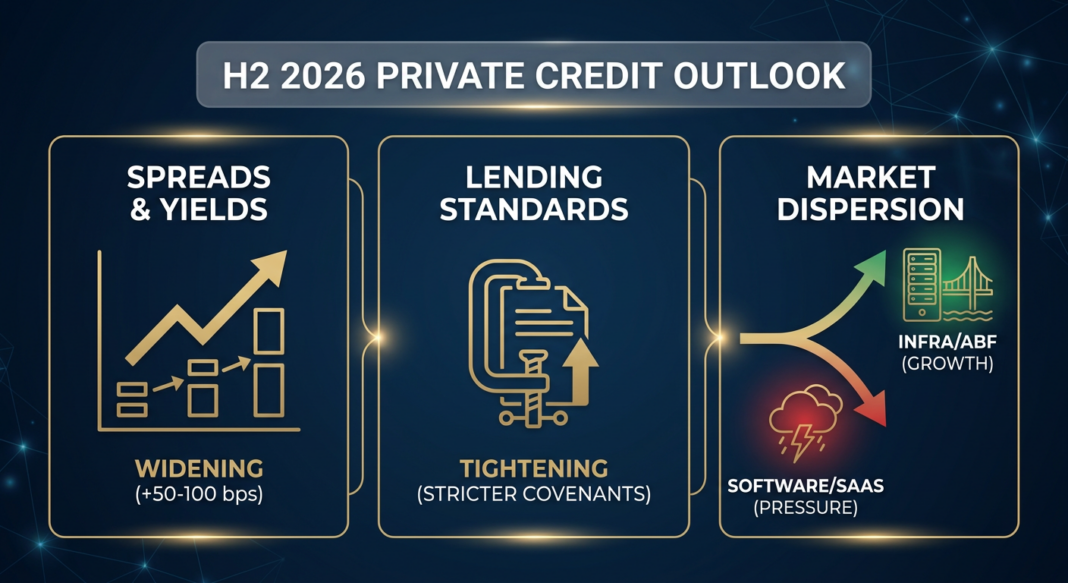
The headline story is not a credit crisis. It is a selective lender-friendly recalibration. According to PitchBook data cited by Lord Abbett at midyear, private credit spreads have widened by roughly 50 to 100 basis points since late 2025, while loan documentation has materially improved — with fewer PIK requests, tighter covenants, and less aggressive leverage. New loans are increasingly coming with better credit structures, making today’s environment potentially more attractive for disciplined lenders than the tighter conditions of six months ago.
At the same time, PitchBook LCD’s Q2 2026 wrap confirms that direct lending volumes fell sharply quarter-over-quarter, with deal flow particularly weak among PE-backed borrowers. The result is a bifurcated market: capital is plentiful but selective, deal structures are improving, and the H2 2026 outlook will be defined by dispersion — between sectors, vintages, and manager quality.
Quantitative Market Snapshot
The following data box summarises the key market metrics as of mid-July 2026, drawing on the most recent published data from the Federal Reserve, PitchBook LCD, Valuation Research Corp. (VRC), Proskauer, and Hamilton Lane.
| Metric | Current Reading | Prior Period | Change | Source |
|---|---|---|---|---|
| Middle Market Private Credit Spreads (unitranche) | SOFR + 475–550 bps | SOFR + 425–475 bps (YE 2025) | +50–100 bps wider | VRC Q2 2026 Report |
| Direct Lending First Lien Yields (unitranche, all-in) | ~8.0–8.5% (floor range) | ~8.5–9.5% (H1 2025) | Modest compression vs. prior year peak | Morgan Stanley MSIM Outlook 2026 |
| Software Sector Secondary Loan Spreads vs. B-Rated Index | ~+229 bps above B-rated index | At-index (YE 2025) | +245 bps wider vs. YE 2025 | VRC / PitchBook LCD (June 19, 2026) |
| Q2 2026 Direct Lending Deal Volume (LCD) | $29.2B across 138 transactions | $74.1B across 217 deals (Q1 2026) | -61% by volume vs. Q1 2026 | PitchBook LCD Q2 2026 Wrap |
| Fed SLOOS: Net % Banks Tightening C&I Standards (Large & Middle Market) | +8.1% net tightening (Q2 2026) | Tighter in Q1 2026 (January SLOOS) | Sustained tightening bias in 2026 | Federal Reserve FRED / SLOOS (May 2026) |
| Private Credit Default Rate (Proskauer Index, Q1 2026) | 2.73% (697 loans, $189.2B tracked) | 1.84% (two quarters earlier) | +89 bps rise | Proskauer Private Credit Default Index, via Forbes |
| 3-Month Term SOFR (June 2026) | 3.68–3.69% | ~3.50–3.75% (Fed funds target range, Q1 2026) | +1 bp QoQ; higher-for-longer path confirmed | VRC Q2 2026 / Federal Reserve |
| Private Credit CLO Issuance YTD (mid-June 2026) | $17.3B (mid-June) | Comparable to H1 2025 pace | Stable; AAA tranches pricing at ~148 bps over benchmark | PitchBook, via Benzinga (July 2026) |
KPI Underwriting Environment: FCCR & Leverage Multiples
The higher-for-longer rate environment is having a direct and measurable impact on lender underwriting thresholds. Lincoln International has documented that lenders are now underwriting to a forward-looking Fixed Charge Coverage Ratio (FCCR) that incorporates forward rate expectations, structurally constraining the quantum of debt a company can support and compressing leverage multiples at the point of origination. Companies carrying the same absolute debt load as in 2022 are often now facing all-in interest costs that have doubled — a dynamic that is directly eroding FCCR headroom and tightening effective debt-to-EBITDA capacity across the middle market.
S&P data cited by Columbia Threadneedle estimates that debt-to-EBITDA ratios have reached 7.5x–8x in some sectors, excluding EBITDA addbacks, while PIK loans now account for more than 11% of the market — up from roughly 5% in early 2022. Meanwhile, Coller Private Credit Secondaries (SEC N-CSR filing) reports that stronger EBITDA growth has supported a lift in median interest coverage to 1.6x on a portfolio basis, while the company-count default rate on an LTM basis showed a first decline from Q1 2025 levels to 3.1%, offering a degree of macro stability beneath the headline volatility.
The Federal Reserve’s April 2026 SLOOS confirmed that over Q1 2026, banks reported tighter lending standards for C&I loans of all sizes. Critically, a new set of special questions on non-depository financial institution (NDFI) loans revealed that significant net shares of banks have tightened standards for business credit intermediaries — a direct read-through to private credit fund lending costs and access to bank-provided leverage facilities.
Sector Analysis: Who’s Hot, Who’s Scrutinised, and Where the Structural Shift Is
🔴 Under Pressure: Software & SaaS
Software remains the sector under the most acute lender scrutiny. VRC’s Q1 2026 Credit Update notes that technology and software services loans continue to price at wider-than-average premiums, with secondary spreads approximately 245 bps wider than year-end 2025 levels, reflecting continued uncertainty around AI-driven disruption to SaaS business models. Lord Abbett (PitchBook data) points out that private leveraged finance markets carry roughly 20% software exposure versus ~13% in the liquid market — a structural overweight that amplifies the sector’s impact on portfolio performance. New software-related direct lending transactions are pricing at premiums of approximately 75–100 bps above year-end 2025 levels, per VRC’s standard pricing matrix. Lenders are now evaluating AI-impacted borrowers on a case-by-case basis, with particular focus on 2019–2022 vintage loans — a cohort financed when rates were low and AI disruption was not a central underwriting concern.
🟡 Selectively Active: Healthcare
Octus Data confirms that healthcare led all sectors in private credit deal activity in 2025, accounting for 19% of all direct lending transactions. It was also the only industry not to see significant year-over-year price tightening, with spreads averaging approximately SOFR + 500 bps in Q4 2025. However, some institutional managers are now trimming healthcare exposure: Morgan Stanley MSIM has flagged a significant underweight to healthcare in certain strategies, noting that the sector has led all industries in loans placed on non-accrual status over the past year — a divergence between deal volume leadership and credit performance. The Financial Stability Board has specifically flagged the concentration of private credit in technology, healthcare, and services as a systemic surveillance concern.
🟢 Strong Structural Demand: Infrastructure, Data Centers & Asset-Based Finance
The most structurally compelling growth areas in 2026 are those insulated from AI disruption risk. Creative Planning, citing Reuters/Morgan Stanley analysis, estimates that private credit could supply more than half of the $1.5 trillion needed for global data center buildouts through 2028, with AI-related private credit loans having nearly doubled in the 12 months through early 2025 (UBS data). Infrastructure debt and asset-based finance (ABF) are seeing growing capital reallocation, with With Intelligence projecting that ABF could challenge or even overtake direct lending over the long term as banks continue to de-risk balance sheets. The Chambers Private Credit 2026 Guide (Latham & Watkins) notes that private credit dry powder has reached record levels of $450–550 billion, with the funded global private credit market now at approximately $2 trillion.
Regulatory Shift: Leveraged Lending Guidance Rescinded
A significant structural development is the December 2025 rescission of the 2013 Interagency Guidance on Leveraged Lending by the OCC and FDIC. Chambers/Latham observes that this allows lenders to make their own institution-specific determinations of leveraged lending risk appetite, potentially enabling private credit lenders to compete at deeper leverage levels previously restricted under prior supervisory constraints — a regulatory tailwind for well-capitalised origination platforms.
Implications: What This Means for Borrowers and Institutional Investors
For Borrowers and Operators
The operative dynamic for middle-market borrowers in H2 2026 is bifurcated access. High-quality, non-software, non-cyclical businesses with demonstrable free cash flow and FCCR well above 1.2x will continue to find competitive financing — often at tighter spreads from both bank and private lenders competing for the same credits. However, borrowers with meaningful AI disruption exposure, covenant-lite legacy structures, or debt-to-EBITDA above 6.5x will face significantly more friction: wider spreads, demand for financial maintenance covenants, and more rigorous due diligence on revenue quality. With North American M&A volumes tracking 52.3% below January 2026 levels as of June, refinancing risk is elevated for any borrower whose loan was originated at the 2021–2022 rate lows and is approaching maturity without a clear exit. Operators with private equity sponsors should expect extended hold periods and should proactively engage lenders on covenant compliance before breach, not after.
For Institutional Investors and Lenders
The market has moved unambiguously in the direction of lender discipline. Lord Abbett’s midyear assessment frames the dynamic clearly: more transactions to finance, less capital competing aggressively for each one, and greater ability to negotiate on both price and structure. The implication is that managers with substantial dry powder and institutional-quality origination infrastructure are in an advantaged position, not a disadvantaged one, relative to six months ago. PitchBook’s Q2 2026 wrap notes that while BDC redemption pressures are real — with Q2 requests totalling $15.6 billion across the BDC universe — the redemption caps are functioning as designed, and funds with institutional capital bases are not experiencing equivalent pressure. Northleaf Capital specifically identifies institutional lenders with consistent allocations as positioned to benefit from more favourable supply-demand dynamics as retail-oriented vehicles moderate activity. Investors should note the emerging divergence in the leveraged loan versus high yield bond markets: Bloomberg’s Q1 2026 attribution analysis confirms that the US leveraged loan index declined 1.09% year-to-date through early March while the HY index gained 0.74% — a 183 bps performance divergence driven primarily by software sector spread widening in loan collateral pools.
Forward-Looking View: Liquidity and Lending Dynamics Through Q4 2026
The H2 2026 outlook is shaped by three competing forces. First, a refinancing wave is building as 2021–2022 vintage loans approach maturity in a higher-rate, lower-multiple environment — creating both risk for legacy borrowers and opportunity for disciplined new lenders. Morgan Stanley MSIM expects new deal demand and refinancing needs to gradually overtake private credit supply, preserving lender terms discipline and protecting the illiquidity premium over public markets.
Second, the bank re-entry into upper middle market lending — documented by VRC’s Q2 2026 report as becoming more visible in June — is increasing competitive pressure on the upper end of the private credit market. For borrowers at or above $500M EBITDA, dual-track processes between syndicated and private financing are becoming standard. For core middle market borrowers (sub-$100M EBITDA), private credit retains its structural advantage in speed, structure flexibility, and execution certainty.
Third, the regulatory and FSB supervisory lens is tightening. The Financial Stability Board’s May 2026 report on private credit vulnerabilities explicitly flagged valuation opacity, multi-layered leverage structures, and sector concentration risk — and proposed a core set of comparable metrics for regulatory monitoring. In the U.S., the NAIC is reviewing internal credit ratings for insurance company capital treatment. These are not immediate operational constraints, but they represent a long-cycle tightening of the operating environment that managers should be building governance frameworks around today. The second half of 2026 belongs to managers who can combine origination discipline with portfolio transparency.
Key Market Insights
- Spread reset is real and structural: Middle market private credit spreads are 50–100 bps wider than late 2025 (PitchBook/Lord Abbett), with unitranche coupons now ranging 4.75%–5.50% over SOFR — a regime shift, not a temporary dislocation. Disciplined lenders originating today face a materially better risk-adjusted entry point than at any point in the past 18 months.
- Software exposure is a binary underwriting question: With secondary spreads ~245 bps above the B-rated index and new originations priced 75–100 bps above year-end levels (VRC/PitchBook LCD), any portfolio with material 2019–2022 SaaS vintage concentration requires granular review of EBITDA quality, AI disruption risk, and refinancing runway before Q4 2026 maturity walls arrive.
- FCCR and coverage ratios are the new leverage gatekeepers: As lenders underwrite to forward-looking FCCR rather than spot multiples, deal structures are being sized to debt-service capacity — not headline EBITDA. Borrowers with fixed charges above 75%–80% of operating cash flow will face structural leverage compression regardless of absolute EBITDA levels.
- BDC redemption pressure is a capital reallocation signal, not a systemic event: Q2 2026 BDC redemption requests totalled $15.6 billion — exceeding the 5% cap at 10 of 16 monitored BDCs — but caps are functioning as designed. Institutional allocators with long-dated mandates and no liquidity gates are the structural beneficiaries of retail-oriented capital retreating from the asset class.
- Infrastructure, ABF, and data center credit are the structural growth vectors: With private credit projected to finance more than half of the $1.5 trillion global data center buildout through 2028, and Basel IV driving European bank retrenchment, the most durable origination opportunities lie in asset-backed and infrastructure-linked lending — not in the legacy direct lending formats that have attracted the most regulatory and reputational scrutiny in 2026.


