
Market Headline: The Reset Is Real — and So Is the Distress
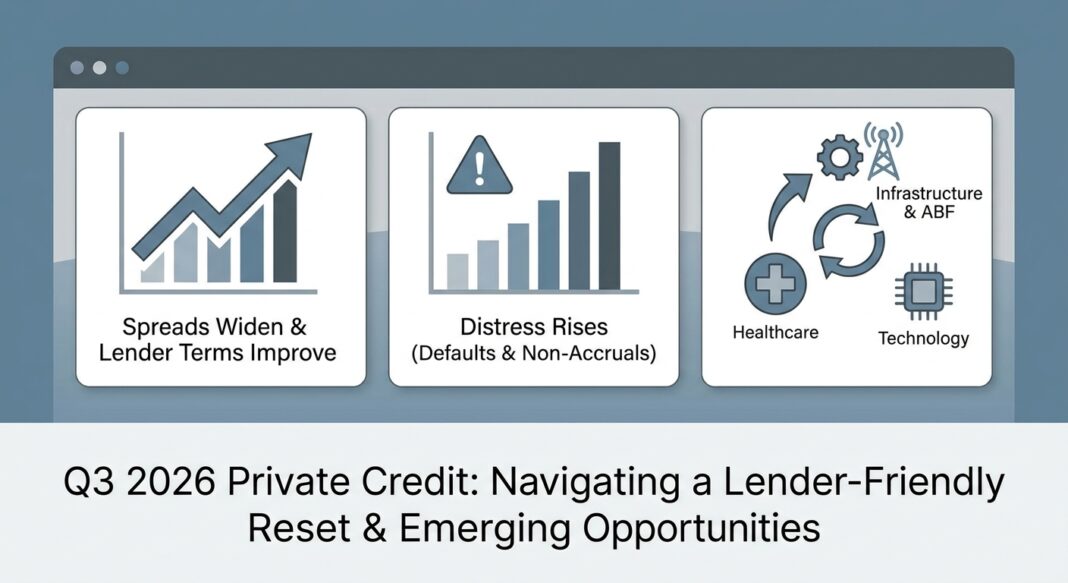
The defining macro story in credit markets as of September 2026 is a simultaneous lender-friendly reset and rising credit stress — two forces that, on the surface, appear contradictory but are, in fact, the twin products of the same cycle turning. According to Lord Abbett’s 2026 Midyear Outlook, spreads have widened by roughly 50 to 100 basis points since late 2025, defensive terms have improved, and the market has reset in a more lender-friendly direction. Yet simultaneously, Fitch Ratings reported the private credit default rate climbed to a record 6% through Q2 2026, and non-performing loans at major BDCs including Ares, Blackstone’s Secured Lending Fund, and Golub Capital have reached five-year highs.
The macro forces driving this are well-documented. Valuation Research Corporation’s Q1 2026 analysis identified three structural catalysts: a sharp selloff in software and technology services driven by AI disruption fears, significant investor redemptions from private funds following valuation concerns tied to technology assets, and a renewed Middle East conflict that elevated inflation risk and complicated the Federal Reserve’s policy path. These forces collectively stalled primary lending markets in Q1, before a partial stabilization arrived in Q2 as banks gradually re-entered the upper middle market.
The Federal Reserve’s rate environment adds another layer of complexity. VRC’s Q2 2026 Private Markets Report shows three-month Term SOFR at 3.68% and five-year U.S. Treasury yields at 4.23% — up from 3.92% in March — with the forward curve broadly flat, reflecting a higher-for-longer environment. For operators and institutional allocators alike, this is not a temporary dislocation. It is a structural recalibration of risk pricing, underwriting discipline, and sector selectivity.
Quantitative Market Snapshot
The following data box summarizes key market metrics as of Q2–Q3 2026. All figures are sourced from institutional market intelligence providers and regulatory filings.
| Metric | Current Value (Q2/Q3 2026) | Prior Period | Source |
|---|---|---|---|
| Middle Market Private Credit Spreads | S+500 bps (context); Unitranche 4.75%–5.50% over SOFR | Mid-400s bps (late 2025); ~25 bps lower at YE 2025 | Hamilton Lane (2026); VRC Q2 2026 |
| 3-Month Term SOFR | 3.68% (June 2026) | 3.67% (March 2026); ~3.0% expected at YE 2025 | VRC Q2 2026 |
| 5-Year U.S. Treasury Yield | 4.23% (June 2026) | 3.92% (March 2026) | VRC Q2 2026 |
| ICE BofA US High Yield Index Effective Yield | ~7.0% (July 2026) | Private credit illiquidity premium over HY compressed to ~150–200 bps (vs. ~350 bps in 2019) | BlueBay (July 2026); Owners.pe (April 2026) |
| BDC Non-Accrual Rate (Top 10 BDCs) | 3.95% of total debt at cost (Q2 2026); adjusted rate 5.95% | 2.0%–2.4% average range through YE 2025 | Morningstar / PitchBook LCD (Aug 2026) |
| Private Credit Default Rate (Fitch) | 6.0% through Q2 2026 — record high | BSL default rate (excl. LMEs): 1.44% as of March 2026 | InvestmentNews / Fitch (Aug 2026) |
| Software Sector Secondary Spread Premium (vs. B-Rated Loan Index) | ~229 bps above broad B-rated loan index (June 2026); ~245 bps vs. YE levels | Broadly in line with index at YE 2025 | VRC / PitchBook LCD (Q2 2026) |
| Lower Middle Market Spread Premium vs. Large-Cap | +232 bps (widened) | Large-cap spreads compressed below 500 bps in Q3 2025 | Avante Capital Partners (Feb 2026) |
Bank Lending Standards (Fed SLOOS): The July 2026 SLOOS reported basically unchanged C&I lending standards for firms of all sizes in Q2, alongside stronger demand for C&I loans from large and middle-market firms. Notably, CRE standards eased — the most since early 2022 — while the April 2026 SLOOS revealed that banks tightened standards for all categories of non-depository financial institution (NDFI) loans over the past year, including loans to business credit intermediaries and private equity funds — a direct tightening signal for leveraged credit structures.
Sector Analysis: Where Capital Is Flowing — and Where It Is Retreating
🟢 Infrastructure & Asset-Backed Finance (ABF): The Defining Strategic Rotation
BlackRock’s 2026 Private Markets Outlook identifies asset-based financing as an area where it expects “a profound increase in opportunities,” driven by bank retrenchment, AI-related capital spending, and the expanding digital infrastructure buildout. Industry estimates from Macfarlanes (May 2026) put the ABF market at approximately $6.1 trillion in 2025, with projections of $9 trillion by 2029. InsuranceAUM’s 2026 Private Infrastructure Outlook highlights AI data centers, fiber networks, power generation, and grid modernization as key deployment themes, noting that infrastructure debt funds represent only 8.1% of infrastructure AUM — a structural underpenetration that creates durable origination runway for dedicated credit managers.
🟡 Healthcare: Strong Deal Flow, but Non-Accrual Risk Emerging
Octus data confirms that healthcare led all sectors in 2025 private credit activity, representing 19% of all direct lending deals — and was the only major sector not to experience significant year-over-year pricing compression, with spreads averaging approximately SOFR+500 bps in Q4 2025. Demographic shifts and non-cyclical service models continue to attract lenders seeking stable, predictable cash flows. However, Morgan Stanley Investment Management maintains a significant underweight to healthcare, citing the sector’s leadership in loans placed on non-accrual status over the past year, driven by operational complexity, reimbursement risk, and elevated leverage among healthcare rollup platforms. Healthcare’s dual identity — as both a structural favorite and a source of credit stress — demands borrower-level diligence rather than sector-level allocation.
🔴 Software & Technology Services: Idiosyncratic Risk, Not Systemic — but Concentrated
VRC Q2 2026 data sourced from PitchBook LCD shows software sector secondary spreads approximately 245 basis points wider than year-end levels and roughly 229 basis points above the broader B-rated loan index, reflecting continued uncertainty related to AI-driven disruption. CAIA Association analysis (April 2026) identifies software concentration in BDC portfolios as a significant underlying driver of the current redemption wave, with Octus reporting that information technology stood out as the sector driving the most significant non-accrual deterioration in Q1 2026. Lord Abbett flags that portfolios with vintage 2021–2022 software concentration face elevated restructuring and non-accrual exposure — a direct consequence of deals originated at near-zero rates without AI disruption as an underwriting variable.
🟡 Industrials & Energy-Intensive Manufacturing: Tighter Standards Post-Geopolitical Shock
Capstone Partners’ Q1 2026 Middle Market Leveraged Finance Report confirmed that lenders responded to Middle East-driven energy cost spikes by tightening underwriting standards for energy-intensive industries and businesses whose leverage was predicated on stable energy costs. Oil price movements will remain a key variable for deal structuring over the next several quarters, constraining leverage tolerance in affected segments.
🔴 Office CRE: Continued Lender Retreat
The July 2026 SLOOS notes that banks generally eased CRE standards — but this applies selectively to industrial and multifamily segments. Office CRE continues to face lender retreat as uncertainty around future demand, compounded by technological and workplace structural changes, increasingly influences both bank and private credit lending decisions.
Implications for Borrowers and Institutional Investors
For Borrowers
The credit environment has bifurcated sharply by quality, sector, and size. VRC Q2 2026 confirms that lending activity remains competitive for higher-quality deals even as the market overall has tightened. Borrowers in non-cyclical sectors with demonstrable free cash flow, FCCR above 1.2x–1.5x at close, and conservative leverage profiles retain strong negotiating leverage. Conversely, businesses with AI-exposed revenue models, energy cost sensitivity, or vintage 2021–2022 capital structures will encounter more granular due diligence, stricter covenant packages, and materially higher pricing. Cleary M&A Watch notes that while the market for debt financing remains highly competitive at the large-cap segment, borrowers perceived as carrying execution risk should expect more detailed information requests and tighter covenant design.
For lower middle market borrowers (EBITDA $5M–$25M), Avante Capital Partners confirms that the capital wave from large institutional funds has not reached the lower end — creating a persistent spread premium of 232 bps over large-cap that actually widens the cost of capital for this segment even as competition intensifies at the top.
For Institutional Investors and Lenders
Lord Abbett’s Midyear 2026 analysis argues that the most durable advantage in the current environment comes from better documentation, more conservative leverage, and the time to conduct stress analysis before capital is deployed. Morgan Stanley Investment Management’s midyear outlook reinforces that today’s market increasingly rewards lenders with broad origination capabilities and the flexibility to provide customized financing solutions. Non-accruals, PIK usage, sector concentration, and 2021–2022 vintage exposure are the portfolio monitoring KPIs that matter most right now.
With Intelligence fundraising data shows the industry on pace to blow past its 2025 full-year fundraising total — confirming that long-term institutional allocators, including pension plans and insurers, are increasing exposure even as retail redemptions pressure evergreen vehicles. PwC’s 2026 Global Private Credit Survey of more than 120 portfolio managers found that over 80% expect increased allocations — with regulatory frameworks (particularly insurance capital rules) actively supporting growth in ABF, infrastructure debt, and investment-grade private corporate debt.
Forward-Looking View: Liquidity, Dispersion, and the H2 2026 Setup
Lord Abbett’s midyear assessment identifies the second half of 2026 as likely to be defined by dispersion — with the gap between stronger and weaker portfolios becoming more visible as non-accruals, PIK usage, and sector concentration crystallize into realized performance differences. Morgan Stanley expects new deal demand together with a large refinancing wave to gradually overtake private credit supply, creating conditions that allow disciplined lenders to preserve terms and capture the illiquidity premium to public markets.
Middle market private equity deal value has shown early recovery, increasing approximately 10.7% year-over-year with exit activity rising 14% per PitchBook data through Q2 2026 — signals that the M&A pipeline is recovering, even if sponsor-backed LBO volume as a share of total deal activity (currently 44%) remains below the 61% share seen in 2021. PitchBook projects that buyout volume will improve but not set records, as greater macro clarity and pent-up sponsor demand gradually unlock the exit backlog. This is constructive for new-money private credit origination but will increase competition among lenders for the best deals.
The structural rotation into ABF is accelerating. Moody’s projects private credit AUM exceeding $2 trillion in 2026 and approaching $4 trillion by 2030, driven by the shift from corporate lending to the ABF market. For operators and investors with positions in AI infrastructure, digital infrastructure, and non-bank consumer finance, the structural tailwinds are among the most durable in the current cycle. The central risk for H2 2026 is not systemic — it is concentrated: in software vintage exposure, in semi-liquid vehicle redemption dynamics, and in borrowers whose leverage assumptions did not account for a higher-for-longer rate path.
Key Market Insights — Actionable Takeaways
- Spreads have reset 50–100 bps wider since late 2025, with unitranche coupon spreads now ranging from 4.75%–5.50% over SOFR — a structurally more attractive origination environment for disciplined lenders with available dry powder. (Lord Abbett; VRC Q2 2026)
- Non-accruals at the top 10 BDCs have reached 3.95% of total debt at cost in Q2 2026 (adjusted rate: 5.95%), with the Fitch private credit default rate hitting a record 6% — underscoring that FCCR monitoring, PIK rate tracking, and vintage-level stress analysis are non-negotiable portfolio management tools for the balance of 2026. (Morningstar / PitchBook LCD; InvestmentNews / Fitch)
- Software and technology service credits require case-by-case underwriting, with secondary spreads 229 bps above the broad B-rated loan index; portfolios with 2021–2022 vintage software concentration face the most acute restructuring risk. (VRC / PitchBook LCD)
- Asset-backed finance (ABF) is the clearest structural growth vector in private credit for H2 2026 and beyond, with the ABF market projected to grow from $6.1 trillion (2025) to $9 trillion by 2029, driven by AI infrastructure, bank retrenchment, and insurer regulatory demand. (Macfarlanes; BlackRock)
- The Fed SLOOS confirms a bifurcated bank lending environment: C&I standards are broadly unchanged for large and middle-market firms (positive for deal flow), but banks have tightened all categories of NDFI lending — a direct structural tailwind for private credit lenders competing with bank-sponsored leverage facilities. (Federal Reserve July 2026 SLOOS)


