
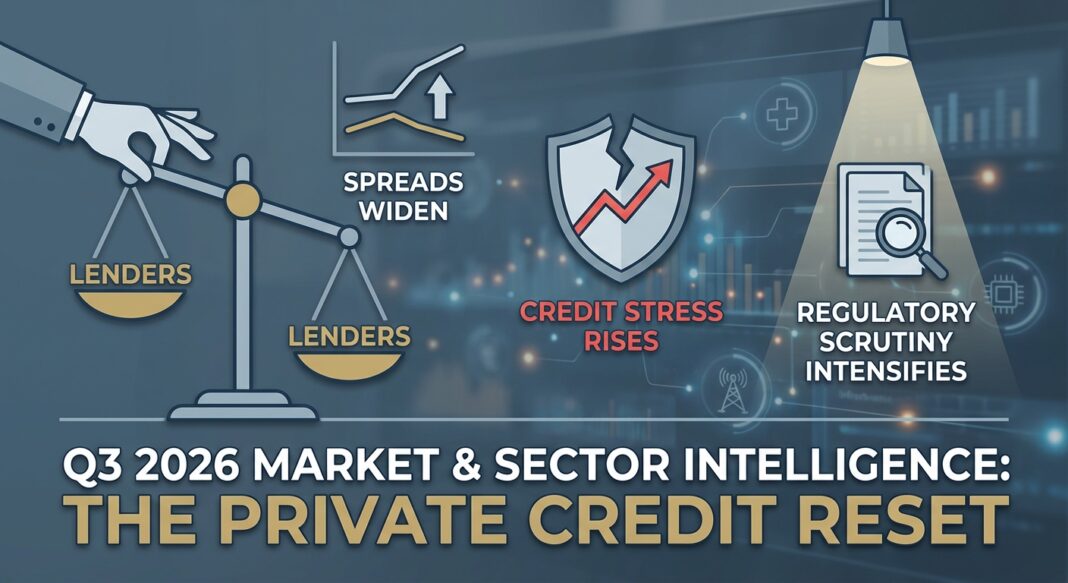
Market Headline: The Credit Cycle Has Turned — Lenders Regain the Upper Hand
After a multi-year borrower-friendly regime defined by compressed spreads and loosening documentation, the U.S. private credit market entered Q3 2026 in a decisive lender-friendly reset. The convergence of AI-driven disruption in technology portfolios, elevated geopolitical risk, BDC redemption pressures, and a rising default rate has collectively shifted negotiating leverage back toward capital providers — but not without cost. The Fitch trailing 12-month private credit default rate has reached 6.1% as of July 2026, a record high, even as Q2 2026 fundraising across the asset class remained robust at $119 billion in a single quarter. The result is a bifurcated market: institutional capital is abundant in aggregate, yet selectively and conditionally deployed.
Against this backdrop, macroeconomic forces are reinforcing the pivot. The July 2026 Federal Reserve SLOOS confirmed that commercial and industrial (C&I) lending standards for large and middle-market firms returned to flat (0.0 net tightening) in Q3 2026 after a sustained tightening cycle running from Q3 2025 through Q2 2026 — signaling that bank credit is incrementally more available but far from resurgent. Meanwhile, the Financial Stability Board (FSB) issued a landmark May 2026 report warning that private credit’s complexity, leverage, and interconnectedness could amplify systemic stress in adverse scenarios, placing the entire asset class under a new supervisory lens. For institutional investors and operators, the message is unambiguous: underwriting discipline, sector selection, and covenant structure are now more consequential than at any point in the past five years.
Quantitative Market Snapshot
The table below captures the key metrics defining the current credit environment as of Q2–Q3 2026. All figures are sourced from primary institutional and regulatory data.
| Metric | Current Value (Q2/Q3 2026) | Prior Period Comparison | Source |
|---|---|---|---|
| Unitranche Coupon Spread (Middle Market) | SOFR + 475–550 bps (4.75%–5.50%) | ~25 bps tighter at year-end 2025; 50–100 bps wider vs. late 2025 peak | VRC Q2 2026 |
| U.S. High Yield OAS (Broad Market) | 275 bps (June 2026) / ~286 bps (Sept. 24, 2026) | 281 bps full-year 2025; 5-yr avg 359 bps | Fidelity / BofA LCD, June 2026; Macrotrends, Sept. 2026 |
| U.S. Leveraged Loan OAS | 453 bps (June 2026) | 404 bps (2025); 5-yr avg 448 bps | Fidelity / LCD, June 2026 |
| Borrower Debt / EBITDA (Private Credit, New Issues) | 5.0x–6.0x for high-quality credits | FSB estimates 5–6x headline; adjusted "true" leverage potentially closer to 7x due to EBITDA add-backs | FSB May 2026; VRC Q2 2026 |
| Fitch Private Credit Default Rate (TTM) | 6.1% (July 2026) — record high | 5.7% in Q1 2026; below 4% pre-2024 | Angel Investors Network / Fitch, July 2026 |
| Top-10 BDC Non-Accrual Rate (at Cost) | 3.95% reported; 5.95% adjusted (Q2 2026) | 3.75% in Q1 2026; 1.3–1.5% band through Q4 2025 | Angel Investors Network / PitchBook, Q2 2026 |
| Fed SLOOS — C&I Tightening (Large & Mid-Market) | 0.0% net tightening (Q3 2026) | 8.1% Q2; 5.3% Q1; 9.5% Q3 2025 | FRED / Federal Reserve, Aug. 2026 |
The spread differential between direct lending unitranches (SOFR+475–550 bps) and broadly syndicated leveraged loans (OAS ~453 bps) remains meaningful, compensating institutional lenders for illiquidity and documentation risk. However, the compression of the high yield OAS to 275–286 bps — well below its 5-year average of 359 bps — signals that public credit markets remain risk-on even as private credit stress indicators deteriorate. This divergence demands careful cross-market positioning from institutional allocators.
Sector Analysis: Appetite Shifts and Structural Reconfiguration
Healthcare: New Pole Position, But Watch Non-Accruals
Healthcare claimed the top sector position in direct lending in Q1 2026, accounting for 22% of direct lending issuance year-to-date through March, up from 18% in 2025, according to PitchBook LCD. This displacement of Technology reflects both the sector’s non-cyclical cash flow profile and sponsors’ rotation away from AI-exposed credits. Yet lenders must exercise selectivity: healthcare was the only sector that did not see meaningful spread tightening in 2025, with spreads landing at an average of approximately SOFR+500 bps in Q4 2025, per Octus data — a pricing premium that reflects genuine credit complexity rather than mere illiquidity.
Technology and Software: Structural Re-Pricing Underway
The January–March 2026 AI disruption selloff triggered the sharpest sector-specific repricing in the current cycle. Software spreads in secondary markets widened by approximately 200 basis points since year-end 2024, and new software-related direct lending transactions are now expected to price at premiums of approximately 75–100 basis points above VRC’s standard yield matrix ranges. Technology’s share of direct lending issuance slipped to 14% year-to-date through March 2026, down from 18% in 2025. Lenders are requiring higher risk premiums for AI-, tariff-, and cycle-exposed assets — a structural shift that may persist even if AI revenue fears prove overstated.
Infrastructure, Digital Assets, and Asset-Based Finance: Capital Flowing In
The FSB’s May 2026 report noted that technology (including data center and digital infrastructure) has reached 34% of private credit deals in 2025, up from a five-year average of 17% — driven largely by hyperscaler CAPEX financing backed by long-term lease cash flows. Paul Weiss’s 2026 outlook identifies energy infrastructure, digital infrastructure, defense/national security, and next-generation manufacturing as priority sectors attracting patient institutional capital. Asset-based finance is expanding rapidly, with insurers diversifying into equipment finance, data center lending, and specialized receivables — aligning with their capital-efficiency mandates under Solvency II and similar frameworks.
Consumer, Retail, and Auto: Elevated Stress Watch
The PwC Global Private Credit Survey 2026 found that managers expect credit stress to be most acute in consumer and retail (56% of respondents), automotive (42%), and hospitality/leisure (27%) over the next one to two years. These sectors face simultaneous headwinds from sticky inflation, softening consumer spending power, and tariff-driven margin compression — making new underwriting in these areas subject to more conservative structural demands.
Implications for Institutional Investors and Operators
For Borrowers and Operators
Operators seeking debt capital in H2 2026 should expect meaningfully tighter terms compared to the borrower-friendly environment of 2024–early 2025. The shift is already visible: spreads have widened by roughly 50–100 basis points since late 2025, per PitchBook data cited by Lord Abbett. Lenders are requiring FCCR above 1.2x–1.5x at close for new credits, with some platforms insisting on interest coverage targets above 2.0x. PIK (payment-in-kind) requests are being resisted more aggressively — a leading indicator that lenders are prioritizing cash interest quality over deal volume. Borrowers in software, consumer, or cyclical sectors should prepare for pricing premiums of 75–100 bps above benchmark and more rigorous EBITDA add-back scrutiny, as lenders tighten tolerance for aggressive adjustments. Critically, smaller borrowers face the harshest conditions: issuers with $25 million or less in EBITDA defaulted at a 12.3% rate in July 2026, roughly triple the 3.9% rate for the next size cohort, per Fitch data.
For Institutional Investors and Lenders
The current environment rewards scale, selectivity, and structural discipline. Across multiple rate cycles, private credit has delivered 200–400 basis points of excess return over liquid credit markets, reflecting compensation for illiquidity and active underwriting. That premium is re-anchoring after a period of compression. Institutional allocators with consistent deployment mandates — rather than retail-channel BDC structures subject to redemption pressure — are positioned to benefit from improved supply-demand dynamics. However, the FSB’s May 2026 regulatory report represents a material governance risk: authorities are actively working to close data gaps, harmonize definitions, and enhance supervisory monitoring across the private credit ecosystem. Funds with opaque valuation practices, concentrated sector exposure, or complex bank interlinkages face the greatest regulatory scrutiny. Fund-level debt-to-equity ratios at 1.0x warrant monitoring; the Heron Finance Q2 2026 benchmark report flags that a drift toward 1.2x could materially amplify losses in stress scenarios.
Forward-Looking View: Next 3–6 Months
LBO activity showed early recovery in Q1 2026, rising to approximately 40.3% of total deal volume from 36.2% in Q4 2025, with volumes increasing again in April. M&A pipelines are building — Octus reported dozens of middle-market auction processes launched in January alone — and private equity dry powder exceeding $1 trillion globally will drive deployment pressure through year-end. Unitranche yields should remain broadly stable in Q3–Q4 absent another macro shock, with spot unitranche yields supported by a three-month Term SOFR of approximately 3.69% in June 2026. The next six months will likely see continued performance dispersion: top-tier lenders with diversified, disciplined portfolios will extend their advantage over managers carrying legacy software exposure or aggressive 2021–2022 vintage leverage.
Key Market Insights — Actionable Intelligence
- Spreads are re-anchoring, not spiking: Middle-market unitranche coupons at SOFR+475–550 bps represent a 25–50 bps widening from year-end 2025 levels — a lender-friendly normalization, not a crisis. New capital deployed today enters at the most attractive risk-adjusted entry point since 2022.
- The BDC non-accrual signal demands scrutiny: The top-10 BDC adjusted non-accrual rate of 5.95% at Q2 2026 — 50% above the headline figure of 3.95% — reflects concentrated deterioration in legacy software and consumer credits. Investors should interrogate adjusted metrics, not press-release figures.
- Healthcare leads deal flow but carries a spread premium for a reason: At SOFR+500 bps average and a 22% share of Q1 2026 direct lending issuance, healthcare commands the highest lender appetite — but non-accrual exposure in the sector has been sector-leading. Structural protections and FCCR covenants are non-negotiable in new healthcare credits.
- Regulatory risk is no longer theoretical: The FSB’s May 2026 vulnerability report signals an inflection point. Private credit funds with opaque valuations, bank revolving credit interlinkages, and semi-liquid retail structures face the highest probability of enhanced disclosure and oversight requirements within 12–18 months.
- Small-borrower default risk is systemic-level elevated: A 12.3% trailing default rate among sub-$25 million EBITDA issuers (Fitch, July 2026) confirms that the lower end of the middle market is under acute stress. Lenders and operators with exposure to this cohort — particularly in consumer, retail, and software — should conduct immediate portfolio triage and stress-test FCCR at current all-in rates.


