
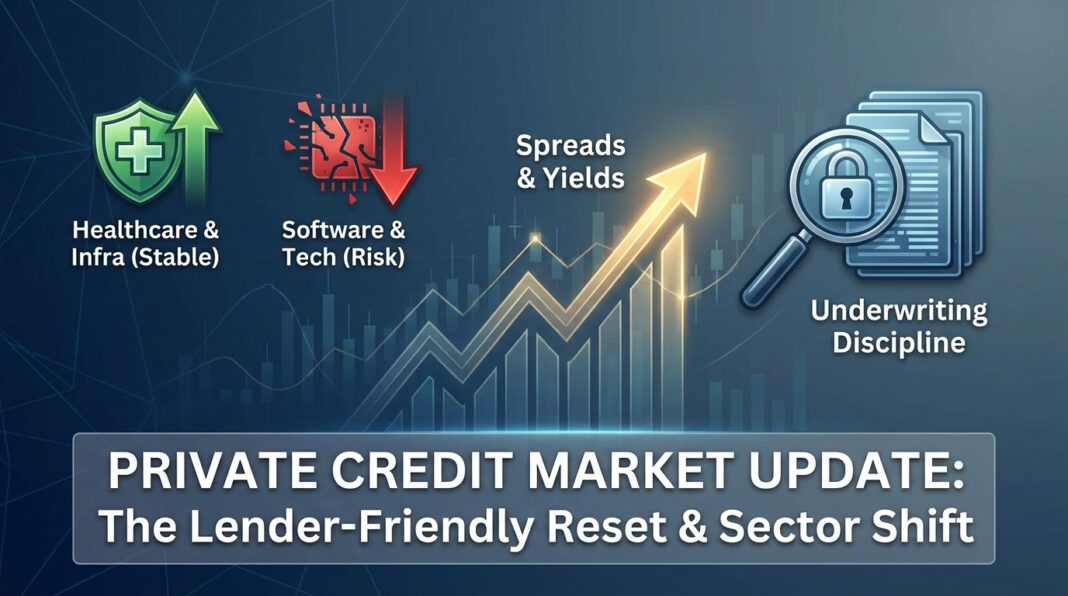
Market Headline: A Lender-Friendly Reset Takes Hold
The U.S. private credit market is navigating a decisive mid-cycle inflection. After more than two years of relentless spread compression — driven by a wall of institutional and retail capital chasing a finite deal universe — the pendulum has swung. According to Lord Abbett’s midyear analysis citing PitchBook data, middle market private credit spreads have widened by roughly 50 to 100 basis points since late 2025, while defensive documentation terms have also improved. This is not a superficial repricing. Capital has grown more selective, covenant packages are tightening, and managers with dry powder are in a position to be genuinely discriminating about the credits they finance.
Three converging forces drove this reset. First, a U.S.-Iran military conflict in late February 2026 introduced macro volatility and renewed inflation risk through oil price channels. Second, a sharp reassessment of software sector creditworthiness — driven by AI disruption fears — created a sudden repricing of technology-heavy portfolios. Third, a wave of redemption requests from retail-oriented private credit vehicles (notably non-traded BDCs) exposed structural vulnerabilities in the semi-liquid channel, moderating aggregate capital supply. Capstone Partners’ Q1 2026 Leveraged Finance report describes these as three “largely unforeseeable” developments that collectively stalled primary market activity and pushed credit markets back into price discovery mode.
The result: a credit environment that is more complex, more dispersed, and — for disciplined lenders with institutional capital — more rewarding than at any point since 2022. The H2 2026 opportunity is real, but capturing it will require precision in sector selection, underwriting rigor, and KPI discipline that was absent during the years of compressed spreads.
Quantitative Market Snapshot
The following data box synthesizes current market metrics across the private and public credit landscapes as of August 5, 2026. All figures are sourced from primary institutional data providers and recent market surveys.
| Metric | Current Level | Prior Period | Change | Source |
|---|---|---|---|---|
| Overnight SOFR (Base Rate) | 3.65% | 3.68% (3-mo Term SOFR, Q2 2026) | Stable / Marginally Lower | NY Fed via SOFRrate.com, Aug 3, 2026 |
| Middle Market Direct Lending Spread | ~SOFR + 500 bps | ~SOFR + 450 bps (mid-2025) | +50 bps | Hamilton Lane, 2026 Private Credit Focus |
| Middle Market All-In Direct Lending Yield (Unlevered) | High single digits | Mid-to-high single digits (2025) | Improving | Northleaf Capital, Q1 2026 Private Credit Update |
| 5-Year U.S. Treasury Yield | ~4.23% | ~3.92% (March 2026) | +31 bps QoQ | VRC Q2 2026 Private Markets Update |
| Healthcare Sector Direct Lending Spread | ~SOFR + 500 bps | ~SOFR + 490 bps (Q3 2025) | Minimal tightening; best-in-class | Octus Direct Lending Analytics, 2025 FY Data |
| Software / Tech Secondary Spreads | ~245 bps wider than year-end | In-line with B-rated loan index (YE 2025) | ~229 bps above B-rated loan index | PitchBook LCD via VRC, June 19, 2026 |
| Secondary B-Rated Loan Spreads | ~67 bps wider than year-end | Year-end 2025 levels | +67 bps | VRC / PitchBook LCD, Q1 2026 Update |
| Fed SLOOS: C&I Tightening (Large & Mid-Market Firms) | Net +8.1% tightening (Q2 2026) | Tighter standards (Q1 2026) | Gradual easing from Q1 peak | Federal Reserve SLOOS via FRED, May 4, 2026 |
| Private Credit vs. Public High Yield Spread Premium | ~150–200 bps over HY | ~350 bps premium (2019) | Compressed ~150–200 bps vs. historical norm | Owners.pe, April 2026 |
| BDC Non-Accrual Rate (Lower-Middle Market, Stressed) | Approaching 5% (aggressive lenders) | Sub-2% reported average (2024) | Significant deterioration in tail names | FinancialContent / MarketMinute, April 2026 |
Data as of August 5, 2026. Market metrics are indicative ranges drawn from cited institutional sources. Direct lending spreads are new-issue approximations and vary by deal size, structure, and sponsor quality.
Key Rate & KPI Context
With overnight SOFR at 3.65% and the 5-year Treasury at approximately 4.23%, the rate environment remains firmly “higher for longer.” Market expectations, per the forward curve, are broadly flat through the remainder of 2026. For middle market borrowers carrying floating-rate direct loans at SOFR + 500 bps, all-in coupons are running approximately 8.65% — placing significant pressure on Fixed Charge Coverage Ratios (FCCR). Lenders are now demanding minimum FCCR thresholds of 1.20x–1.35x on new originations, up from the 1.10x–1.15x floors that were accepted during the 2023–2024 spread compression era. Loan-to-value (LTV) ratios have remained conservative across private credit segments, with stable LTVs indicating lenders have not materially loosened collateral underwriting despite competitive pressure over the past three years.
Sector Analysis: The Great Bifurcation
The defining structural shift of mid-2026 is what market participants are calling the “Great Bifurcation” — a widening gulf between sectors commanding tight, competitive credit terms and those facing meaningfully elevated risk premiums, scrutiny, and in some cases lender retreat.
🟢 High-Appetite Sectors
Healthcare & Life Sciences: Healthcare remains the crown jewel of direct lending. According to Octus Direct Lending Analytics, healthcare led the way for private credit last year, accounting for 19% of all 2025 direct lending deals — and was the only major industry to avoid significant year-over-year price tightening, with spreads holding at approximately SOFR + 500 bps in Q4. Demographic-driven demand, non-cyclical service models, and strong free cash flow generation continue to attract lenders seeking stable coverage ratios. Specialist healthcare private credit funds have posted median net IRRs of 15% versus 11% for generalist U.S. direct lending funds, per bfinance data cited by White & Case. The sector’s appeal is structural, not cyclical.
Infrastructure & Asset-Backed Finance: Infrastructure is emerging as a distinct high-growth origination channel. As bank balance sheet constraints reduce capacity for complex structured lending, non-bank platforms with specialized servicing infrastructure are filling the gap. Morgan Stanley estimates private credit could supply more than half the $1.5 trillion needed for global data center buildouts through 2028 — a transformational opportunity. Apollo Global Management and Ares Management have each built dedicated asset-based origination platforms targeting these segments. Infrastructure carries an 11.6% CAGR within private credit market forecasts through 2035.
Industrials & Manufacturing (Selective): Industrials are attracting lender interest where supply chain exposure to energy costs is limited. M&A in the sector is rebounding, particularly in the middle market. However, energy-intensive sub-sectors face tighter underwriting following oil price volatility related to the Middle East conflict, with lenders now explicitly stress-testing leverage assumptions against energy cost scenarios.
🔴 Reduced-Appetite Sectors
Software & Technology Services: Software is the most consequential stress point in private credit today. Secondary spreads for software credits are approximately 245 basis points wider than year-end 2025 levels and roughly 229 basis points above the broader B-rated loan index, per PitchBook LCD data as of June 19, 2026. AI-driven disruption concerns have led lenders to question the durability of ARR-based underwriting models, tighten covenant packages, and in some cases decline new software-sector originations outright. Portfolio differentiation is accelerating: exposure to older (2021–2022) vintage software credits with aggressively structured financing is increasingly viewed as a liability for BDC and direct lending managers.
Consumer-Facing & Tariff-Exposed Businesses: Companies with significant exposure to tariff-driven input cost inflation and consumer discretionary demand are receiving higher risk premiums. Lenders are applying more conservative EBITDA normalization assumptions, tightening leverage covenant definitions, and requiring more detailed working capital analysis at origination.
Implications: What This Means for Borrowers and Lenders
For Borrowers & Operators
The era of borrower-friendly terms is materially narrowing — at least for credits outside the top tier. Lenders are demanding stronger FCCR coverage (1.20x–1.35x minimum on new deals), tighter covenant definitions including maintenance-based financial covenants that were stripped from many 2022–2024 deals, and greater scrutiny of AI exposure within business models. Companies with floating-rate debt stacks are carrying all-in interest burdens of 8–9%+ against base rates that show no near-term path to meaningful decline. This means EBITDA growth must do the heavy lifting on coverage: operators who have not undertaken structural cost reduction or pricing optimization since 2023 are operating with diminishing margin for error.
For refinancing candidates — and there is a substantial maturity wall approaching — the window of opportunity is present but not unlimited. Banks have begun to re-enter the upper middle market, creating competitive pressure in the $100M+ deal band and giving well-positioned borrowers negotiating leverage. Deal value in middle market private equity increased approximately 10.7% year-over-year and exit activity rose 14% over the same period, suggesting the transaction environment is gradually normalizing.
For Institutional Investors & Lenders
The current environment structurally favors experienced managers with institutional capital bases, large dry powder reserves, and the operational infrastructure to conduct deep diligence. Wider spreads, improving documentation, and more conservative leverage structures are constructive for new originations. However, the critical risk variable is vintage exposure: portfolios concentrated in 2021–2022 era software-adjacent credits are facing mark-to-market pressure, rising PIK income ratios, and non-accrual drift. Non-accruals, PIK usage, sector concentration, and 2021–2022 vintage exposure should remain the most important portfolio monitoring indicators through year-end.
The retail channel for private credit — non-traded BDCs and semi-liquid evergreen vehicles — faces a structural headwind. Net outflows from private credit funds moderately exceeded new inflows in Q1 2026 for the first time in the cycle, per Federal Reserve Financial Stability Report (May 2026) coverage. Redemption queues at several large non-traded BDCs are likely to persist well into 2027. Institutional capital — with its longer duration and absence of liquidity mismatch — is the structural winner in this environment.
Forward-Looking View: H2 2026 and Into 2027
The second half of 2026 is likely to be defined by dispersion at the manager, portfolio, and sector level — not by broad directional moves in the asset class as a whole. Several dynamics will shape the trajectory:
Rate Environment: The SOFR forward curve is broadly flat. Market expectations continue to reflect a higher-for-longer rate environment, with the forward curve showing minimal easing through year-end 2026. For floating-rate borrowers, this means coverage pressure persists. For lenders, it sustains attractive all-in yield generation on new originations.
M&A Recovery: The deal backdrop is gradually improving from a Q1 2026 trough. U.S. M&A/LBO deal volumes in Q1 2026 increased by more than 30% relative to the same period last year, though transaction count declined as fewer but larger deals closed. As the bid-ask gap continues to narrow and private equity sponsors confront six- and seven-year hold periods demanding resolution, deal flow is expected to broaden across sectors — technology, healthcare, industrials, and media — in H2 2026 and into 2027.
Bank Re-Entry: Banks have gradually returned to the upper middle market lending space in Q2 2026, with the July 2026 Fed SLOOS reporting basically unchanged C&I lending standards for large and middle market firms — a meaningful improvement from the Q1 2026 SLOOS, which reported net tighter standards across all firm sizes. This is creating incremental competition in larger deal tranches but is simultaneously freeing private credit lenders to focus capital deployment in the core middle market ($10M–$75M EBITDA), where bank appetite remains structurally constrained.
Regulatory Watch: The Financial Stability Board’s May 2026 report on private credit vulnerabilities flagged data opacity, liability-asset maturity mismatches in retail channels, and rising PIK income as the three primary structural risk vectors. Regulatory scrutiny of private credit’s interconnections with the banking sector is intensifying, with the April 2026 Fed SLOOS introducing new questions specifically on Non-Depository Financial Institution (NDFI) lending — where significant net shares of banks reported tighter standards over the past year. This regulatory attention is unlikely to result in near-term structural restrictions but will increase reporting burdens and potentially affect fund financing terms over a 12–18 month horizon.
📌 Key Market Insights: Five Actionable Takeaways
- Spreads have reset, not collapsed: Middle market direct lending spreads are back to approximately SOFR + 500 bps — 50–100 bps wider than mid-2025 trough levels. This represents a genuine yield improvement for new originations, but borrowers should expect corresponding tightening in documentation, leverage, and coverage covenant packages. Lenders should capitalize on the window before competitive dynamics compress spreads again as M&A volume normalizes.
- Software exposure is a portfolio-level risk event, not a name-specific issue: The 245 bps secondary spread widening in software credits and rising non-accrual trends in BDC portfolios signal that AI disruption risk is being systematically repriced. Any portfolio with meaningful 2021–2022 vintage software concentration warrants immediate review of PIK income ratios, amendment frequency, and coverage cushion. If PIK income approaches 10% of total portfolio interest income, it is a leading indicator of approaching hard defaults.
- Healthcare and infrastructure are the structural anchors of lender appetite: Healthcare’s consistent 19% share of direct lending deal flow, combined with specialist fund IRRs of 15% vs. 11% for generalist peers, validates sector concentration for lenders with operational expertise. Infrastructure’s AI-driven data center buildout pipeline — potentially exceeding $750B in private credit addressable financing through 2028 — represents the largest single sector opportunity in the asset class.
- FCCR and LTV discipline is the new competitive differentiator: With all-in floating-rate debt costs at 8–9%+, operators and lenders alike must anchor underwriting to cash-flow reality. Stable LTV ratios across private credit segments indicate lenders have maintained collateral discipline despite three years of competitive pressure. Borrowers presenting FCCR coverage of 1.35x+ on a fully-loaded basis, supported by durable EBITDA, will continue to access the most competitive terms.
- Institutional capital has a structural advantage over retail capital in 2026–2027: The retail BDC channel faces persistent net outflows and redemption queues likely extending into 2027. Institutional-grade managers with permanent or long-duration capital, deep sponsor relationships, and disciplined vintage management are positioned to capture the best H2 2026 origination opportunities — including the growing pipeline of PE-sponsored M&A refinancings — at more favorable terms than at any point in the past three years.


