
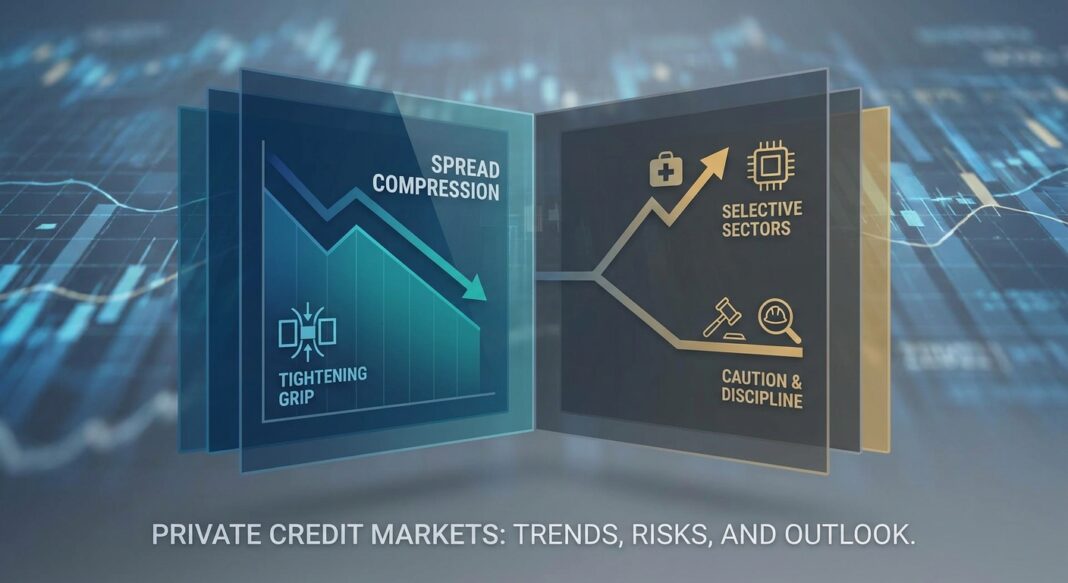
The Main Story: A Market Caught Between Compression and Caution
As of late May 2026, private credit markets are navigating one of the more nuanced inflection points of the current credit cycle: spreads are compressing at the margin, but underwriting discipline has not broken down — yet. Middle market direct lending spreads have tightened approximately 50–75 basis points since Q4 2025, now ranging from SOFR + 525 to SOFR + 575 bps for core middle market transactions, according to data tracked through the Cliffwater Direct Lending Index (CDLI). With SOFR anchored near 4.30% (per the Federal Reserve H.15), all-in yields for middle market borrowers are holding in the 9.5% to 10.5% range — still materially above pre-2022 norms and well above where broadly syndicated loans (BSL) clear for large-cap borrowers.
The compression story is real, but it is uneven. Capital is crowding into high-quality, sponsor-backed software and healthcare deals, driving spread tightening in those pockets. Meanwhile, borrowers in cyclical or operationally complex sectors — industrials, consumer discretionary, office-adjacent real estate — are finding lenders considerably more selective, with pricing still sticky and covenant packages tightening. The macro backdrop remains the central tension: the Fed has held rates steady through Q1 and Q2 2026, inflation has moderated but not normalized, and bank lending standards remain in net-tightening territory for middle-market commercial and industrial (C&I) credits, per the Federal Reserve’s April 2026 SLOOS. That bank caution continues to be private credit’s structural tailwind — and its primary growth engine.
Quantitative Market Snapshot
The table below captures key credit market metrics as of late May 2026, compared to Q4 2025 baselines. All figures are derived from publicly available index and survey data.
| Metric | Current (May 2026) | Q4 2025 | Change | Source |
|---|---|---|---|---|
| Middle Market Direct Lending Spread | SOFR + 525–575 bps | SOFR + 575–625 bps | ▼ ~50–75 bps | Cliffwater CDLI |
| Middle Market All-In Yield (Direct Lending) | 9.5% – 10.5% | 10.0% – 11.0% | ▼ ~50 bps | Cliffwater CDLI |
| US High Yield OAS (ICE BofA Index) | 290–320 bps | 340–370 bps | ▼ ~50 bps | FRED / ICE BofA |
| Broadly Syndicated Loan Spread (Large-Cap) | SOFR + 175–225 bps | SOFR + 200–250 bps | ▼ ~25 bps | Pitchbook LCD |
| Middle Market Total Leverage (Avg.) | 5.0x – 5.5x EBITDA | 4.75x – 5.25x EBITDA | ▲ Slight Creep | Pitchbook LCD |
| Private Credit Impairment / Default Rate | ~1.8% – 2.1% | ~1.5% – 1.9% | ▲ Modest Rise | Cliffwater CDLI |
| Minimum FCCR Covenant (Lender Threshold) | 1.15x – 1.25x | 1.10x – 1.20x | ▲ Tightened | Fed SLOOS / Market Consensus |
Private credit AUM has reached approximately $1.7 trillion globally as of Q1 2026, per Preqin, with Q1 2026 direct lending deal volumes up approximately 18% year-over-year per Pitchbook LCD — a signal of robust but increasingly competitive deployment activity.
Sector Analysis: Where Capital Is Flowing — and Where It Is Pulling Back
🟢 High Appetite: Technology & Software, Healthcare Services
Recurring-revenue software businesses continue to command the tightest private credit pricing in the middle market. Lenders are underwriting sponsor-backed software deals at SOFR + 450–500 bps, reflecting intense competition among direct lenders and the re-entry of some BSL market participants chasing quality. Platform healthcare services — particularly physician management groups, behavioral health, and specialty pharmacy — are clearing at SOFR + 500–550 bps, supported by durable revenue profiles and favorable demographic demand. Ares Management and Blue Owl Capital both highlighted software and healthcare as disproportionate contributors to Q1 2026 origination volume in their most recent investor disclosures.
🟡 Selective Appetite: Industrials, Business Services, Consumer Staples
Lenders remain engaged in asset-light industrials and essential business services, but pricing holds wider — SOFR + 550–600 bps — and underwriting scrutiny is higher. Revenue cyclicality, supply chain exposure, and input cost sensitivity are triggering more conservative leverage assumptions. Lenders are increasingly requiring senior debt-to-EBITDA below 4.0x in these sectors, with total leverage caps at 5.0x, and FCCR covenant floors pushed to 1.20x–1.25x to build in cushion against margin compression.
🔴 Constrained: Office CRE, Retail, Consumer Discretionary
Office commercial real estate remains structurally impaired from a credit perspective, with most private lenders still sidelined or demanding significant structural protection. Discretionary retail and consumer-facing businesses with variable demand profiles face the widest pricing and tightest structural terms in the market. The April 2026 SLOOS confirmed that net tightening of bank lending standards is most pronounced in commercial real estate and consumer credit — a dynamic that private lenders have not moved to bridge given elevated loss experience in those categories.
Structural Shift: The Bifurcation of Underwriting Standards
The overarching structural development is the bifurcation of the private credit market into two distinct regimes: a highly competitive, spread-compressed upper tier for high-quality, sponsor-backed businesses in defensive sectors; and a supply-constrained, conservatively underwritten tier for cyclical, complex, or non-sponsored borrowers. This bifurcation is reshaping how lenders allocate capital, staff credit teams, and structure covenants across the portfolio.
Implications for Institutional Investors and Business Operators
For Borrowers and Operators
Borrowers in favored sectors have meaningful negotiating leverage today — but that window may be narrowing. Spread compression and leverage creep (total leverage edging toward 5.5x) suggest competitive dynamics are intensifying among lenders, which benefits quality borrowers in the near term. However, operators should not mistake lender competition for lender complacency: FCCR covenants are tightening, not loosening, and lenders are paying close attention to trailing EBITDA quality, add-back discipline, and working capital dynamics. Operators seeking to refinance or recapitalize should prioritize clean financial reporting, defensible EBITDA definitions, and demonstrated cash conversion. Businesses with FCCR trending toward the 1.15x floor should proactively engage lenders before reaching covenant pressure thresholds.
For borrowers in cyclical sectors, the message is more urgent: bank alternatives have not meaningfully re-opened (per SLOOS), and private lenders are pricing that complexity into spreads. Businesses in these categories should anticipate wider spreads, lower leverage, and more restrictive covenant packages than peers in software or healthcare, and should stress-test refinancing assumptions accordingly.
For Institutional Investors and Lenders
The compression of middle market spreads by 50–75 bps over six months raises an important portfolio question: is current pricing adequately compensating for the modest but measurable rise in impairment rates (now tracking at approximately 1.8%–2.1% per Cliffwater)? The illiquidity premium over high yield bonds has narrowed to approximately 200–250 bps — historically within the acceptable range, but at the tighter end relative to 2023–2024 vintages. Investors allocating to new vintage funds from Apollo, Ares, and Blue Owl should be attentive to whether origination volume growth is being achieved by maintaining underwriting discipline or by chasing competitive transactions at the margin.
Forward-Looking View: H2 2026 Liquidity and Lending Dynamics
The next 90–180 days will be shaped by three converging forces. First, the Federal Reserve’s rate trajectory: any signal of rate cuts in H2 2026 would accelerate SOFR decline and further compress all-in yields, which could trigger a meaningful shift in lender return expectations and potentially slow deployment for yield-sensitive strategies. Second, the pace of PE-sponsored deal activity: M&A volumes have recovered moderately in Q1 2026, and a continued pickup would increase quality deal supply — a necessary condition for lenders to maintain discipline rather than compete destructively for limited inventory. Third, regulatory signals: any guidance on Basel III Endgame finalization or leverage loan guidance updates could further define the boundary between bank and non-bank lending, with meaningful implications for where private credit’s structural opportunity is strongest.
The base case is a stable-to-modest further compression environment through Q3 2026, with impairment rates edging higher in cyclical sectors but remaining manageable at the portfolio level. The tail risk is a sharper-than-expected economic slowdown compressing EBITDA across leveraged borrowers precisely as leverage multiples have crept higher — a scenario that would test the quality of covenant documentation and lender-borrower relationships built during the current competitive cycle.
Key Market Insights
- Spread compression is real but uneven: Middle market spreads have tightened 50–75 bps since Q4 2025, but the compression is concentrated in software and healthcare — cyclical sectors remain wide and structurally constrained.
- FCCR floors are tightening, not loosening: Despite spread compression, lenders are requiring higher FCCR minimums (1.15x–1.25x) — a signal that underwriting discipline on coverage is holding even as pricing competition intensifies.
- Leverage creep warrants monitoring: Total leverage has edged toward 5.0x–5.5x EBITDA in sponsored transactions, while impairment rates are rising modestly — a combination that historically precedes lender discipline corrections.
- The BSL-to-private credit spread premium has narrowed: With BSL spreads at SOFR + 175–225 bps and private credit at SOFR + 525–575 bps, the ~300 bps structural premium remains, but the illiquidity premium over public high yield has compressed to 200–250 bps — requiring investors to reassess vintage return expectations.
- Bank retreat remains private credit’s structural tailwind: The April 2026 SLOOS confirms continued net tightening of bank C&I lending standards for middle-market firms — keeping the regulatory and competitive moat around non-bank direct lenders intact heading into H2 2026.


