
The Main Story: A Surplus of Capital Is Reshaping the Credit Landscape
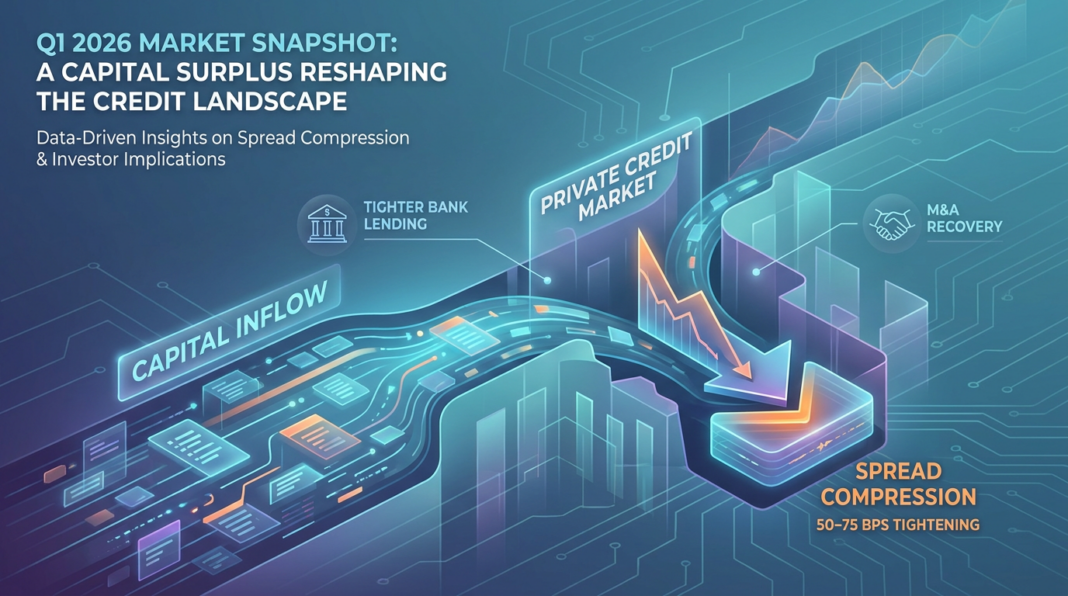
Entering Q1 2026, the private credit market is navigating a defining tension: record levels of dry powder are compressing spreads at the same moment that bank lending standards remain selectively tight and M&A volumes are finally recovering. Middle market direct lending spreads have tightened approximately 50–75 basis points over the trailing six months, with core middle market all-in yields now ranging from 9.5% to 11.0% — down from the 10.5%–12.0% range that defined much of 2024 and early 2025. According to Cliffwater’s Direct Lending Index (CDLI), the asset class delivered a trailing net return of approximately 9.8% through Q3 2025, underscoring its continued income advantage over public fixed income — but that advantage is narrowing.
Meanwhile, the Federal Reserve’s most recent Senior Loan Officer Opinion Survey (SLOOS, Q4 2025) confirmed that commercial banks continue to tighten underwriting standards for middle-market C&I borrowers, even as conditions ease modestly for investment-grade corporates. This bifurcation is the structural engine driving capital deeper into private markets — and it is reshaping the negotiating dynamics between borrowers, sponsors, and lenders in real time.
Quantitative Market Snapshot
The following data box reflects market conditions as reported through Q4 2025 and early Q1 2026. All figures represent ranges observed across institutional-grade direct lending transactions.
| Metric | Current Level (Q1 2026) | Prior Period (Q2–Q3 2025) | Source |
|---|---|---|---|
| Core MM Private Credit Spread | S+500 – S+575 bps | S+550 – S+625 bps | Pitchbook LCD |
| Lower MM All-In Yield | 11.5% – 13.0% | 12.5% – 14.0% | Cliffwater CDLI |
| US High Yield OAS | ~275 – 300 bps | ~325 – 375 bps | Bloomberg US HY Index |
| Broadly Syndicated Loan Spread | S+175 – S+225 bps | S+200 – S+250 bps | S&P Global / LCD |
| Leverage Multiples (Core MM) | 4.0x – 5.5x Net Debt/EBITDA | 3.75x – 5.0x Net Debt/EBITDA | Pitchbook / LCD |
| BSL Default Rate (LTM) | ~2.8% | ~3.2% | Fitch Ratings |
| Private Credit AUM (Global) | ~$1.7 trillion | ~$1.5 trillion | Preqin |
The private credit premium over broadly syndicated loans remains in the range of 275–350 basis points — still a meaningful illiquidity premium, but compressed relative to the 400+ bps gap that characterized 2023. High yield bond spreads near post-GFC tights signal that public credit markets are pricing in a benign default environment, while private credit must increasingly compete not only with other direct lenders, but with a reopened leveraged finance market.
Critically, lenders are revisiting KPI thresholds. The modal Fixed Charge Coverage Ratio (FCCR) covenant floor in new middle market deals has edged up to 1.15x–1.25x from the 1.10x floors that were common in peak-competition vintages, as lenders incorporate higher base-rate sensitivity into structural protections. Debt-to-equity expectations for sponsored transactions generally fall in the 40/60 to 55/45 range, with lenders showing less tolerance for highly levered structures absent significant recurring revenue or contracted cash flows.
Sector Analysis: Where Lender Appetite Is Expanding — and Contracting
Technology & Software: The Preferred Collateral
Software and technology-enabled businesses continue to attract the most competitive lending terms in the middle market. Recurring revenue models — particularly SaaS businesses with net revenue retention above 100% — are pricing 25–40 basis points tighter than comparable-EBITDA industrial peers, reflecting lender preference for predictable cash flow visibility. Preqin data confirms technology and software accounted for the largest share of private credit deployments in H2 2025, continuing a multi-year structural shift. Lenders in this segment are actively stretching leverage to 5.0x–6.0x for high-quality software assets with strong ARR growth profiles, particularly in vertically-focused SaaS.
Healthcare Services: Regulatory Tailwind, Operational Scrutiny
Healthcare services — including physician management organizations, behavioral health platforms, and ambulatory surgical centers — remain a high-conviction sector for direct lenders. However, S&P Global has flagged increased underwriting scrutiny around reimbursement rate risk and labor cost inflation. Lenders are requiring tighter FCCR minimums of 1.20x–1.30x and more explicit covenant triggers linked to payor mix. Deal count in healthcare services rose approximately 12% year-over-year in Q4 2025, per Pitchbook, driven by continued PE consolidation of specialty practices.
Infrastructure-Adjacent & Defense Tech: Emerging Favorites
Government-contracted and infrastructure-adjacent businesses — including defense technology, energy transition services, and critical supply chain logistics — are seeing a meaningful increase in lender appetite. The combination of federal spending visibility and long-duration contract structures makes these credits attractive from a coverage standpoint. Spreads in this segment are beginning to tighten toward software-like levels for the strongest contracts.
Office CRE, Consumer Retail, & Pre-Revenue Biotech: Structural Cold Zones
Office commercial real estate remains functionally frozen as a private credit category, with lenders requiring loan-to-value ratios below 55% and avoiding new originations in secondary and tertiary markets. Consumer discretionary retail faces headwinds from tariff-related cost pressure and softening unit economics. Pre-revenue biotech, while occasionally accessed via specialized lenders, commands spreads exceeding 700–900 bps over SOFR with warrant coverage, reflecting binary risk profiles.
Strategic & Operational Implications
For Borrowers
The compression in spreads is a genuine near-term tailwind for well-positioned borrowers. Sponsors and operators with strong EBITDA quality — defined increasingly by revenue predictability, customer concentration below 20%, and demonstrated margin stability — can access capital at historically attractive risk-adjusted terms. However, the rise in FCCR floor covenants and more disciplined debt-to-equity structuring means that financial engineering is less available than in 2021–2022 vintages. Borrowers should prioritize relationships with lenders who have demonstrated sector expertise, as underwriting is becoming more differentiated by vertical.
Operators facing variable or cyclical revenue should anticipate that lenders will stress-test coverage ratios at 10–15% EBITDA haircuts before committing to leverage above 4.5x. The days of covenant-lite structures at 6x+ leverage for sub-$25M EBITDA businesses are largely behind us.
For Institutional Investors and Lenders
The compression of spreads is the most important risk signal for LPs currently allocated to private credit. Vintage selection matters enormously: funds deploying capital today are doing so at materially lower risk-adjusted spreads than 2022–2023 vintages, and the illiquidity premium over public high yield has narrowed to its thinnest level in five years. Investors should examine manager-level portfolio composition for PIK income concentration, which has risen across the industry as some borrowers manage cash interest burdens — a leading indicator of latent credit stress.
The opportunity set is migrating toward complexity: lenders willing to underwrite bespoke structures, junior capital, and asset-backed credit in niche sectors are finding less competition and better terms than in vanilla first-lien sponsored deals.
Forward-Looking View: The Next 3–6 Months
The trajectory of the Federal Reserve’s rate policy remains the dominant macro variable. With the Fed funds rate expected to remain in the 4.25%–4.50% range through mid-2026 per current Fed dot plot projections (Federal Reserve), floating-rate private credit still provides a meaningful nominal yield floor — but the all-in yield advantage over fixed-rate high yield is compressing. If the Fed delivers 50+ basis points of cuts by Q3 2026, middle market all-in yields on new originations could decline into the 8.5%–10.0% range, fundamentally altering the return proposition for income-focused LPs.
Deal flow is expected to accelerate through Q2–Q3 2026 as PE sponsors finally act on pent-up exit and acquisition demand. Preqin projects global private credit fundraising to remain above $200 billion in 2026, sustaining capital surplus conditions. The risk is that lender competition further erodes structural protections — a pattern historically associated with late-cycle underwriting behavior. Credit selection discipline, covenant integrity, and sector conviction will define performance differentiation in the 2026 vintage.
Key Market Insights
- Spread compression is real and accelerating: Core middle market spreads have tightened 50–75 bps over six months; lenders chasing deal flow risk accepting structures that will underperform in a stress scenario.
- FCCR floors are rising even as leverage multiples expand: The combination signals lenders are structuring for coverage quality rather than asset coverage — a meaningful philosophical shift in underwriting discipline.
- Software and healthcare remain the most contested sectors: Pricing pressure is most acute here; lenders must differentiate on structure, not just spread, to manage downside risk.
- PIK income growth is a yellow flag: Rising paid-in-kind interest across BDC portfolios warrants LP scrutiny — it can mask cash flow stress in a high-rate environment and distort realized return calculations.
- The private credit illiquidity premium is at a five-year low: At 275–350 bps over BSL, investors must rigorously assess whether current spreads compensate for duration, complexity, and liquidity constraints relative to public alternatives.


