
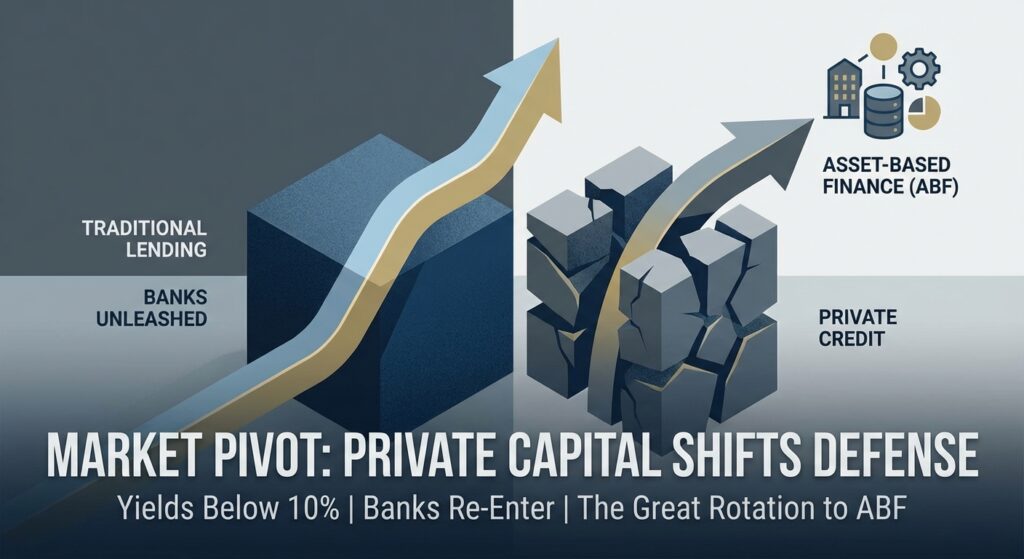
Market Headline: Banks Unleashed, Private Credit Pivots as Yields Breach 10% Floor
As of February 2026, the uneasy truce between private credit and traditional banks has officially fractured. Following the withdrawal of leveraged lending guidelines in December 2025, banks have aggressively re-entered the leveraged finance arena, weaponizing lower costs of capital to recapture market share. This regulatory shift, combined with the Federal Reserve’s Q4 2025 rate cuts, has driven direct lending all-in yields below 10% for the first time in three years, fundamentally altering the return profile for the asset class.
The “Golden Age” of easy double-digit returns in plain-vanilla direct lending appears to be tapering. In response to spread compression and renewed competition from the Broadly Syndicated Loan (BSL) market, private credit managers are executing a strategic rotation. Capital is rapidly flowing away from competitive corporate LBO financing and toward Asset-Based Finance (ABF) and hybrid capital solutions, where scarcity value—and premiums—still exist.
Quantitative Snapshot: Q1 2026
The pricing environment has shifted decisively in favor of borrowers, driven by a resurgent BSL market and monetary easing.
| Metric | Current Level (Feb 2026) | Trend / Comparison | Source |
|---|---|---|---|
| Fed Funds Rate | 3.75% | Down 50bps since Q3 2025 (Cuts in Oct/Dec) | Mondaq |
| Direct Lending Yields | < 10% | First time below 10% in 3 years | CreditSights |
| BSL Recapture Volume | $48 Billion (TTM) | Significant refinancing of private deals into BSL | CreditSights |
| Private Credit AUM | > $2 Trillion | Projected to hit $4T by 2030 | Moody’s |
| Deal Volume (2025) | ~$140 Billion | Resilient despite BSL competition | CreditSights |
Sector Analysis: The Great Rotation to Asset-Based Finance
Cooling: Corporate LBOs & Software
The traditional bread-and-butter of private credit—corporate LBO financing, particularly in software and technology—is facing intense margin pressure. With banks no longer constrained by leverage caps, they are underwriting more aggressive deals, forcing private lenders to compress spreads to win mandates. Documentation is also loosening; “covenant-lite” structures are bleeding back into current deals as documentation standards converge with BSL norms. CreditSights notes that sector concentration risks in tech and healthcare are becoming a key systemic monitoring point.
Heating Up: Asset-Based Finance (ABF) & Infrastructure
To combat yield erosion, managers are increasing allocations to Asset-Based Finance. This sector is emerging as the primary growth engine for 2026. Opportunities are coalescing around:
- Data Infrastructure: Capital-intensive AI and cloud infrastructure projects that require flexible, non-bank capital.
- Consumer & Commercial Pools: Private credit is stepping in to fund diverse asset pools (consumer loans, receivables) as updated Basel III rules continue to incentivize banks to offload these risk-weighted assets.
Moody’s identifies this shift from corporate lending to ABF as the defining trend of the 2026 vintage, driven by the need to fund “newer, more diverse pools of assets.”
Implications for the Market
For Borrowers: A Refinancing Bonanza
Borrowers currently hold the leverage. The combination of lower base rates (3.75%) and fierce competition between banks and private funds has created an optimal environment for refinancing. Recent activity shows record loan repricings as issuers swap expensive 2023-2024 vintage debt for cheaper BSL or competitively priced private paper.
For Lenders & Investors: The Alpha Squeeze
The “easy beta” of private credit is gone. With yields compressing, lenders must differentiate through complexity. Investors should expect a bifurcation in performance: managers capable of sourcing proprietary ABF deals or navigating complex liability management transactions (LMTs) will outperform those sticking strictly to sponsored direct lending. Additionally, the rise of “Mega Funds” and consolidation (e.g., acquisitions of established players) means smaller managers without niche specializations face an existential threat.
Forward Look (Next 6 Months)
Expect the BSL vs. Private Credit war to intensify. As the Fed potentially eyes another rate cut in 2026, further yield compression is likely. The market should watch for increased “Liability Management Transactions” (LMTs) as distressed capital structures from the high-rate era are reworked, often pitting creditor classes against one another.
Key Market Insights
- Yield Floor Breached: With all-in yields dipping below 10%, private credit is losing its massive yield premium over public markets, forcing a hunt for complexity premiums.
- Regulatory Arbitrage Flip: The Dec 2025 removal of leveraged lending guidelines has re-empowered banks; private credit creates less value purely from “regulatory arbitrage” than it did two years ago.
- ABF is the New Direct Lending: Allocations are shifting structurally toward asset-based finance (infrastructure, consumer credit) to escape the commoditization of corporate cash-flow lending.
- Refi Wave Continues: The $48bn BSL recapture trend is accelerating; expect private lenders to fight hard to retain high-quality assets, likely by cutting pricing on existing books.
- Systemic Interconnectivity: The deepening ties between insurance capital, private equity, and banking (via NAV lending and SRTs) are creating new contagion channels that regulators are beginning to scrutinize closely.


