
Introduction: Beyond the Yield Headline
In the world of private credit, the interest rate—or “yield”—often grabs the headlines. However, for sophisticated participants, the most critical metric isn’t how much interest a loan pays, but where that loan sits in the line for repayment. This concept is known as Capital Stack Seniority.
As we navigate the market landscape of early 2026, understanding the capital stack is essential for both investors seeking capital preservation and business operators optimizing their cost of funds. The capital stack determines the hierarchy of cash flows: who gets paid first when things go well, and more importantly, who gets paid first if they don’t.
This article explores the mechanics of subordination, the protective layer known as the “equity cushion,” and why senior secured positioning remains the bedrock of the modern direct lending market.
The Concept: The Capital Stack Hierarchy
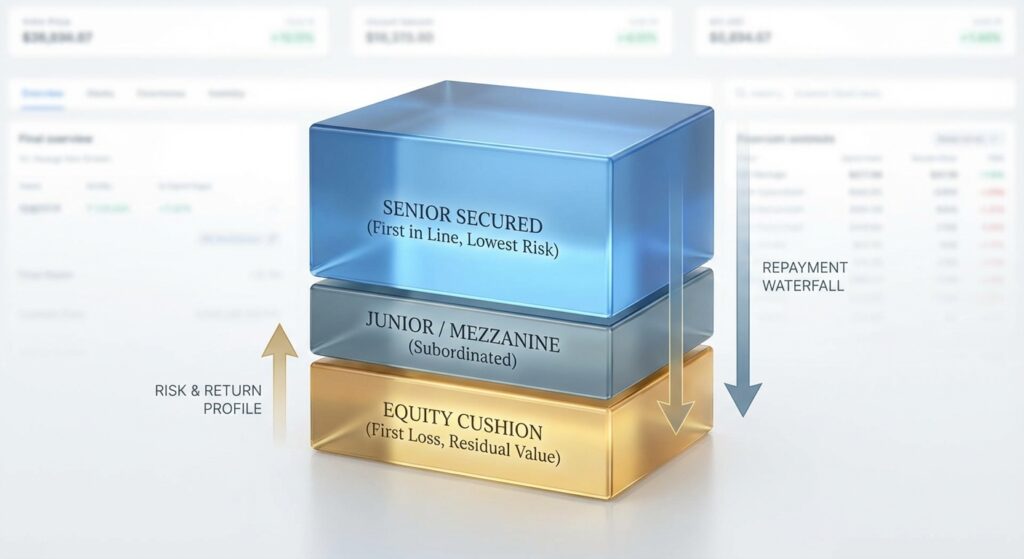
The capital stack represents the layers of financing that fund a company. It is structured like a layer cake, with the safest positions at the top (Senior Debt) and the highest-risk positions at the very bottom (Common Equity).
In private credit, the hierarchy is generally structured as follows:
- Senior Secured Debt: This sits at the very top. It has the first claim on cash flows and assets. If a company dissolves, these lenders are paid first. Because they take the least risk, they accept the lowest cost of capital (yield).
- Unitranche / Mezzanine: These are hybrid layers. Unitranche combines senior and junior risk into a single instrument, while Mezzanine sits explicitly below senior debt. These lenders get paid only after senior lenders are satisfied.
- Equity (The Cushion): This is the ownership stake. Equity holders only realize value after all debt obligations are met. In a downside scenario, equity is the first capital to be wiped out, acting as a “cushion” that absorbs losses before they reach the lenders.
According to T. Rowe Price, senior loans’ position at the top of the structure provides significant protection against losses, distinguishing them from the volatility often seen in equity markets.
How It Works: A Concrete Example
To understand the mechanics of seniority and the equity cushion, let’s look at a hypothetical manufacturing business, “Acme Corp,” valued at an Enterprise Value (EV) of $100 million.
The Structure:
- Senior Loan (Private Credit): $40 million (40% of EV)
- Junior / Mezzanine Debt: $10 million (10% of EV)
- Sponsor Equity: $50 million (50% of EV)
In this scenario, the Loan-to-Value (LTV) ratio for the senior lender is 40%. The “Equity Cushion” protecting the lender is 50%.
Scenario A: Stability
Acme Corp operates normally. It pays interest on the Senior Loan first, then the Junior Debt. Any remaining profit increases the value of the Equity.
Scenario B: Distress & Asset Sale
Suppose Acme Corp faces a severe market downturn and is forced to sell its assets for only $45 million—a 55% drop in value.
Here is how the waterfall of repayment flows:
- Senior Lender: Owed $40M. They are paid in full ($40M). Despite the company losing over half its value, the senior lender suffers $0 in principal loss.
- Junior Lender: Owed $10M. There is only $5M remaining ($45M sale – $40M senior payout). They receive $5M (a 50% loss).
- Equity Holders: Owed residual. There is $0 remaining. They experience a 100% loss.
This example illustrates why Blackstone notes that private credit loans are typically senior secured with a “meaningful cushion” below them. The equity and junior debt must be completely erased before the senior lender loses a single dollar of principal.
Current Market Relevance (2026 Perspective)
As of 2026, the dominance of senior secured structures in private credit has solidified. Following the volatility of higher rate environments in 2024 and 2025, investors have increasingly prioritized position over pure yield.
Key market fundamentals include:
- Shift to Direct Lending: Adams Street Partners highlights that the predominant form of private credit is now senior secured direct lending. Borrowers are bypassing traditional bank syndication for the certainty of execution offered by private lenders.
- LTV Discipline: While improved from 2023 lows, lending standards remain disciplined. Lenders are generally maintaining LTVs that preserve a healthy equity cushion (often 40-50%) to insulate against economic fluctuations.
- Income Resilience: As noted by Lord Abbett, private credit values tend to fluctuate less dramatically than public equities. This stability is largely derived from the senior status of the loans; because repayment priority is high, the market value of the debt is less sensitive to minor changes in enterprise value compared to the equity slice.
Decision Framework
Both investors and operators must evaluate the capital stack through different lenses.
For Investors: The “Sleep Well” Test
When evaluating a private credit fund or direct deal, the primary question should be: Where do I sit in the stack?
- Check the Attachment Point: This is the LTV at which your loan begins. (e.g., 0% LTV).
- Check the Detachment Point: This is the LTV where your exposure ends (e.g., 45% LTV).
- The Cushion: If the detachment point is 45%, the business value must drop by 55% before you lose principal. A thicker cushion implies lower risk (and arguably lower yield).
For Operators: Cost vs. Dilution
For business owners wondering why they should take on senior debt:
- Cost of Capital: Senior debt is the cheapest capital available (typically 10-12% vs. 20%+ for equity).
- Dilution Protection: Raising $20M in debt allows you to keep your equity ownership. Raising $20M in equity requires giving up a permanent stake in the company’s future upside.
- Constraint: The trade-off is the obligation. Senior debt covenants are stricter because the lender accepts a capped return and demands safety.
Key Takeaways
- Seniority is Safety: Senior secured lenders are first in line for repayment, meaning they are the last to suffer losses in a downside scenario.
- The Equity Cushion: This represents the amount of value that can be eroded before the debt is impaired. A 50% LTV implies a 50% equity cushion.
- Risk-Adjusted Returns: Private credit yields are often higher than public bonds not primarily because of default risk, but due to illiquidity premiums, despite often having better structural protections.
- Direct Negotiation: Unlike public bonds, private credit allows for bespoke covenants that protect this seniority, monitoring the borrower’s health in real-time.
- Strategic Capital: For operators, utilizing the top of the capital stack minimizes equity dilution, optimizing the Weighted Average Cost of Capital (WACC).


