
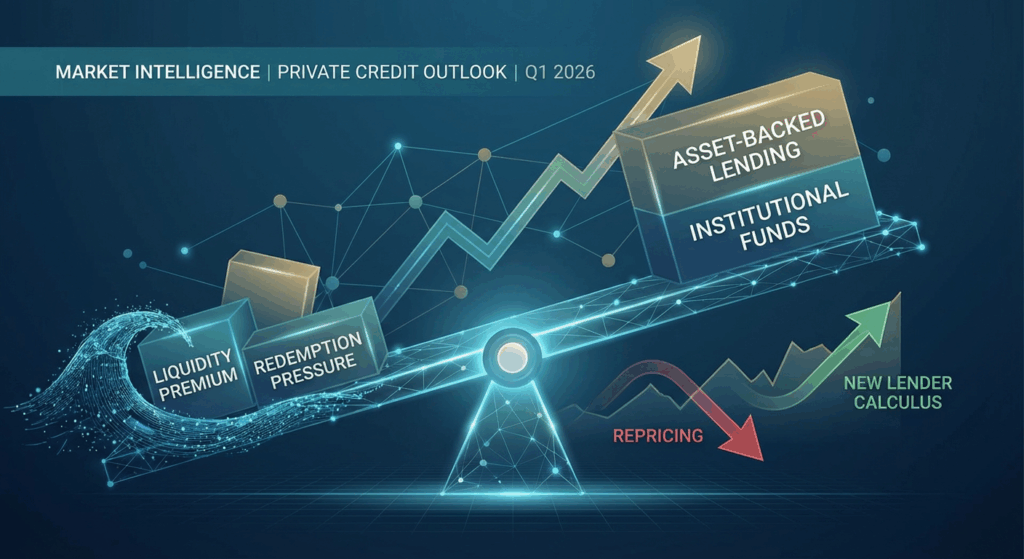
The Main Story: A Liquidity and Valuation Repricing, Not a Solvency Crisis — But the Distinction Is Narrowing
Private credit entered Q1 2026 confronting the most complex stress test since the asset class emerged as a mainstream institutional allocation. The headline is not a generalized solvency collapse — it is something more structurally nuanced and, in some ways, more difficult to manage: a simultaneous repricing of liquidity premiums, reported NAV credibility, and underwriting discipline concentrated at the intersection of semi-liquid retail structures and riskier middle-market borrowers.
According to atlaspeakresearch.com, the sharpest stress is appearing where illiquid middle-market loans have been packaged inside semi-liquid vehicles sold through wealth channels — not in the classic 5–8 year closed-end drawdown funds that still dominate institutional direct lending. This vehicle-level mismatch, not deteriorating credit fundamentals across the board, is the primary driver of current market dislocation. Global private credit AUM is now estimated between $1.34 trillion (U.S. Fed, Q2 2024) and more than $2.5 trillion globally (BIS), with the definitional variance itself reflecting the opacity that makes mark-to-model valuations so contested right now.
At the same time, kkr.com notes that despite elevated macro and geopolitical uncertainty, credit spreads across public and private markets remain near historical tights on a relative basis — a divergence that raises important questions about whether current pricing adequately compensates for forward risk, particularly in software and AI-adjacent sectors where valuations are being actively reassessed.
Quantitative Market Snapshot
The data picture in Q1 2026 is one of sharp bifurcation — aggregate headline metrics appear manageable, but sub-segment stress is intensifying at a pace that warrants active monitoring.
📊 Data Box: Key Private Credit Market Metrics — Q1 2026
| Metric | Current Value | Prior Period | Source |
|---|---|---|---|
| Broad Private Credit Default Rate | 9.2% (full universe, 2025) | 8.1% (2024) | ainvest.com |
| Senior-Secured Loan Default Rate | 1.84% (Q3 2025) | Stable YoY | ainvest.com |
| Private Credit Non-Accrual Rate (institutional direct lending) | 0.9% (Q3 2025) | Below 20-year avg (~1.0% loss rate) | heronfinance.com |
| Average Borrower LTV (institutional funds) | ~40% | Stable | heronfinance.com |
| First-Lien Loan Composition (institutional funds) | ~90% of loan assets | Consistent | heronfinance.com |
| Public BDC Equity Performance | -16% (sentiment-driven selloff) | Prior period: positive | ainvest.com |
| Bank Leverage Supporting Private Credit | ~$300B | Growing; fragility flagged | ainvest.com |
The divergence between the 9.2% aggregate default rate and the 1.84% senior-secured default rate is the most operationally significant data point in the current cycle. It confirms that capital structure seniority — not sector selection alone — is the primary risk-differentiator. Borrower leverage ratios (Debt/EBITDA) and interest coverage ratios (EBITDA/interest) have marginally improved as interest rates have moved lower, providing modest structural relief for existing borrowers, per heronfinance.com.
Sector Analysis: Where Lender Appetite Is Concentrating — and Retreating
🔴 Software & Technology: The Sharpest Repricing
Software is the most active pressure point in private credit underwriting as of Q1 2026. atlaspeakresearch.com identifies software as the sector where valuation stress is most acute, as recurring-revenue multiples used to underwrite deals in 2021–2023 are being systematically marked down. ARR-based lending structures — which became ubiquitous in software private credit — are now facing covenant stress as net revenue retention rates compress and churn rises in the post-AI disruption environment. Lenders are tightening FCCR floors and scrutinizing Rule of 40 metrics more aggressively than at any point in the past five years. kkr.com explicitly flags software valuation reassessment as a primary credit risk theme for 2026.
🟡 AI Infrastructure & Power: Elevated Activity, Elevated Scrutiny
Generative AI infrastructure — data centers, power generation assets, and hyperscale-adjacent logistics — is attracting significant lender attention, but not without structural complexity. atlaspeakresearch.com notes power sector implications as a distinct underwriting theme, with project finance structures and asset-backed lending becoming the preferred mechanism for lenders seeking exposure without taking on technology obsolescence risk. fiducientadvisors.com cautions against over-concentration, noting that duplicating AI themes across every asset class risks crowding without commensurate return differentiation.
🟢 Asset-Backed Lending & Real Assets: The Structural Beneficiary
Asset-backed lending (ABL) is emerging as the structural winner of the current cycle’s repricing. With mark-to-model scrutiny rising in unsecured and covenant-lite middle-market lending, fiducientadvisors.com identifies strong demand for flexible, asset-backed lending solutions as a defining structural theme of 2026. Real estate credit, stabilizing after an extended rate-driven valuation reset, is also beginning to attract renewed lender interest — particularly in traditional property types where cap rate normalization has improved debt serviceability metrics.
🔴 Riskier Middle-Market Segments: Structural Fragility
Smaller middle-market borrowers with limited liquidity buffers are bearing the brunt of the default cycle. The 9.2% aggregate default rate is disproportionately concentrated here, per ainvest.com. Lenders in this segment are reporting tighter covenant packages — specifically higher minimum FCCR thresholds (increasingly set at 1.20x–1.35x versus the 1.10x–1.20x floors prevalent during the 2021 vintage) — alongside reduced tolerance for PIK-heavy capital structures, where PIK interest as a percentage of gross income is being monitored against a 5% early-warning threshold, per heronfinance.com.
Implications for Institutional Investors & Operators
For Borrowers
Operators seeking debt capital in Q1 2026 face a market that is open but increasingly selective. Access to credit is bifurcating by capital structure seniority, business quality, and sector. Borrowers with demonstrable EBITDA stability, LTV ratios at or below 40%, and FCCR above 1.25x are accessing institutional direct lending markets on terms comparable to 12 months ago. Those relying on covenant-lite structures, PIK flexibility, or ARR-based underwriting are finding a meaningfully tighter window — with some lenders imposing full GAAP profitability requirements for the first time since 2019. Refinancing risk for 2022–2023 vintage deals with below-1.10x FCCR coverage is the most pressing near-term operational exposure.
For Lenders & Institutional Investors
The $300 billion in bank leverage underpinning private credit fund returns — flagged by ainvest.com — represents the most systemic risk variable in the current market structure. JPMorgan’s loan value reductions signal a potential tightening of subscription line and NAV facility availability, which would compress returnable leverage for managers. Investors with exposure to semi-liquid, wealth-channel private credit vehicles should scrutinize the size and composition of each fund’s liquid sleeve against its redemption gate structure. Closed-end institutional direct lending funds, by contrast, retain structural integrity due to capital lockup matching asset duration.
Forward-Looking View: Next 3–6 Months
The trajectory for private credit through mid-2026 is one of orderly repricing rather than systemic rupture — but the orderliness is contingent on three stabilizing conditions holding: (1) retail redemption pressure remaining manageable within existing gate structures; (2) bank lending facilities not meaningfully contracting NAV-based leverage; and (3) the AI/software valuation reset not accelerating beyond current mark-to-model estimates.
fiducientadvisors.com notes that the opportunity for outsized returns in private markets remains substantial — but is unlikely to be found where capital is already concentrating. The structural case for disciplined institutional direct lending, asset-backed credit, and real estate debt — in that priority order — remains intact. The market is not in retreat; it is in recalibration. Managers and operators who understand that distinction will be best positioned to act on the dislocations Q2 2026 is likely to surface.
⚡ Key Market Insights
- Default divergence is the defining signal: The 740-basis-point gap between the broad private credit default rate (9.2%) and the senior-secured rate (1.84%) confirms that capital structure seniority is the primary risk lever — not sector selection alone.
- Institutional closed-end funds remain structurally sound: With ~90% first-lien composition, ~40% LTV, and non-accruals below the 20-year loss average, core institutional direct lending portfolios are not signaling systemic distress — the stress is concentrated in semi-liquid wealth-channel vehicles.
- Software underwriting is being fundamentally repriced: ARR-based lending structures are under active reassessment; lenders are resetting FCCR floors and demanding GAAP profitability metrics absent in many 2021–2023 vintage deals.
- $300B in bank leverage is the market’s latent systemic risk: Any meaningful pullback in NAV facilities or subscription lines would compress fund-level returns and force managers to de-lever portfolios, potentially triggering forced asset sales.
- Asset-backed lending and real estate credit are the structural opportunity: As mark-to-model scrutiny rises and covenant-lite structures reprice, lenders and investors with hard-asset collateral coverage are best positioned to deploy capital on improving risk-adjusted terms through mid-2026.


