
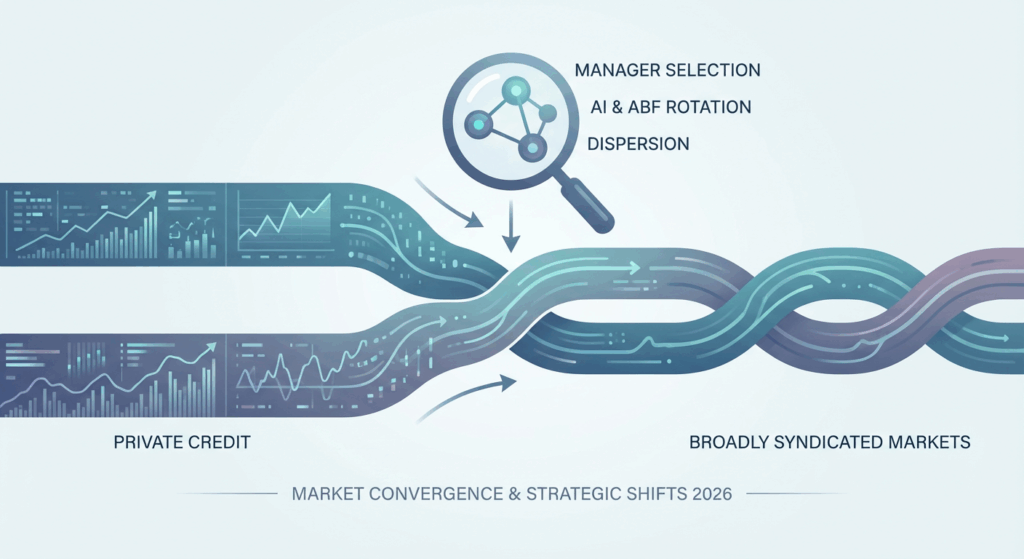
The Great Convergence: Spread Compression and the \”Mainstreaming\” of Private Credit
March 9, 2026 – The walls between private credit and the broader syndicated markets are crumbling. As global private credit assets under management surpass $3.5 trillion, the asset class is undergoing a distinct regime shift defined by \”convergence.\” The once-stark premium for private execution has narrowed significantly, with spread differentials between private credit and broadly syndicated loans (BSL) compressing to just 100 to 150 basis points.
Driving this shift is a resurgence in M&A activity—LBO volumes jumped approximately 40% year-over-year in late 2025—and the profound entry of traditional banks into the sector via formal partnerships rather than competition. Banks, including heavyweights like JPMorgan and Citi, are now estimated to originate 25% of private credit volume through partnership channels in 2026. For borrowers, this creates a fertile environment of competitive tension; for lenders, it signals the end of the \”scarcity\” era and the beginning of a cycle defined by credit selection and manager dispersion.
Quantitative Snapshot: Market Metrics (Q1 2026)
| Metric | Current Level | Trend / Prior Period | Source |
|---|---|---|---|
| First Lien Yields | 8.0% – 8.5% | Decreasing (Down from 10%+ peaks) | PRISM 2026 Outlook |
| PC vs. BSL Spread | 100 – 150 bps | Compressing (Tightened from hist. avg) | Private Markets Insights |
| MM Default Rate | 5.5% | Rising (Up from historical ~3%) | PRISM / Morningstar |
| Non-Accrual Rate | 0.9% | Stable/Tick Up (Below 1% hist. loss rate) | Heron Finance |
| LBO Deal Volume | +40% YoY | Rebounding (Exit pressure driving flow) | PRISM 2026 Outlook |
Sector Analysis: The AI & ABF Rotation
While the aggregate market grows, capital allocation is rotating aggressively toward asset-backed and infrastructure-heavy sectors, while traditional software lending faces new scrutiny.
- Asset-Based Finance (ABF): This is the consensus growth engine for 2026. With 65% of managers identifying ABF as their highest growth potential, the sector is deepening beyond niche equipment finance into a $40 trillion total addressable market. It offers lenders structural protection in an environment where corporate cash flows are pressured by higher-for-longer baseline rates.
- AI & Digital Infrastructure: Artificial Intelligence has evolved from a tech investment theme to the dominant source of incremental credit supply. With hyperscaler investment projected to exceed $2.7 trillion through 2029, credit demand for data centers and power infrastructure is absorbing massive capacity. However, this creates correlation risk; portfolios appearing diversified across sectors may actually hold concentrated exposure to the \”AI arms race\” macro bet.
- Software & Tech: Traditionally the darling of private credit, software is under the microscope. Lenders are actively re-underwriting portfolios to assess AI displacement risk. While loan-to-value ratios remain healthy at roughly 40% across PC funds, the dispersion in performance is widening. Managers are increasingly wary of \”recurring revenue\” models that may not survive the technological capital expenditure shift.
Implications for the Market
For Borrowers:
The convergence of private and public markets is a net positive for cost of capital. With yields moderating to the 8.0–8.5% range and banks aggressively partnering to deploy capital, borrowers can negotiate tighter pricing. However, structural discipline remains: unlike the BSL market where covenants have largely vanished, 80% of private credit deals still retain maintenance covenants, ensuring lenders keep a seat at the table.
For Lenders & Investors:
The \”beta\” trade in private credit is over. We are seeing a massive dispersion in performance—up to 400–600 basis points—between top-quartile and bottom-quartile managers. The widening default rate (5.5% in middle market) suggests that vintage selection and underwriting rigor will determine returns in 2026 more than general market beta. The influx of retail capital (Wealth Management is the fastest-growing client segment) and insurance money provides a liquidity backstop, but also increases pressure to deploy, potentially tempting undisciplined managers to drift down-market.
Key Market Insights
- Spread Compression is Real: The precipitous drop to a 100-150 bps premium over BSL forces investors to rely on structural protections (covenants) rather than pure yield excess for alpha.
- Dispersion > Distress: A systemic crash is unlikely given healthy LTVs (40%) and high first-lien composition (90%), but the gap between winning and losing managers is widening to record levels.
- The \”Bank\” Bid is Back: Banks have stopped fighting private credit and started funding it. $96 billion in pledged loan commitments to PC vehicles fundamentally alters the competitive landscape.
- AI Concentration Risk: Investors must diligence whether their \”diversified\” private credit exposure is inadvertently levered to a single AI capex cycle.
- European Opportunity: With the US market saturating, Europe (currently 30% of global AUM) represents the next frontier for yield, remaining significantly underpenetrated compared to the US.


