
The Story: A Billion-Dollar Exit That Paid Founders Nothing
In January 2025, a rent-to-own startup called Divvy Homes announced it was selling to Brookfield Properties for approximately $1 billion. On the surface, it looked like a triumphant exit for a company that had genuinely changed lives — helping more than 2,000 American families step onto the homeownership ladder through an innovative rent-to-own model.
Then the letter arrived.
CEO and co-founder Adena Hefets wrote to shareholders, former employees, and “Divvy supporters” to explain what would actually happen when the deal closed. The letter, reported by TechCrunch, stated that after repaying outstanding indebtedness, covering transaction costs, and fulfilling liquidation preferences for preferred shareholders, neither common shareholders nor founders would receive any consideration whatsoever.
A billion-dollar company. A real product. A decade of building. Zero dollars for the founders.
Divvy had been valued at $2.3 billion in 2021. It raised hundreds of millions across multiple venture rounds — Series A through Series D — each round stacking new preferred equity with its own liquidation preferences on top of the last. When interest rates surged in 2022, the asset-heavy rent-to-own model fractured. Three rounds of layoffs followed. New home acquisitions paused entirely in 2023. By the time Brookfield entered, Divvy was carrying over $735 million in debt on top of a mountain of preferred equity liquidation preferences that had to be satisfied before common shareholders — including founders — would see a single cent.
The acquisition price was not enough to clear the stack.
The Capital Decision: What Divvy Chose — and What Cohesity Did Instead
To understand what went wrong at Divvy, you have to understand how capital decisions compound over time — and then compare them to a founder who made a very different set of choices.
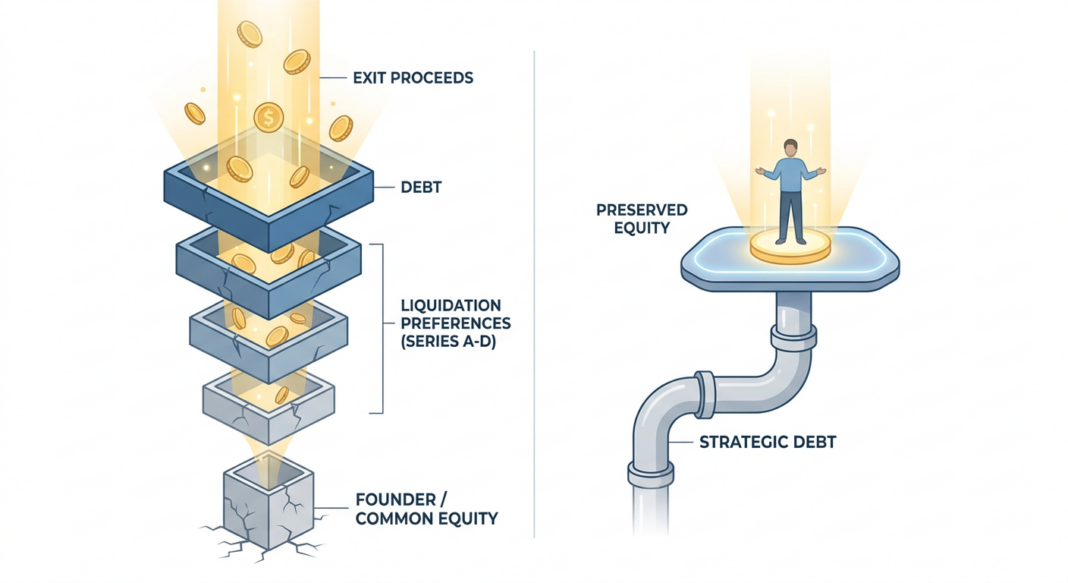
Divvy’s capital structure was built around venture equity. Each round of preferred equity came with liquidation preferences — contractual rights that guaranteed investors would receive a minimum return before any common shareholder, including the founders, received a cent at exit. According to multiple reports on the deal structure, preferred shareholders negotiated preference stacks that could pay out at 1x, 2x, or even 3x their investment before founders saw any proceeds. Stack four rounds of preferred equity on top of $735 million in senior debt, and even a $1 billion exit leaves nothing for the people who built the company.
The debt, in isolation, was not the problem. It was the combination of mismatched debt — borrowed to fund illiquid physical assets like homes in a rising interest rate environment — and cascading preferred equity liquidation preferences that created the lethal waterfall.
Now consider what Cohesity did in 2024. The data management platform had already raised significant equity, culminating in a $1 billion-plus Series G round. When it needed additional capital to fund its transformative acquisition of Veritas’ data protection business and accelerate growth, it did not go back to equity markets. Instead, it closed a $3.1 billion debt deal. The combined company was valued at approximately $7 billion at the time of the transaction, with Cohesity’s valuation rising to $8 billion following a tender offer in April 2025.
The debt was structured to match what Cohesity actually had: durable, subscription-based recurring revenue and predictable infrastructure demand. The structure allowed the company to finance an industry-defining acquisition without issuing new dilutive equity, without adding another layer of liquidation preferences to the cap table, and without surrendering any additional board seats or control provisions to new institutional investors.
Same market era. Diametrically opposite capital decisions. Diametrically opposite outcomes for ownership.
The Outcome: The Waterfall That Wiped Out Equity vs. The Debt Stack That Preserved It
The Divvy outcome is not an anomaly — it is a predictable consequence of a capital structure that was never designed to protect founder economics. The liquidation waterfall math is not complicated. It is brutal.
When a company exits, proceeds flow in a strict order: first, debt holders are made whole; second, preferred equity investors collect their liquidation preferences (which can be multiples of their original investment); third, only whatever remains flows to common shareholders and founders. When the exit price falls below the aggregate of debt plus preferences — as it did at Divvy — founders receive nothing. Adena Hefets confirmed as much in her shareholder letter, writing that the outcome “was not the ending I had hoped for.”
Cohesity’s story is still being written — the company was targeting an IPO in 2026, according to CEO Sanjay Poonen’s comments to CNBC. But the capital discipline already demonstrated tells its own story. By choosing debt over new equity rounds after reaching critical scale, Cohesity preserved the ownership positions of existing shareholders. The $3.1 billion debt facility — structured against recurring revenue, not cyclical assets — allowed the company to acquire a major strategic asset, scale aggressively, and head toward a public exit with a cap table that has not been eroded by late-stage preferred equity liquidation preferences layered in at peak valuations.
The contrast becomes even sharper when viewed through a market-wide lens. According to PitchBook data highlighted in the 2024–2025 Venture Debt Review by Runway Growth Capital, total venture debt deal value reached a record $53 billion in 2024 — even as the number of deals fell to its lowest level in a decade. Founders are doing fewer, larger, and more deliberate debt transactions. They are choosing capital that comes with a repayment schedule rather than a liquidation preference stack that quietly erodes everything they built.
The Lessons: A Framework for Founders Facing the Debt vs. Equity Decision
The Divvy-vs.-Cohesity comparison is not an argument against venture capital. For pre-revenue, capital-intensive businesses at the earliest stages, equity remains essential — there is simply no cash flow to service debt. The argument is against the reflexive, habitual choice of equity at every growth stage, long after a company has developed the revenue predictability and cash flow stability that make structured debt not only viable, but superior for founder economics.
The practical framework for evaluating the choice looks like this:
When Debt Preserves Equity (and Should Be Chosen First)
- Recurring, predictable cash flows exist. If the business generates subscription, contract, or recurring revenue, debt can be sized and structured against those cash flows — exactly as Cohesity’s lenders did. Recurring revenue is collateral that lenders understand and can underwrite.
- The company is beyond early-stage dilution risk. According to Carta’s State of Private Markets data, median dilution sits at approximately 19.5% for seed rounds and 18% for Series A rounds — and these figures are higher than the peak of 2021. By Series C and beyond, stacking additional equity rounds creates exponential dilution. Debt stops the compounding.
- The debt matches the asset being financed. Divvy’s fatal error was not debt itself — it was using long-duration, rate-sensitive debt to fund illiquid physical real estate assets in a rising rate environment. The mismatch, not the leverage, was the cause of failure. Cohesity borrowed against durable software subscriptions. The assets matched the liability.
- The exit range is defined. Knowing your exit valuation range lets you calculate exactly how much preferred equity liquidation preference the business can absorb before founders are zeroed out. If that calculation is uncomfortable, structured debt with a fixed repayment obligation — and no liquidation preference — is almost always the cleaner solution.
When Equity Is Still the Right Tool
- Pre-revenue or negative cash flow stages where there is nothing to service debt against.
- Network-effect businesses where speed of scale outweighs dilution cost.
- Situations where strategic investors bring partnerships, distribution, or customer relationships that are genuinely worth the dilution.
The private credit market has matured to the point where founders are no longer forced to choose between bank lines and institutional equity. According to data from the 2024–2025 Venture Debt Review, 61% of founders and investors no longer see venture debt as “rescue financing.” It is increasingly seen as a sign of capital discipline — a deliberate choice by founders who understand the waterfall math and have decided to protect their equity at the moments that matter most.
The market infrastructure now supports this shift. The global private credit market stood at approximately $1.6 trillion in assets under management as of 2024, according to Preqin — and BlackRock projected it could exceed $3.5 trillion by 2028. Founder-owned companies can now access institutional-grade debt on genuinely competitive terms, structured to their cash flows, without surrendering board seats, governance rights, or ownership fractions to new investors.
Key Insights
- The waterfall kills before the exit does. Divvy Homes sold for $1 billion and founders received $0 — not because the company failed, but because stacked preferred equity liquidation preferences consumed all proceeds before common shareholders could be reached. Understanding the waterfall before you sign is non-negotiable.
- Debt is not the enemy of founders — mismatched debt is. Divvy’s $735M+ in debt financed illiquid real estate in a rising rate environment. Cohesity’s $3.1 billion debt deal financed recurring software revenues. Same instrument, opposite risk profiles. The match between debt structure and underlying asset determines survival.
- Every equity round adds a new liquidation preference layer. With median Series A dilution now running at approximately 18-20% and each round stacking new preferences on top of the last, late-stage founders are playing a game where the exit price needed to reach common equity grows with every check they accept.
- The private credit market now offers founders a genuine third path. With global venture debt hitting a record $53 billion in deal value in 2024 and non-sponsor direct lending going mainstream, founder-owned companies with proven revenue can access institutional capital without surrendering control, governance, or cap table position.
- Capital discipline is now a competitive advantage at exit. Founders who actively manage their capital structure — choosing debt where it is appropriate and equity only where it is irreplaceable — arrive at exit events with cleaner cap tables, lower preference stacks, and meaningfully higher founder economics when proceeds are distributed.


