
The Story: A Founder, a $2.5 Million Decision, and a Clean Exit
In early 2021, Simon Turner had a problem most founders would envy — and one they’d quietly dread. Myagi, the retail sales enablement platform he’d co-founded, was growing fast. The pandemic had scrambled his original equity-raise timeline, but the disruption had paradoxically supercharged demand for digital retail tools. Myagi posted its best six months of growth on record. The opportunity was real. The momentum was undeniable. What the business needed, urgently, was cash.
Turner had been down this road before. He’d sold his first retail company in 2014, and he understood the quiet, creeping cost of equity rounds: the dilution, the board seats, the shifting incentive structures that slowly reframe what “winning” looks like. This time, he made a different call. Instead of reopening the equity fundraising cycle, Turner turned to TIMIA Capital for a $2.5 million non-dilutive debt facility.
The decision would prove transformative. Less than two years later, Myagi was acquired by Rallyware in a deal that rewarded its founders and existing shareholders — because the capital table hadn’t been carved up along the way.
“Debt is a powerful tool for capital-efficient businesses when used under the right circumstances,” Turner reflected after the exit. It’s a sentence that contains multitudes. The key word is circumstances.
The Decision: What the Options Actually Looked Like
Turner’s choice in early 2021 crystallized a fork in the road that thousands of software founders face every year. On one side: a traditional equity round, likely at seed or Series A terms, with dilution running anywhere from 15% to 25% per raise, new investors joining the cap table, and the implicit pressure to chase a venture-scale exit whether or not that aligned with the business’s natural trajectory.
On the other side: a structured debt facility, sized to Myagi’s recurring revenue, repaid over time, with no equity surrendered and no new voices in the boardroom.
TIMIA’s $2.5 million facility was structured around Myagi’s revenue visibility — a model built on the premise that predictable SaaS cash flows are reliable collateral. The financing allowed Turner to double down on Myagi’s referral-based sales model and accelerate software development without the distraction of an equity process that could consume months of executive bandwidth.
The math of avoided dilution is rarely discussed with enough clarity. If Myagi had raised a $2.5M seed extension at a $10M post-money valuation, founders and early shareholders might have surrendered 25% of the company. At exit, that 25% becomes real money — transferred permanently from builders to investors who joined at the eleventh hour. Non-dilutive capital, by contrast, has a defined cost — the interest and fee structure of the debt — and nothing more.
Around the same time, in a parallel story that would only become fully visible years later, Divvy Homes was making the opposite bet — at a scale that would eventually erase billions of dollars of founder and employee value entirely.
The Outcome: Two Exits, Two Very Different Endings
Myagi’s story ended cleanly. The TIMIA capital fueled the growth that positioned the company as an attractive acquisition target. When Rallyware came calling, the cap table was tidy, founders held meaningful stakes, and the deal could be structured to reward the people who built the business. No liquidation preferences eating through proceeds. No debt senior to everything else in the waterfall. A founder-friendly exit, enabled by a founder-friendly capital decision made two years earlier.
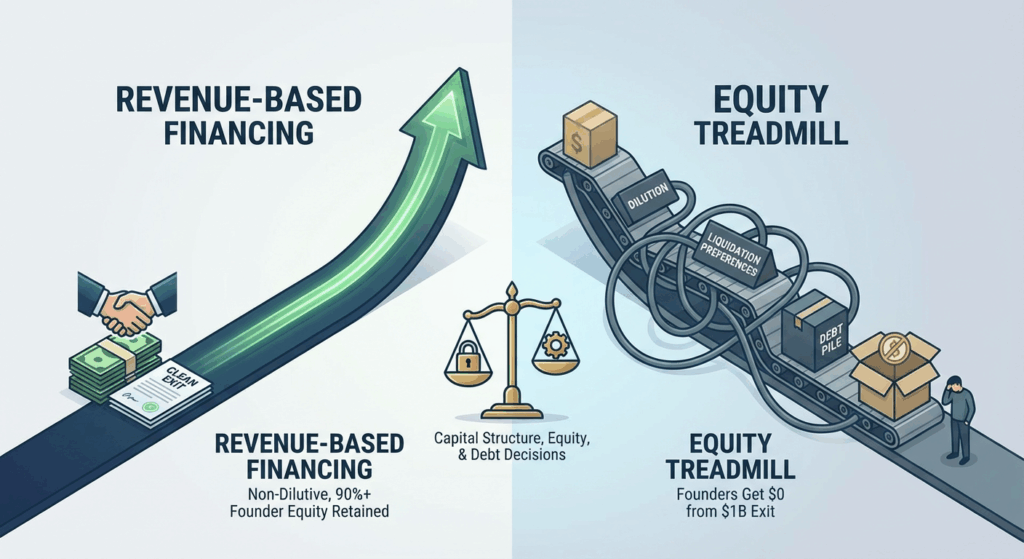
The contrast with Divvy Homes is instructive and, frankly, sobering. As SaaStr’s Jason Lemkin detailed in February 2026, Divvy raised over $400 million in venture equity — building a preferred stack with heavy liquidation preferences — and then, in October 2021, layered approximately $735 million in debt financing on top of that structure. When interest rates surged through 2022 and Divvy’s capital-intensive rent-to-own model buckled under the weight of that cost structure, the company entered a years-long restructuring. In January 2025, Brookfield Properties acquired Divvy for approximately $1 billion.
One billion dollars. And yet: founders received $0. Employees received $0. Most venture investors received $0. The debt was senior. The preferred liquidation preferences consumed what remained. The people who built a company from nothing to a $2.3 billion peak valuation walked away with nothing, because the capital structure had been architected — layer by layer, raise by raise — to ensure that outcome in any scenario short of a spectacular upside exit.
The lesson isn’t that debt is dangerous and equity is safe. It’s that the wrong debt, at the wrong scale, in the wrong business model, is lethal — and that equity’s hidden costs, embedded in liquidation preferences and dilution, can be equally punishing.
The Lessons: What Founders Can Take From Both Stories
A third data point sharpens the picture further. Inkle, an all-in-one financial operations platform for VC-backed startups, faced a familiar capital tension in its early growth phase: seasonal demand spikes that required capital to capture, but a founding team unwilling to pay the equity price of another round. According to Efficient Capital Labs, Inkle used non-dilutive financing structured around its predictable revenue streams to expand into new markets, accelerate product development, and hire — avoiding what the company estimated as approximately two rounds of dilution. The founding team retained roughly 90% equity. Zero board control was surrendered.
Co-founder Ranvir Singh’s summary was direct: “With ECL, our founding team avoided two rounds of dilution, held onto control of our company, and kept our high growth trajectory intact without giving up equity.”
Across Myagi, Inkle, and the cautionary tale of Divvy Homes, three principles emerge with clarity:
- Non-dilutive capital is most powerful when cash flows are predictable. Revenue-based financing and venture debt work when repayment can be structured against reliable recurring revenue. They become dangerous when deployed into capital-intensive models where revenue is uncertain and cost bases are fixed and large — as Divvy discovered at devastating scale.
- Equity’s costs are hidden; debt’s costs are explicit. A 20% dilution round feels abstract at the moment of signing. At exit, it is concrete and irreversible. Debt carries an interest rate that is visible, negotiable, and finite. Founders who model both paths honestly often find the equity cost more expensive than it appeared.
- Capital structure determines who wins at exit — not valuation. Divvy Homes sold for $1 billion. Founders got zero. Valuation is a headline. Capital structure is the operating system underneath it. The order of the waterfall — debt senior, preferred next, common last — is the document that actually determines outcomes.
A Framework for Founders Facing This Decision
When evaluating non-dilutive capital versus an equity round, founders should pressure-test four variables before signing anything:
- Revenue predictability: Is your revenue recurring, contracted, and visible enough to service debt without stress? If yes, non-dilutive financing deserves serious consideration. If no, equity may be the appropriate risk-sharing mechanism.
- Capital intensity: Does the business model require continuous, large-scale capital deployment into assets or inventory? High capital intensity combined with high leverage — as Divvy demonstrated — creates catastrophic downside in rate environments that shift unexpectedly.
- Exit timeline and structure: If you’re positioning for an acquisition within a two-to-three year window, a clean cap table is a competitive advantage in deal negotiations. Non-dilutive growth capital that keeps your equity structure simple can materially increase founder proceeds at exit.
- True cost comparison: Model both paths to a realistic exit scenario. What does 20% dilution cost in absolute dollars at your most likely exit valuation? How does that compare to the all-in cost of a structured debt facility? The answer is often surprising — and frequently favors debt for capital-efficient businesses.
Simon Turner said it plainly, and it bears repeating: debt is a powerful tool when used under the right circumstances. The founders who use it well — like Turner at Myagi, or the Inkle team with ECL — tend to share one trait. They understood the cost of equity long before they understood the cost of debt. Once you see both clearly, the decision often makes itself.
Key Insights
- 💡 Non-dilutive debt preserved 90%+ founder equity at Inkle and enabled a clean founder exit at Myagi — outcomes that a traditional equity path would likely have compromised.
- 💡 Divvy Homes’ $735M debt pile — layered on top of heavy preferred equity — left founders and employees with $0 from a $1B exit, illustrating how capital structure, not valuation, determines who actually wins.
- 💡 Revenue-based financing works best when cash flows are predictable and recurring: the structure is built around repayment visibility, not asset collateral or speculative upside.
- 💡 Equity dilution is a permanent transfer of wealth; debt is a time-limited cost with a defined ceiling. Founders who model both paths to exit often find equity more expensive than it appeared at signing.
- 💡 A clean cap table is a strategic asset in M&A negotiations — founders who avoid layering complex preferred stacks retain more control over deal structure, timing, and proceeds distribution.


