
The Story: A Weapons Detection Startup, a Father-Son Team, and a $1M Debt Facility That Changed Everything
In September 2022, Greg and Timothy Holifield — a father-son entrepreneurial duo with three successful exits already behind them — were sitting on something real. Their Florida-based AI weapons detection company, SafePointe, had validated its product, was generating modest recurring revenue, and had a clear line of sight to acquisition interest. What they needed wasn’t a venture capitalist with a five-year fund timeline and a board seat attached. They needed working capital — fast, clean, and without surrendering equity on the eve of a lucrative exit.
They turned to TIMIA Capital for a $1 million USD venture debt facility, drawn in three separate disbursements, specifically structured around SafePointe’s hardware-enabled SaaS model. The problem was structural: SafePointe’s hardware setup costs were embedded into licensing fees, creating a cash flow squeeze every time they signed a new customer. Accounts receivable ballooned. Working capital evaporated. Growth stalled — not for lack of demand, but for lack of liquidity.
The Holifields had navigated this before. They knew exactly what the debt would do, and more importantly, what it would not do: it would not hand equity to a new investor weeks before an exit. As Greg Holifield put it plainly: “Cash was critical to maintain our growth rate in order to ensure a successful exit.”
Less than twelve months after closing that debt facility, SafePointe was acquired by SoundThinking, Inc. (Nasdaq: STTI), a leading public safety technology company. The TIMIA debt had helped the Holifields triple SafePointe’s monthly recurring revenue before the deal closed — maximizing the valuation on which their equity was priced.
It was, by Greg’s own account, “the most satisfying exit process we have ever had.”
The Decision: Debt vs. Equity at the Worst Possible Moment to Dilute
The Holifields’ situation illustrates one of the most consequential — and most frequently mishandled — capital decisions a founder can face: when to use debt and when (or whether) to use equity.
SafePointe did take some equity-based capital concurrently with the TIMIA facility. But the contrast in cost was stark. As Greg noted, those equity investors made 10x on their investment in just nine months. TIMIA’s debt cost a fraction of that. Same growth. Dramatically different economics for the founders.
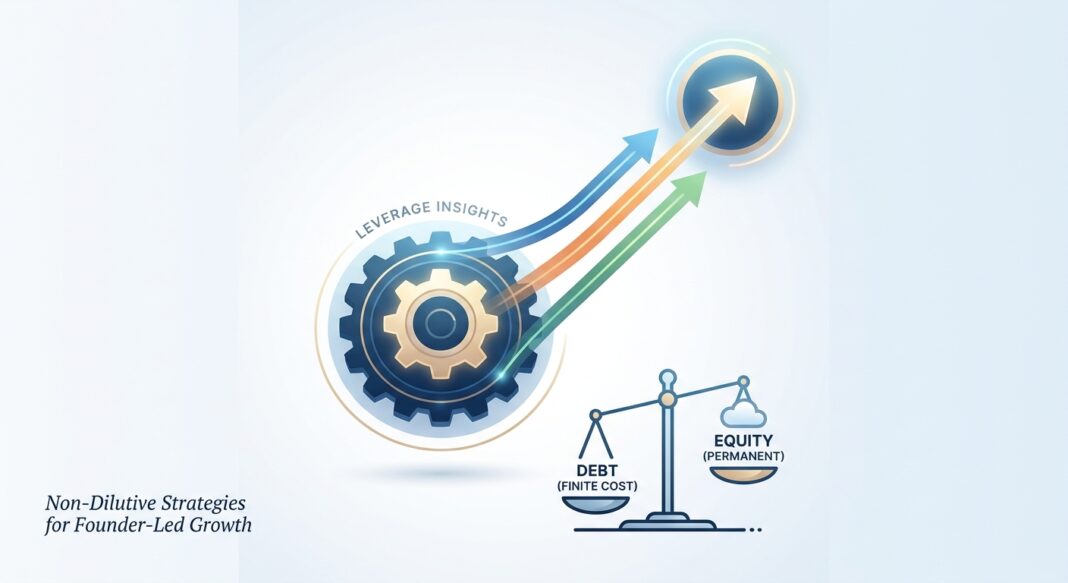
This is the math that most founders never run clearly enough. Equity at the wrong moment is the most expensive capital imaginable — not because the interest rate is high, but because the dilution is permanent and the upside is shared forever. Debt, even at what feels like a steep rate, has a fixed, finite cost. When there are no warrants attached, the founder captures all of the value creation above the debt’s repayment.
“They think the interest rate is too high,” Greg said of skeptical board members, “but when there are no warrants associated with debt, it is truly fantastic money — and much cheaper than equity. I love this class of debt.”
The TIMIA facility was structured in three tranches, timed to SafePointe’s contract milestones and cash deployment needs. There were no equity stakes surrendered, no board seats granted, no liquidation preferences layered onto the cap table. The founders stayed in control of the narrative — and the valuation — right through to closing with SoundThinking. That control is not incidental. It is the point.
The Outcome: What Revenue-Based Debt Did Across Three Founder Stories
SafePointe is not an isolated example. The same logic — non-dilutive capital as a growth and optionality engine — plays out across a range of company types and deal sizes, and the research base is growing.
Myagi, a retail sales enablement SaaS company, used a $2.5 million debt facility from TIMIA Capital in early 2021 after the pandemic disrupted plans for an equity raise. Co-founder Simon Turner deployed the capital into product development, sales, and customer success. The result: ARR grew from $2.4 million to $4.4 million in roughly two years — nearly doubling the business — before Myagi was acquired by Rallyware in 2023. Turner’s reflection is instructive: “Debt is a powerful tool for capital-efficient businesses when used under the right circumstances.” He has since expressed reservations about the VC model’s growth-at-all-costs pressure, noting that many businesses have a natural growth cadence that forced scaling can destroy. The debt let Myagi grow on its own terms, to a valuation its founders could be proud of, according to timiacapital.com.
UnityLab (formerly Unity Laundry Systems) offers perhaps the most layered example. Founder Jonathan Benjamin used revenue-based financing from Sage Growth Capital across three distinct phases: first a $150,000 tranche in 2020 to launch new SKUs when the business had under $1M in revenue; then a $750,000 tranche in 2021 to help finance the acquisition of Hoffman New Yorker — a larger competitor — without surrendering more equity; and a third facility in 2024 to fund international expansion into China and Italy, achieving a 40% reduction in gross margin costs. The cumulative result: 10x growth over four years, from $700,000 to a global enterprise. Crucially, each debt round preserved the cap table cleanly enough to support a well-valued Series A of $6.6 million in Q3 2022 — on terms Jonathan controlled. The full arc is documented at sagegrowthcapital.com.
And at the smallest scale, Modigi — a six-person SaaS company serving enterprise clients inside the Salesforce ecosystem — used a $400,000 revenue-based financing tranche from Founderpath to hire its first salesperson and customer success manager, reaching $1.7 million in ARR profitably while retaining 100% founder ownership. As CEO Ken Hoppe explained: “Founderpath helped us keep control of the company while still getting the capital we needed to grow.” Details are available at founderpath.com.
The Lessons: A Framework for Founders Facing the Same Fork in the Road
These stories share a common architecture. In each case, the founders had recurring revenue, demonstrated product-market fit, and a clear deployment plan for the capital. They chose debt not out of desperation, but out of discipline. That distinction matters enormously.
Non-dilutive financing — whether structured as revenue-based financing, venture debt, or growth loans — works best when three conditions are present:
- Predictable, recurring revenue: Lenders in this category underwrite against MRR or ARR. The more visible and stable the revenue, the better the terms and the faster the close.
- A specific, measurable deployment plan: The Holifields needed to fund hardware for new contracts. Turner needed to build out Myagi’s sales motion. Benjamin needed to launch new SKUs. Debt deployed against a defined growth lever produces returns that clearly exceed its cost.
- A valuation-sensitive moment: The highest cost of equity dilution is incurred just before a valuation inflection point — before a raise, before an acquisition, before a major contract. Debt used to bridge to that moment concentrates the upside in founder hands.
The framework is not anti-equity. Benjamin eventually raised a Series A. Turner explored VC options throughout Myagi’s life. The principle is one of sequencing: use non-dilutive capital to build the value, then price equity from a position of demonstrated strength rather than early-stage vulnerability.
As of 2026, private credit and revenue-based financing markets have continued to expand. For founders with $500K to $5M in ARR, non-dilutive options are more accessible, faster to close, and structurally more aligned with founder outcomes than the conventional VC playbook. The cost of ignoring them — measured in permanent equity dilution — has never been higher.
Key Insights
- Debt’s true cost is finite; equity dilution is forever. SafePointe’s equity investors made 10x in nine months. TIMIA’s debt cost a fraction. Same company, same outcome — radically different economics for the founders who chose strategically.
- Non-dilutive capital is most powerful just before a valuation inflection. Whether it’s an acquisition, a major funding round, or a key contract, bridging to that moment with debt preserves all the upside in founder hands.
- Revenue-based financing aligns repayment with business reality. Variable payback tied to MRR means the debt breathes with the business — it doesn’t strangle during a slow quarter the way fixed-schedule debt can.
- A clean cap table is a strategic asset. UnityLab’s disciplined use of debt kept its equity structure simple enough to attract a well-priced Series A. Messy cap tables from early dilution often discount later-stage valuations.
- VC’s growth-at-all-costs mandate can destroy natural business cadence. As Simon Turner observed, many companies have an organic growth rhythm that forced VC-scale acceleration disrupts. Debt lets founders grow on their own timeline — and sell when they are ready.


